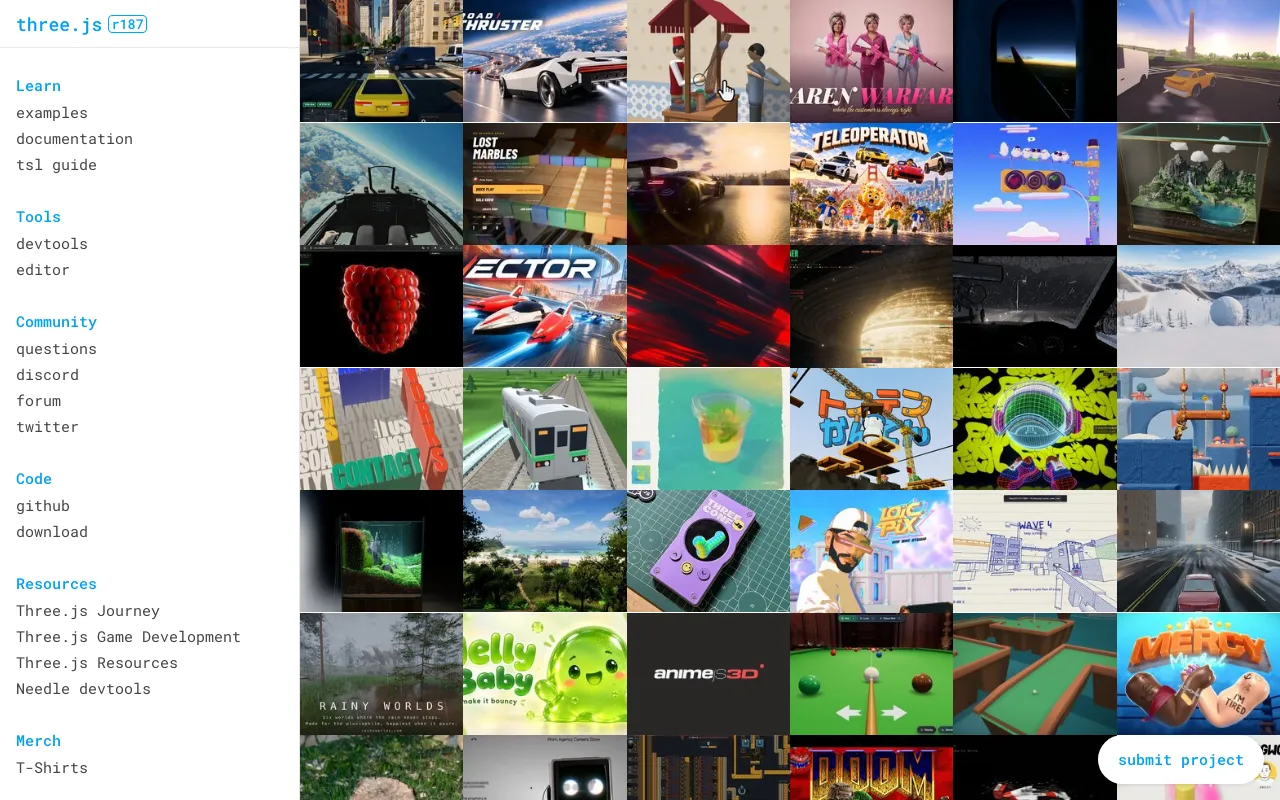
Three.js is a lightweight JavaScript 3D library for browsers. Default builds target WebGL and WebGPU, with optional SVG and CSS3D renderers as add-ons.
Overview
Three.js aims to make real-time 3D graphics approachable in the browser through a general-purpose API. Developers define scenes, cameras, lights, and meshes in JavaScript, then render frames with WebGL or WebGPU backends shipped in the main builds.
Optional add-on renderers cover SVG and CSS-based 3D paths for cases that do not need a full GPU pipeline. Example projects, manuals, and documentation explain how to structure animation loops, load assets, and extend the core classes.
Typical usage creates a renderer attached to a page element, adds objects to a scene, and updates the scene inside a requestAnimationFrame loop. Community forums, Discord, and editor tooling sit alongside the core package for experimentation.
Because the library focuses on client-side rendering, it fits product pages, data visualization, games, and immersive WebXR experiences without prescribing a server stack.
Key features
- Scene, camera, and mesh workflow
- WebGL and WebGPU renderers
- Optional SVG and CSS3D add-ons
- Animation loop friendly API
- Cross-browser 3D focus
- Examples and learning resources
Use cases
- Interactive 3D web experiences
- Browser-based visualization and demos
- WebXR and immersive media prototypes


 Miro