
TensorFlow
End-to-end machine learning platform and tooling ecosystem
TensorFlow is a machine learning platform with Python and C++ APIs, optional GPU packages, and companion libraries for data, training, deployment, and visualization.
Temporal context graphs for evolving agent knowledge
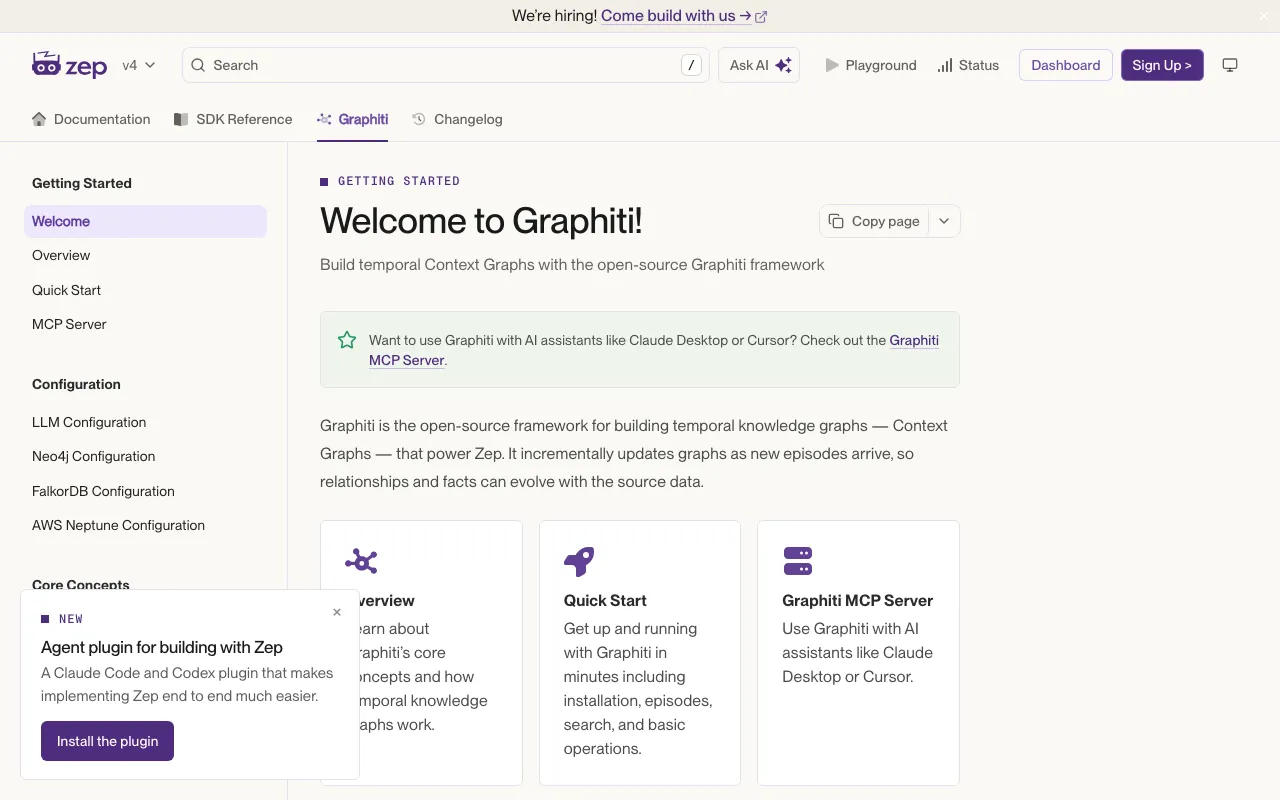
Graphiti is a Python framework that builds and queries temporal knowledge graphs for AI agents, with incremental updates, provenance, and hybrid retrieval.
Graphiti helps developers construct context graphs that track entities, relationships, and facts over time instead of freezing a one-shot summary. Each fact can carry a validity window: when it became true and when a newer fact superseded it, while older states remain queryable.
Ingested episodes—the raw messages, documents, or structured records—feed incremental graph updates without full recomputation. Entities gain evolving summaries; edges represent triplets with temporal metadata; custom node and edge types can be prescribed through Pydantic models or learned from data.
Retrieval mixes semantic embeddings, keyword BM25 search, and graph traversal so agents can ask what is true now or what held at a past time. The framework plugs into several graph databases, including Neo4j, FalkorDB, Amazon Neptune variants, or an embedded Relate store, and expects an LLM plus embedder for extraction and search pipelines.
You operate the database, ingestion, tenancy, and serving layer yourself. Reference MCP and REST servers illustrate protocol exposure but are not hardened for production. Docker Compose examples exist for common graph backends during development.
End-to-end machine learning platform and tooling ecosystem
TensorFlow is a machine learning platform with Python and C++ APIs, optional GPU packages, and companion libraries for data, training, deployment, and visualization.

Shared model definitions for multimodal ML workloads
Transformers is a Python library that defines pretrained text, vision, audio, and multimodal models once in PyTorch for shared inference and training across the ecosystem.
Open-source RAG engine and agent context platform
RAGFlow ingests heterogeneous documents, builds retrievable knowledge, and supports agent workflows with citations. It can run on your own hardware with Docker or a from-source server stack.

Local LLM context compression library and proxy
Headroom shrinks tool outputs, logs, JSON, and chat history before LLM calls to cut input tokens while preserving retrievable originals. It offers a Python library, proxy, MCP tools, and agent wrappers.

Local desktop workspace to run and fine-tune AI models
Unsloth is a desktop application to chat with, fine-tune, and serve LLMs, diffusion, audio, and embedding models on your own hardware with optional agent integrations.
TensorFlow reference models and modeling utilities collection
The TensorFlow Model Garden hosts implementations of models and modeling solutions for TensorFlow, installable via pip as tf-models-official.