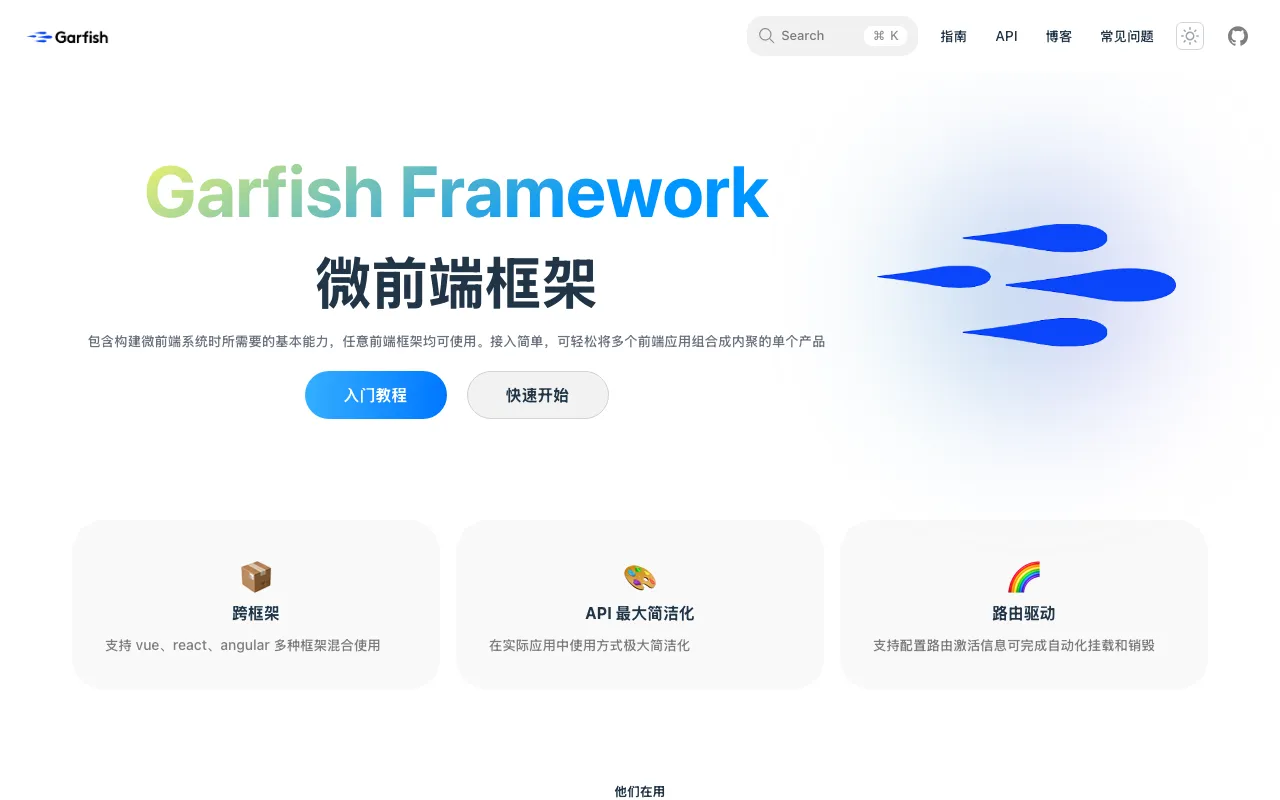
Garfish lets teams load independently built front-end apps into one product. It targets cross-framework integration, isolated routing, and runtime sandboxes for child applications.
Overview
Garfish is a micro front-end framework for assembling multiple separately delivered web applications into one cohesive user experience. It addresses large front-end codebases where teams use different stacks and release on their own cadence.
Sub-applications can use Vue, React, Angular, or other frameworks. Garfish supports independent development, testing, and deployment while the shell presents a single product. Preloading learns user navigation patterns to speed up switches, and shared dependencies can reduce duplicate script loads.
Core modules include a loader for HTML or JS entry points, a router that mounts and tears down apps from configuration, a runtime sandbox isolating JS and style side effects, and a store for cross-app data. A plugin system allows business-specific extensions.
Documentation and the marketing site describe simple integration to combine several front-end apps into one interface. Garfish has been used in production web applications at scale.
Key features
- Any front-end framework sub-apps
- Independent dev, test, and deploy
- HTML and JS entry loading
- Route-driven mount and destroy
- JS and style runtime sandbox
- Cross-app data store
- Dependency sharing
- Preloading based on usage
Use cases
- Multi-team front-end consolidation
- Vue and React in one product
- Incremental migration of legacy UI
- Isolated micro app releases
- Large single-page product shells



 Ionic Enterprise


