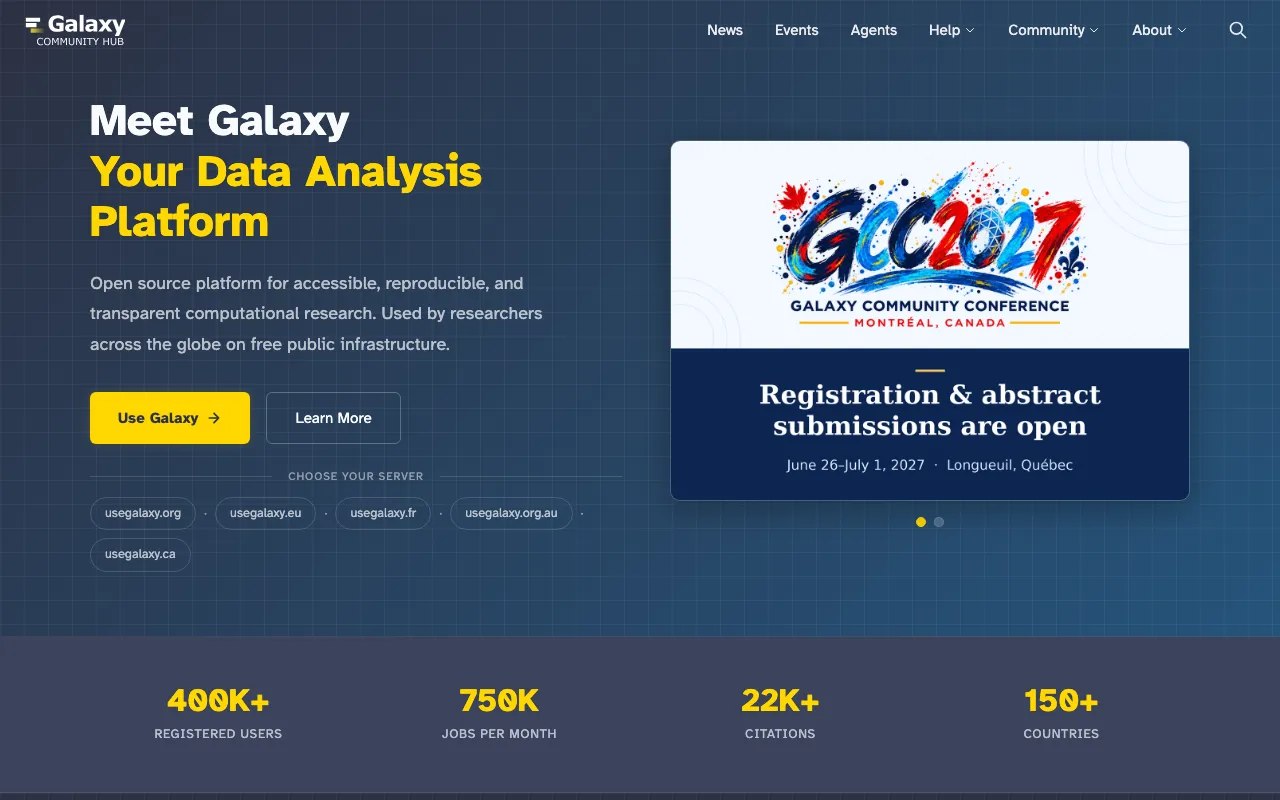
Galaxy is an open data analysis platform with a browser UI for workflows, tools, and histories. Public servers exist worldwide, and you can run your own instance locally.
Overview
Galaxy targets accessible, reproducible, and transparent computational research, especially data-intensive science. Users upload data, run analyses through a web interface without writing code, and share complete histories that record every step for inspection and reuse.
The platform offers curated workflows and thousands of tools installable from the Tool Shed or added manually. Analyses can start from local uploads, links, or public archives. Provenance tracking keeps datasets, workflows, and run histories together so others can repeat or verify work.
Galaxy is used in genomics and broader scientific training; the community hub documents tutorials, admin guides, and events. Free public instances operate in multiple regions, while local deployment requires Python 3.11 or newer and starts via the provided shell script, after which the UI is available in a browser. Tool dependencies may need separate admin installation beyond sample configuration.
Key features
- Browser-based analysis interface
- Automatic workflow provenance tracking
- Tool Shed and custom tool support
- Shareable histories and workflows
- Public and private server deployments
- No programming required for many jobs
- Upload, link, and archive data import
- Community tutorials and admin docs
Use cases
- Genomics and bioinformatics pipelines
- Teaching reproducible data analysis
- Publishing inspectable analysis histories
- Institutional self-hosted science platforms
- Large collaborative sequencing projects