
TensorFlow
End-to-end machine learning platform and tooling ecosystem
TensorFlow is a machine learning platform with Python and C++ APIs, optional GPU packages, and companion libraries for data, training, deployment, and visualization.
Edge-native MoE inference runtime for local GPUs
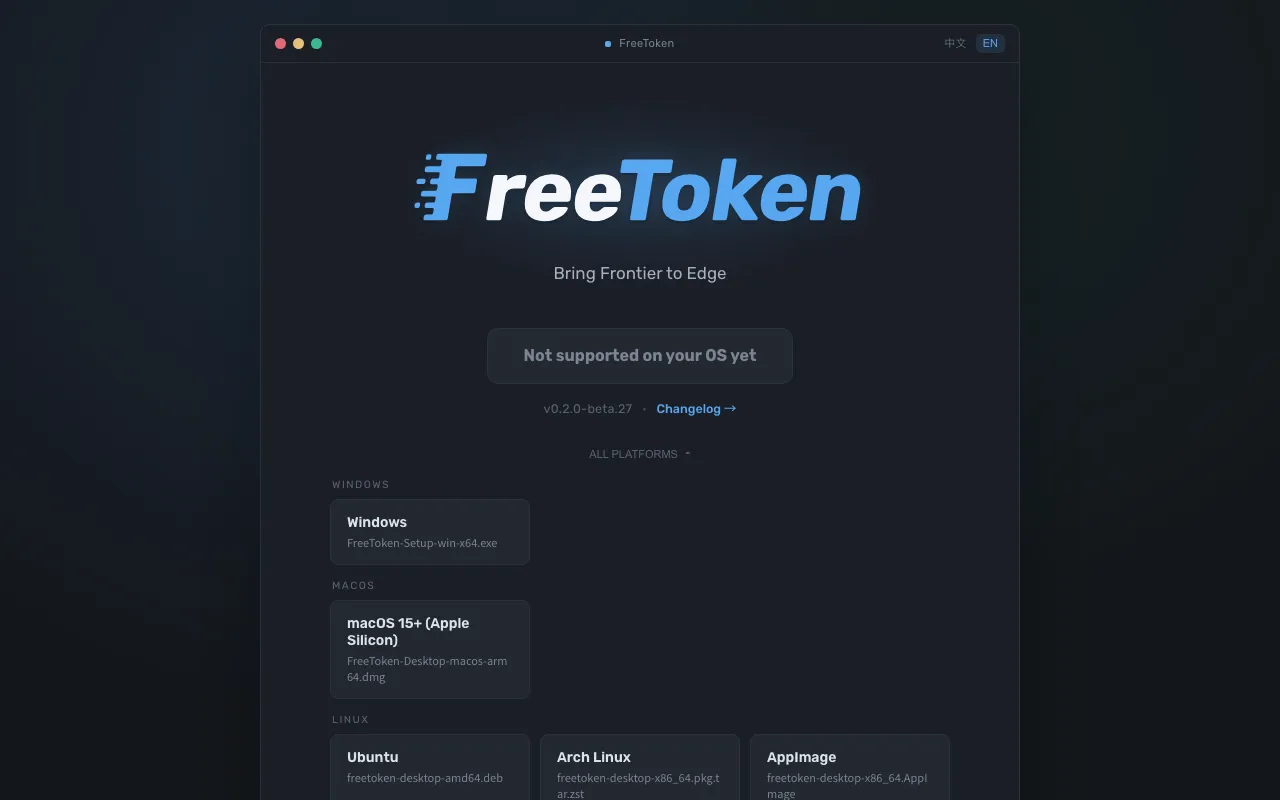
A Mixture-of-Experts serving engine that runs large open-weight models on consumer GPUs and CPUs. It ships as a Windows and Linux desktop app and as a CLI installable via pip or uv.
FreeToken targets interactive local inference for frontier-scale MoE models on gaming PCs, laptops, and workstation GPUs, including recent NVIDIA RTX series hardware. It treats GPU, CPU, memory, and interconnect bandwidth as one elastic platform for expert routing and token generation.
The runtime emphasizes bandwidth-aware CPU and GPU co-execution, double-buffered prefill, LRU expert caching, and a graph-friendly execution path with an FTW weight format. Semantic anchor checkpoints let agent workflows reuse recurrent state and KV cache across tool or thinking edits without full context rebuilds. VRAM can be reshuffled between expert caches and KV storage during a session without restarting the engine.
Supported models named in the project include DeepSeek-V4-Flash, Qwen3.6-35B-A3B, and GLM-5.2 across MXFP4, NVFP4, FP8, BF16, and GGUF quantizations. APIs follow Anthropic and OpenAI-compatible shapes so coding agents and harness tools can plug in.
Users can download the desktop client from flashml.ai for guided setup and chat, or install the CLI for headless serving. Documentation covers quick start, model support, checkpoint repair, and troubleshooting failed loads.
End-to-end machine learning platform and tooling ecosystem
TensorFlow is a machine learning platform with Python and C++ APIs, optional GPU packages, and companion libraries for data, training, deployment, and visualization.

Shared model definitions for multimodal ML workloads
Transformers is a Python library that defines pretrained text, vision, audio, and multimodal models once in PyTorch for shared inference and training across the ecosystem.
Open-source RAG engine and agent context platform
RAGFlow ingests heterogeneous documents, builds retrievable knowledge, and supports agent workflows with citations. It can run on your own hardware with Docker or a from-source server stack.
Local LLM context compression library and proxy
Headroom shrinks tool outputs, logs, JSON, and chat history before LLM calls to cut input tokens while preserving retrievable originals. It offers a Python library, proxy, MCP tools, and agent wrappers.

Local desktop workspace to run and fine-tune AI models
Unsloth is a desktop application to chat with, fine-tune, and serve LLMs, diffusion, audio, and embedding models on your own hardware with optional agent integrations.
TensorFlow reference models and modeling utilities collection
The TensorFlow Model Garden hosts implementations of models and modeling solutions for TensorFlow, installable via pip as tf-models-official.