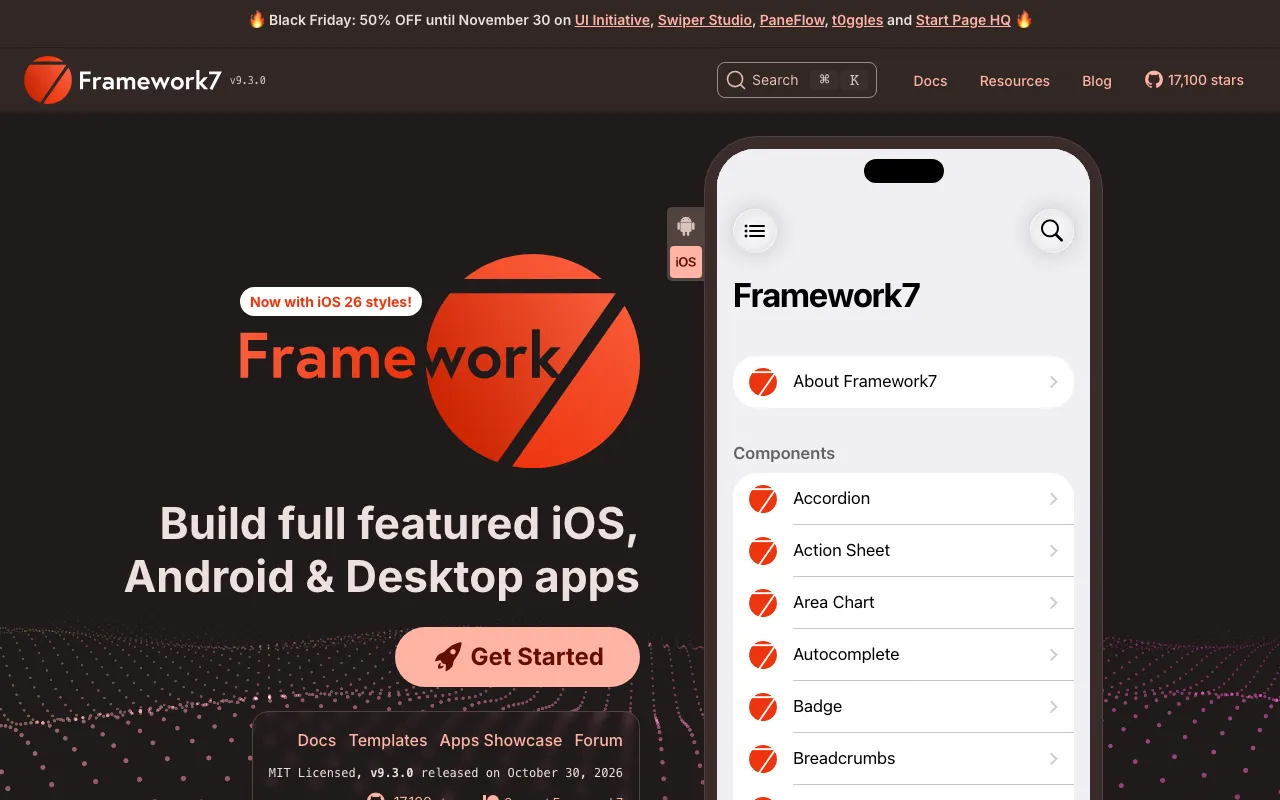
Framework7 helps developers build iOS-, Android-, and desktop-style interfaces from HTML, CSS, and JavaScript. Optional Vue, React, and Svelte component layers add structured UI syntax.
Overview
Framework7 is a front-end toolkit aimed at applications that should feel like native mobile software while staying in the web stack. It ships ready-made interface patterns so teams can assemble screens without designing every control from scratch.
The core library works with plain HTML, CSS, and JavaScript, and companion packages wrap the same elements for Vue, React, and Svelte. Documentation and kitchen-sink demos illustrate how layouts, navigation, and widgets behave across targets.
The component set covers dialogs, popups, action sheets, list views, tabs, side panels, grids, preloaders, forms, cards, and related mobile UI pieces. With Cordova or similar shells it targets installable iOS and Android builds; paired with Electron or NW.js it can back desktop binaries, and it also supports browser and progressive web deployments.
A CLI scaffolds new projects, and an icon collection, templates, plugins, and forum resources sit alongside the core packages for teams extending or learning the stack.
Key features
- Native-styled mobile UI widgets
- Core plus Vue, React, and Svelte bindings
- Dialogs, lists, tabs, and form controls
- PWA and hybrid mobile packaging paths
- Desktop builds with Electron or NW.js
- CLI for creating new apps
- Icons, templates, and plugin ecosystem
- Works with plain HTML, CSS, and JavaScript
Use cases
- Hybrid iOS and Android apps
- Mobile-first progressive web apps
- Clickable native-style prototypes
- Desktop apps from web UI code
- Structured mobile UI in Vue or React




 Ionic Enterprise


