
qmetrics.net

Fmt

Fast type-safe C++ text formatting library

Frameworks & PlatformsDesktop/CLI app
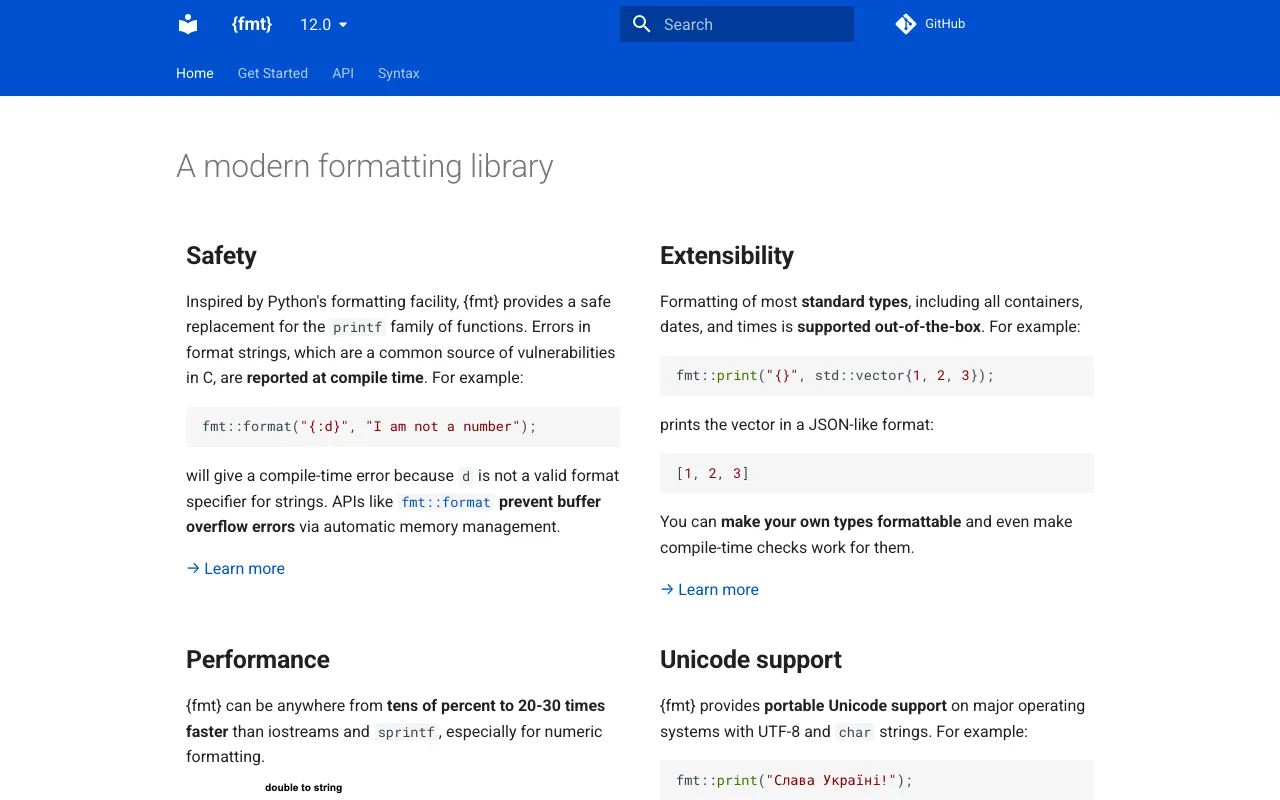
Fmt screenshot

{fmt} formats values into strings or streams with Python-like syntax, aiming to replace printf and iostreams with compile-time checks and automatic buffers. It implements C++20 std::format-style APIs and runs across major compilers.

Overview

{fmt} is a C++ formatting library for building human-readable output safely and quickly. Callers describe layouts with format strings, pass typed arguments, and receive rendered text without manual buffer sizing typical of C printf calls.

The API covers positional arguments for localization, containers, chrono types, colors on capable terminals, and user-defined types via extension hooks. It implements facilities aligned with C++20 std::format and C++23 std::print, reports many format mistakes at compile time, and can run header-only when configured with a macro.

Performance work focuses on numeric conversion with IEEE 754 guarantees, reduced allocations, and optional compilation of format strings into dedicated code paths. Project benchmarks compare runtime and compile-time cost against printf, iostreams, and other formatting stacks across optimized and debug builds.

The core ships as a small set of headers with no mandatory external dependencies, optional modules, portable Unicode output on Linux, macOS, and Windows consoles, and locale-independent behavior by default with an opt-in localized mode.

Key features

  • Python-like format string syntax
  • Compile-time format string checking
  • C++20 std::format compatible API
  • Fast floating-point and integer formatting
  • Portable Unicode and UTF-8 output
  • User-defined type formatting
  • Optional header-only build
  • Safe printf-style positional arguments

Use cases

  • Logging and CLI output in C++
  • Replacing sprintf and iostreams
  • Localized messages with positional args
  • Numeric serialization in hot paths

Tags

Similar software

ECC

Open-source agent engineering toolkit for coding harnesses

ECC adds planning, verification, review, memory, skills, and security scanning to coding agents such as Claude Code, Codex, and Cursor. It installs as plugins, packages, and managed adapters across multiple harnesses.


★ 311.7k⟳ 8 days agoMIT
Frameworks & PlatformsDesktop/CLI app

React

JavaScript library for web and native user interfaces

React helps developers build interfaces from reusable components that manage their own state. Views update declaratively when underlying data changes.

★ 253k⟳ 2 days agoMIT
Frameworks & PlatformsDesktop/CLI app

Flutter

Open-source UI framework for multi-platform apps from one codebase

Flutter is an SDK for building user experiences for mobile, web, and desktop from a single codebase. It uses the Dart language and compiles to native machine code or web targets.

★ 181.5k⟳ todayBSD-3-Clause
Open Source Alternative to:Ionic Enterprise

Bootstrap

Responsive HTML, CSS, and JavaScript front-end toolkit

Bootstrap supplies CSS, JavaScript, and Sass-based styles for building responsive, mobile-first sites. It ships prebuilt grid layouts, UI components, and optional JavaScript plugins.

★ 175.1k⟳ 2 days agoMIT

Langflow

Visual low-code builder for AI agents and workflows

Langflow is a visual builder for AI agents and workflows. Flows can be customized in Python and deployed as an API or as an MCP server, with support for major LLMs and vector databases.

★ 157k⟳ todayMIT
Open Source Alternative to:Relevance AIVoiceflow

LangChain

Framework for agents and LLM-powered applications

LangChain helps developers chain interoperable components and integrations to build agents and LLM-powered applications. It offers a standard interface for models, embeddings, vector stores, and related pieces.

★ 150.1k⟳ 2 days agoMIT



