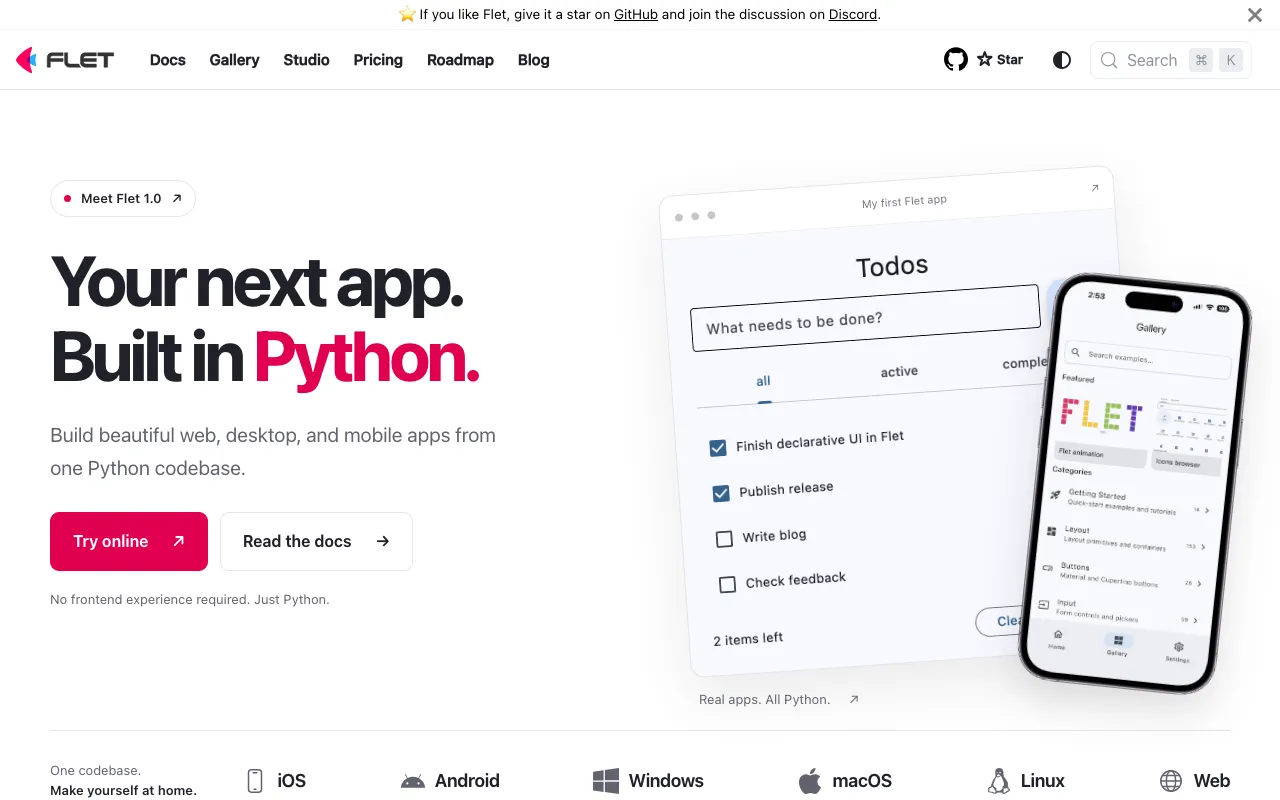
Flet lets teams build web, desktop, and mobile interfaces in Python from one codebase. It provides controls, packaging commands, and optional browser or server-hosted runtimes.
Overview
Flet targets developers who want graphical applications without writing separate frontend languages. You declare or imperatively update UI controls, handle events in Python, and run the same project on iOS, Android, Windows, macOS, Linux, or the web.
The control set covers layouts, forms, navigation, dialogs, Material and Cupertino styling, and theming hooks. State can follow declarative patterns with reusable components, or direct control updates for simpler scripts. Popular Python packages such as NumPy, pandas, Pillow, and cryptography can ship in mobile builds using prebuilt native wheels.
Deployment options include local desktop windows, browser mode via Pyodide and WebAssembly without a Python server, or server-driven updates to connected clients. The flet build command packages binaries for store distribution, while flet test runs pytest flows against packaged apps with optional mobile screenshots.
Flet Studio offers an online editor to create, run, and share example apps, and an MCP server can supply version-specific API context to coding assistants. Extensions can wrap Flutter packages for custom controls and platform APIs.
Key features
- Single Python codebase
- 150+ UI controls and services
- Declarative and imperative UI
- Six target platforms
- flet build store packaging
- Pyodide browser runtime
- Server-driven web updates
- pytest mobile integration tests
Use cases
- Internal data dashboards
- Mobile tools with Python logic
- Desktop utilities for analysts
- Teaching Python GUI basics
- Quick prototypes in Flet Studio




 Ionic Enterprise


