qmetrics.net

Flask-Limiter

Flask extension for HTTP rate limiting

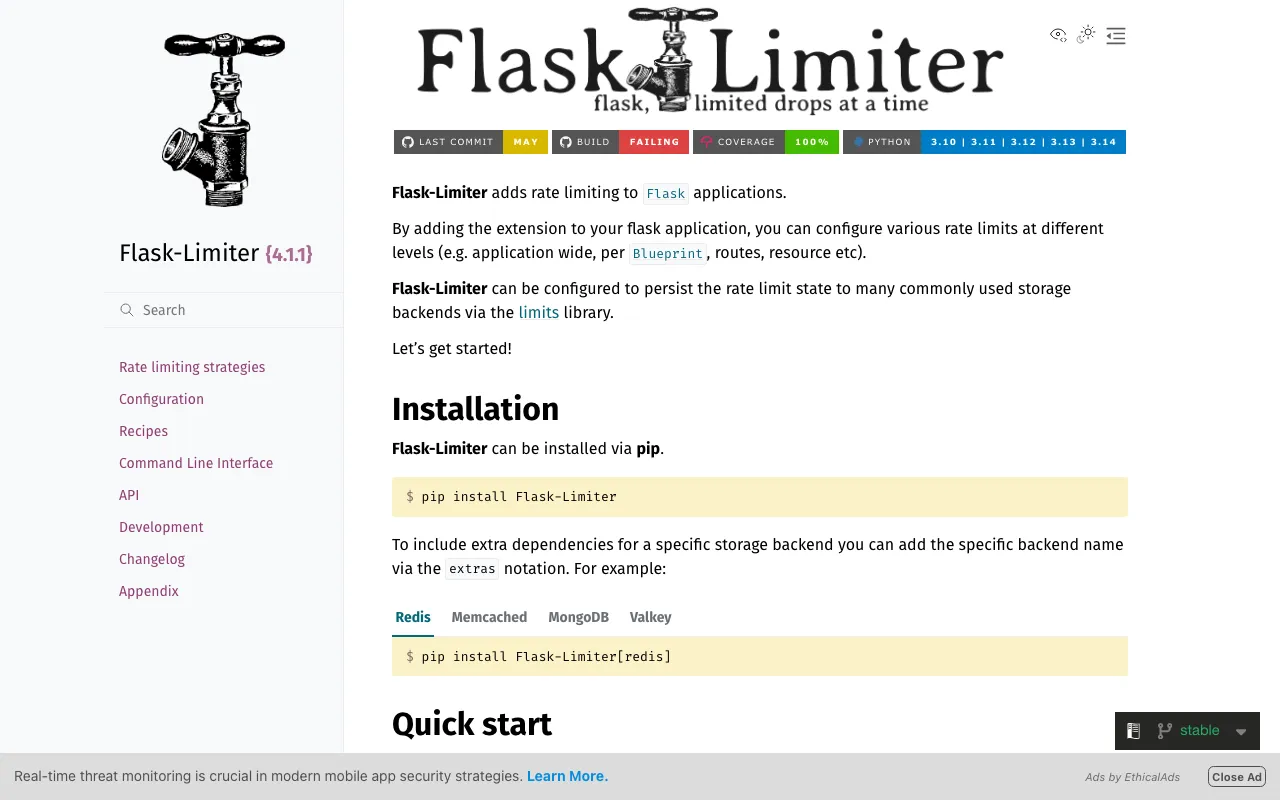
Flask-Limiter screenshot

Adds rate limiting to Flask applications with global defaults, per-route limits, blueprint rules, and exempt routes. State can persist in memory or external stores via the limits library.

Overview

Flask-Limiter is an extension that adds rate limiting to Flask applications. Limits can be defined application-wide, as defaults on routes, per blueprint, on class-based views, or on individual endpoints with decorators.

Configuration options include storage backends such as in-memory storage, Redis, Memcached, MongoDB, Valkey, and Redis cluster URIs through the limits library. Strategies include fixed-window, moving-window, and sliding-window-counter limiters. Requests are keyed by a chosen function, commonly the client remote address.

When a limit is exceeded, the view is not called and the extension raises an HTTP 429 error. Built-in Flask static file routes are exempt from default limits unless configured otherwise. An optional Flask CLI subcommand lists effective limits and configuration after installing the cli extra.

Installation is through pip, with optional extras for each storage backend and for the command-line inspection tools. The extension initializes either in the Limiter constructor with the app or via deferred init_app.

Key features

  • Per-route limit decorators
  • Global default rate limits
  • Blueprint-level limiting
  • Route exemption support
  • Redis and Memcached backends
  • Multiple rate limit strategies
  • Flask CLI limit inspection
  • Custom rate limit key functions

Use cases

  • Protecting public Flask API endpoints
  • Throttling abusive clients by IP
  • Shared limits across blueprint modules
  • Production limits backed by Redis
  • Development testing with in-memory storage

Tags

Similar software

Hetty

HTTP proxy toolkit for security testing work

Hetty combines a MITM HTTP proxy, manual client, and web admin UI for bug bounty and infosec workflows. Projects, scopes, and stored traffic keep engagements organized.

★ 12.6k⟳ 5 months agoMIT
Open Source Alternative to:Burp Suite Professional

REA

MCP and CLI reverse-engineering toolkit for agents

REA connects coding agents and terminals to local analysis tools for binaries, Electron apps, websites, .NET, and Android targets. Setup registers MCP access and investigation skills via npm.

★ 480.8k⟳ todayMIT

axios

Promise-based HTTP client for browser and Node.js

Axios is a promise-based HTTP client for JavaScript environments in the browser and Node.js. It supports common request methods, configurable defaults, and interceptors for request and response handling.

★ 109.5k⟳ 2 days agoMIT

FastAPI

Python web framework for building APIs with type hints

FastAPI is a Python web framework for building APIs using standard type hints. It builds on Starlette and Pydantic and generates interactive OpenAPI documentation for the endpoints you define.

★ 105.1k⟳ 9 days agoMIT

OmniRoute

OpenAI-compatible AI gateway with provider routing

OmniRoute exposes one endpoint that routes chat requests across many LLM providers with quota-aware fallback and compression.

★ 90.7k⟳ todayMIT

Hackingtool

AI-guided terminal toolkit for authorized security testing

Hackingtool bundles many security utilities in one console with optional AI help to pick tools and commands. It targets Linux and macOS and is meant for authorized testing only.

★ 82.2k⟳ 28 days agoMIT
Application SecurityDesktop/CLI app