
TensorFlow
End-to-end machine learning platform and tooling ecosystem
TensorFlow is a machine learning platform with Python and C++ APIs, optional GPU packages, and companion libraries for data, training, deployment, and visualization.
Modular Python toolkit for RAG research
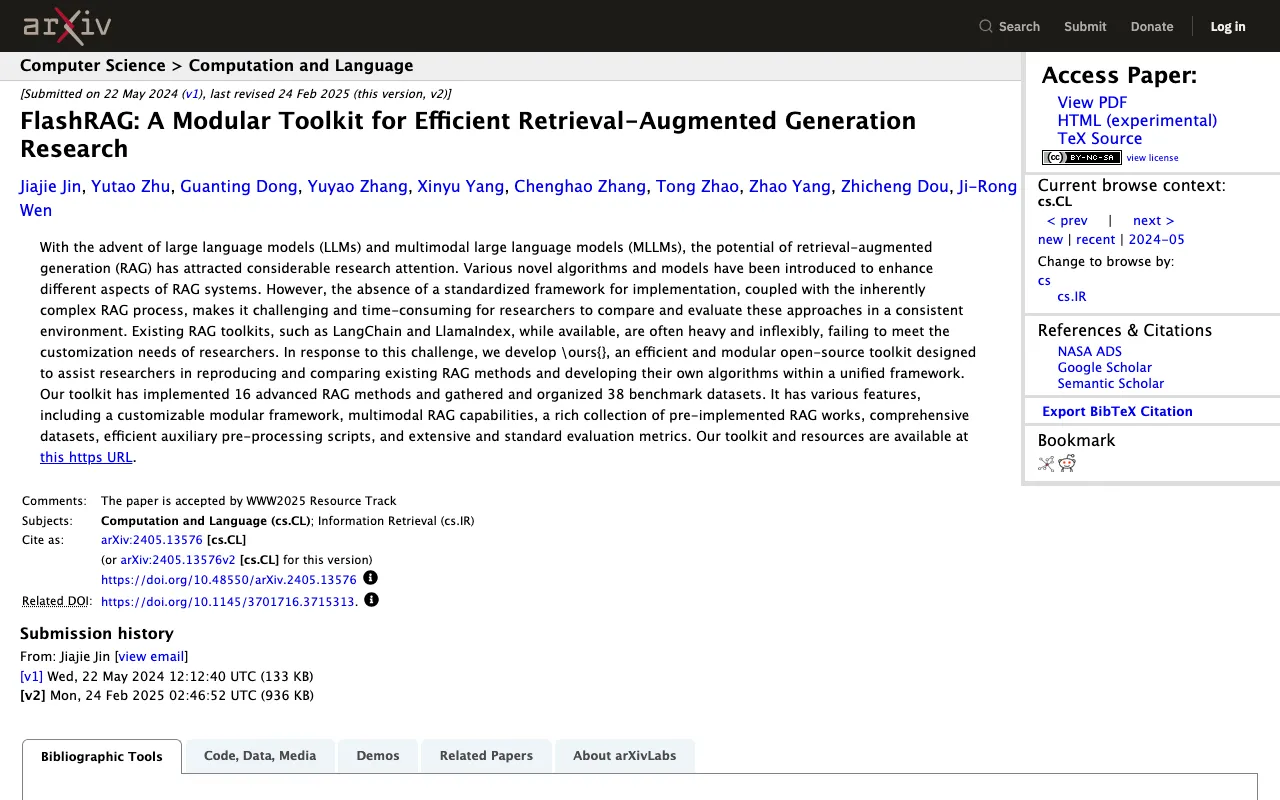
Python toolkit to reproduce and build retrieval-augmented generation workflows. It bundles benchmark datasets, pre-implemented RAG methods, and pluggable retrievers, generators, and pipelines.
FlashRAG is a Python toolkit aimed at reproducing and developing retrieval-augmented generation research. It ships with dozens of pre-processed benchmark RAG datasets and many pre-implemented RAG algorithms, including reasoning-oriented methods that combine retrieval with multi-step reasoning.
The design is modular: retrievers, rerankers, generators, compressors, and related pieces can be assembled into pipelines or replaced individually. Ready-made pipeline classes load from YAML or variable-based configuration and run end-to-end RAG with evaluation metrics. Researchers can also subclass the basic pipeline or call components directly from existing code.
Preprocessing helpers cover corpus formatting, dense indexes with Faiss, sparse BM25 indexes via Pyserini or bm25s, and optional sparse neural indexes. Execution can leverage vLLM, FastChat, and Faiss for inference and vector search. A FlashRAG-UI offers visual configuration and evaluation, and multimodal RAG support is described for certain MLLMs and CLIP-style retrievers.
The accompanying paper positions the toolkit as a lighter, more customizable alternative to general RAG frameworks that the authors describe as heavy and inflexible for research comparisons. Installation is via pip or cloning the GitHub repository, with optional extras for vLLM, sentence-transformers, and Pyserini.
End-to-end machine learning platform and tooling ecosystem
TensorFlow is a machine learning platform with Python and C++ APIs, optional GPU packages, and companion libraries for data, training, deployment, and visualization.

Shared model definitions for multimodal ML workloads
Transformers is a Python library that defines pretrained text, vision, audio, and multimodal models once in PyTorch for shared inference and training across the ecosystem.

Open-source RAG engine and agent context platform
RAGFlow ingests heterogeneous documents, builds retrievable knowledge, and supports agent workflows with citations. It can run on your own hardware with Docker or a from-source server stack.

Local LLM context compression library and proxy
Headroom shrinks tool outputs, logs, JSON, and chat history before LLM calls to cut input tokens while preserving retrievable originals. It offers a Python library, proxy, MCP tools, and agent wrappers.

Local desktop workspace to run and fine-tune AI models
Unsloth is a desktop application to chat with, fine-tune, and serve LLMs, diffusion, audio, and embedding models on your own hardware with optional agent integrations.
TensorFlow reference models and modeling utilities collection
The TensorFlow Model Garden hosts implementations of models and modeling solutions for TensorFlow, installable via pip as tf-models-official.