
acme.sh
POSIX shell client for ACME SSL automation
acme.sh issues, renews, and installs SSL and TLS certificates via the ACME protocol using a single shell script with no Python dependency.

Self-hosted feature flag and release control platform
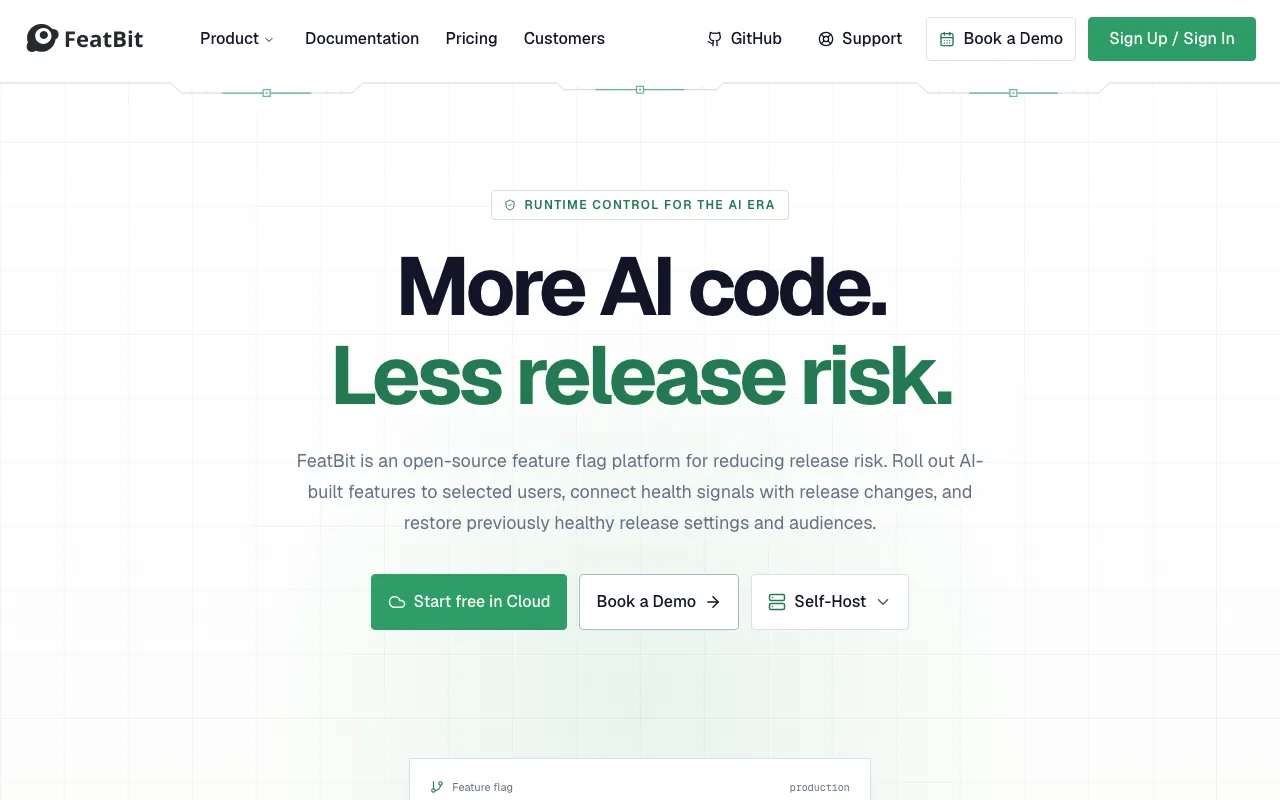
FeatBit manages feature flags, audience targeting, rollouts, and experiments. Teams can self-host it or use FeatBit Cloud without running infrastructure.
FeatBit is a feature flag platform focused on controlling who sees new behavior at runtime. Applications connect through official SDKs using environment keys and evaluate boolean, string, number, or JSON flag variations. The management portal is where teams create flags, define audiences, and tune percentage rollouts or segments.
Release workflows emphasize gradual exposure, observability-linked health checks, and fast rollback when error rates or latency spike. Progressive rollout steps can widen or narrow the audience, and settings can be restored to a prior known-good configuration. Bayesian A/B testing compares business outcomes between variations tied to stable flag splits.
Remote configuration changes values such as limits or timeouts for pilot groups without redeploying application code. Integrations include REST APIs, a CLI, Terraform-oriented GitOps flows, Datadog-style monitoring hooks, and agent skills with MCP for operating flags from coding tools. Role-based access and approval workflows are licensed capabilities on commercial tiers.
Deployment options include FeatBit Cloud for a managed service or self-hosting on your own machines with Docker Compose and documented infrastructure requirements. SDKs cover common application stacks so flag evaluation stays in process after initialization.
POSIX shell client for ACME SSL automation
acme.sh issues, renews, and installs SSL and TLS certificates via the ACME protocol using a single shell script with no Python dependency.

All-in-one scanner for vulnerabilities, IaC, SBOM, and secrets
Trivy scans containers, filesystems, Git repos, VMs, Kubernetes, and related targets for CVEs, misconfigurations, secrets, licenses, and software bills of materials.

Open-source software update framework for macOS apps
Sparkle lets macOS developers ship in-app updates from static files on an HTTPS server. Updates can run in the background with optional user prompts.

SBOM generator for images and filesystems
Syft is a CLI and Go library that lists packages inside container images and directories. Output formats support supply-chain workflows alongside vulnerability scanners.

MCP and CLI reverse-engineering toolkit for agents
REA connects coding agents and terminals to local analysis tools for binaries, Electron apps, websites, .NET, and Android targets. Setup registers MCP access and investigation skills via npm.
POSIX shell version manager for Node.js
nvm installs and switches between Node.js versions from the command line on POSIX shells including bash and zsh.