qmetrics.net

FastClaw

Self-hosted multi-agent AI runtime in one Go binary

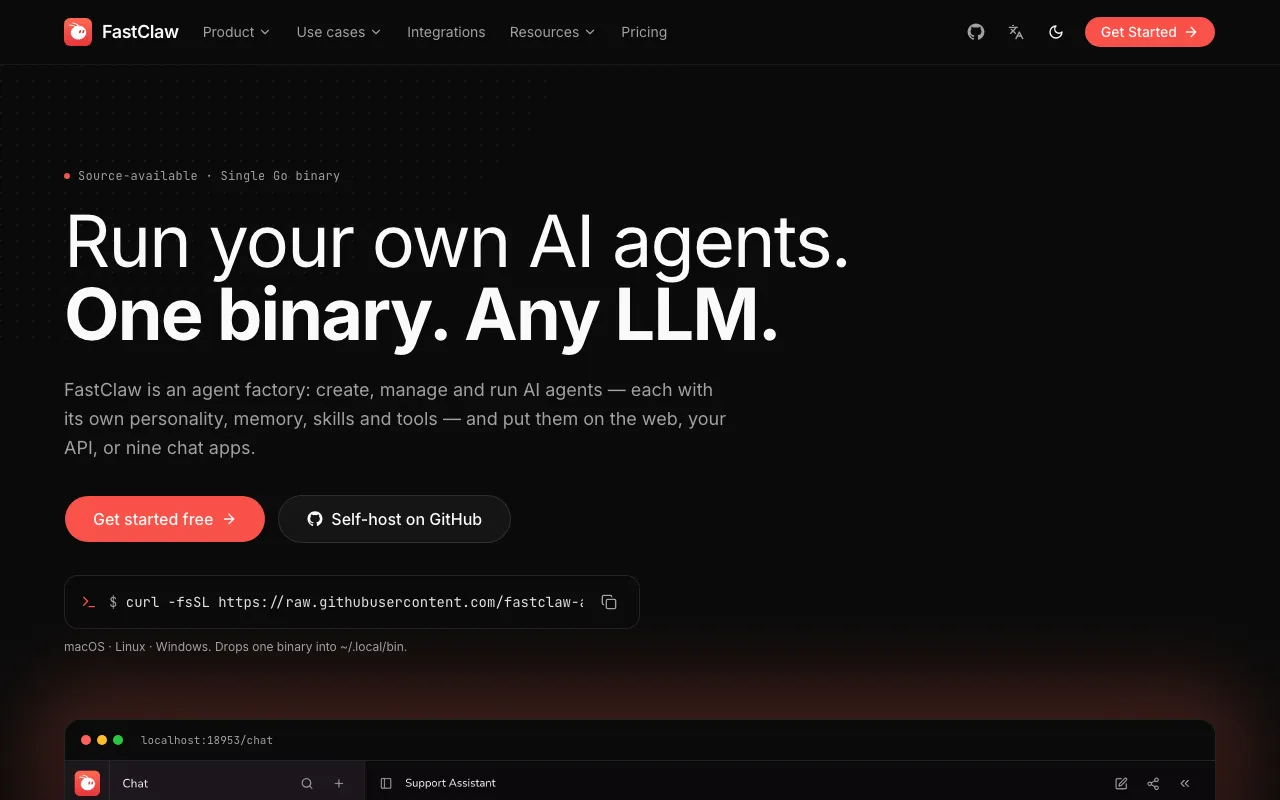
FastClaw screenshot

FastClaw creates and runs many LLM agents, each with its own personality files, memory, skills, and tools. A web console, API, and chat channels serve agents to end users.

Overview

FastClaw acts as an agent factory: every agent can have distinct SOUL.md, identity, memory, model settings, and skill bundles while the runtime handles LLM calls, tool execution, sandboxing, and sessions. SQLite is the default store, with PostgreSQL supported for multi-pod deployments.

Operators configure providers such as OpenAI, Anthropic, Ollama, OpenRouter, and other OpenAI-compatible APIs from a dashboard or CLI. Agents can bind to Telegram, Discord, Slack, WhatsApp, LINE, iMessage, WeChat, Feishu, and WeCom with per-channel session isolation.

Built-in tools cover shell execution, files, web fetch and search, and memory search, optionally inside Docker or E2B sandboxes with workspace sync. Skills install from ClawHub or GitHub, MCP servers extend tooling, and cron or interval schedulers let agents run jobs on their own.

The gateway exposes OpenAI-compatible chat completions, streaming web chat, agent CRUD, API keys with tiered scopes, and an Agent Communication Protocol endpoint. Bootstrap settings use FASTCLAW environment variables; runtime configuration lives in the database without a static fastclaw.json file.

Key features

  • Multi-agent management console
  • Per-agent SOUL, memory, and skills
  • Many IM channel bindings
  • Docker or E2B tool sandboxes
  • OpenAI-compatible HTTP API
  • SQLite or PostgreSQL storage
  • Cron and interval agent scheduling
  • MCP and plugin extensibility

Use cases

  • SaaS backends with per-customer agents
  • Team bots in Slack or Discord
  • Self-hosted personal AI assistants
  • Telegram or WhatsApp community bots
  • API-driven agent products

Tags

Similar software

Browser Use

Open-source Python browser agent with hosted stealth cloud browsers

Open-source browser agent that completes tasks in a real browser by writing Python against Chrome DevTools Protocol. Runs on any LLM, locally or on Browser Use Cloud, adding stealth browsers and a hosted agent API

★ 122.2k⟳ yesterdayMIT

DeerFlow

Open-source super agent harness for research and creation

DeerFlow is an open-source super agent harness that coordinates sub-agents, memory, sandboxes, tools, and skills for tasks from minutes to hours. It supports research, coding, and creative workflows.

★ 85.9k⟳ todayMIT

Sim

Collaborative workspace for AI agents and workflows

Sim lets teams build, deploy, and monitor AI agents and workflows in one workspace. It connects many integrations and LLMs with visual, chat, or code-based authoring.

★ 30.2k⟳ 5 days agoApache-2.0
Open Source Alternative to:DustRelevance AI

Stagehand

SDK for AI-driven browser automation

Stagehand gives agents Playwright-style browser control with natural-language act, observe, and extract helpers. It ships for TypeScript, Python, and Go with local Chrome or hosted cloud browsers.

★ 26.2k⟳ 2 days agoMIT

Skyvern

AI browser automation with a Playwright-compatible SDK and workflow builder

Skyvern automates browser-based workflows using LLMs and computer vision. It offers a Playwright-compatible Python and TypeScript SDK plus a no-code workflow builder, and can work on websites it has not seen before.

★ 23.6k⟳ todayAGPL-3.0

Coze Studio

Visual AI agent development and deployment platform

Coze Studio lets teams design agents, apps, and workflows in a browser with models, RAG, plugins, and workflows. You deploy it with Docker on your own hardware.

★ 21.8k⟳ 4 months agoApache-2.0
Open Source Alternative to:DustRelevance AI