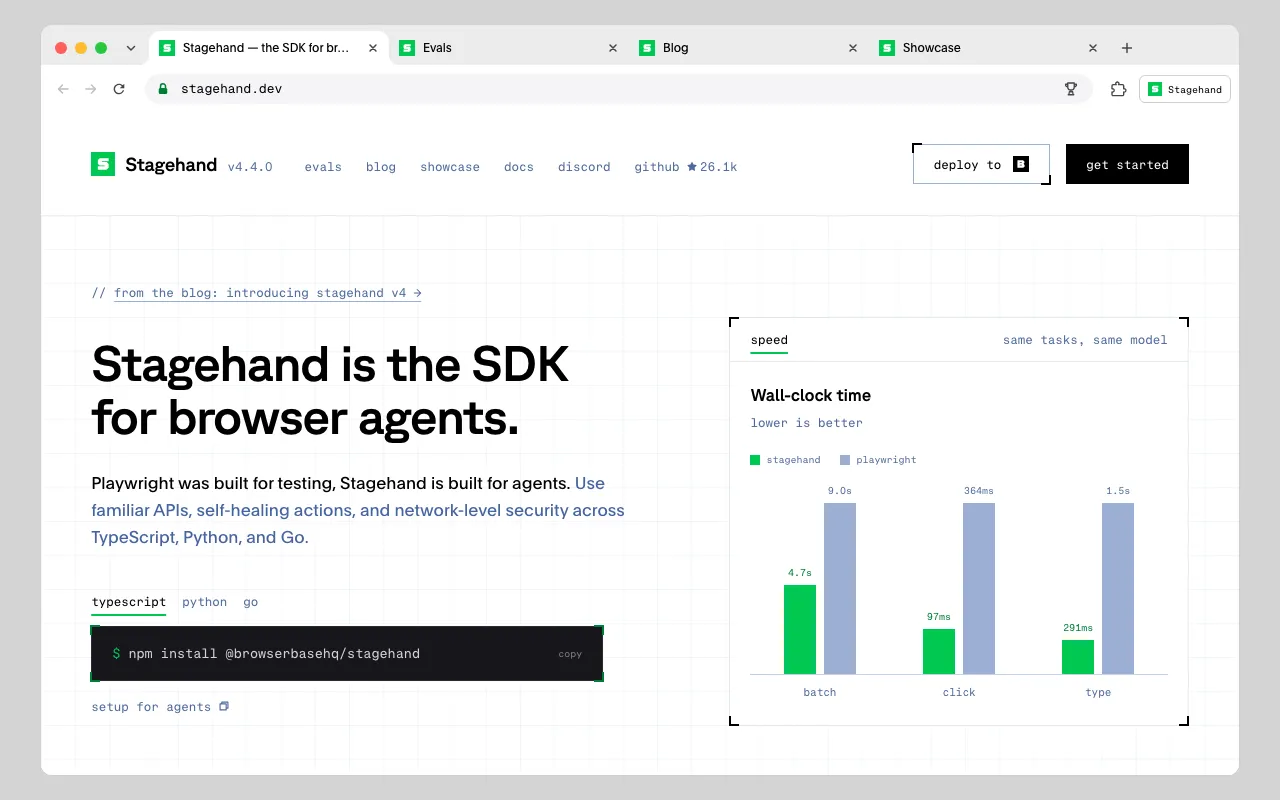
Stagehand gives agents Playwright-style browser control with natural-language act, observe, and extract helpers. It ships for TypeScript, Python, and Go with local Chrome or hosted cloud browsers.
Overview
Stagehand is an SDK aimed at software agents that need to browse the web the way a person would. It exposes familiar page methods such as navigation, clicks, locators, and screenshots, then layers higher-level primitives for describing actions and pulling structured data in plain language.
The runtime can drive a local Chrome installation or connect to Browserbase-managed browsers with proxy, session, and recording options. A hybrid accessibility-tree approach trims page context before it reaches language models, and act, observe, and extract steps can adjust when markup changes.
Agent-oriented capabilities include WebMCP integration, clipboard handling, batched commands, deep locators for nested iframes and closed shadow roots, and OpenTelemetry tracing. Complementary fetch and search utilities return markdown or search results without opening a full session.
Teams can install language packages directly or use a browse command-line tool and skills inside coding agents. A hosted MCP server exposes browser tools to clients that already speak the Model Context Protocol.
Key features
- Playwright-style page methods
- Natural-language act and extract
- Self-healing action adaptation
- Accessibility-tree context trimming
- TypeScript, Python, and Go SDKs
- Local Chrome and cloud browsers
- WebMCP and deep iframe locators
- Fetch and search without browsing
Use cases
- Agentic web data extraction
- Autonomous form filling workflows
- Migrating Playwright test suites
- MCP-connected coding assistants
- Logged-in session scraping