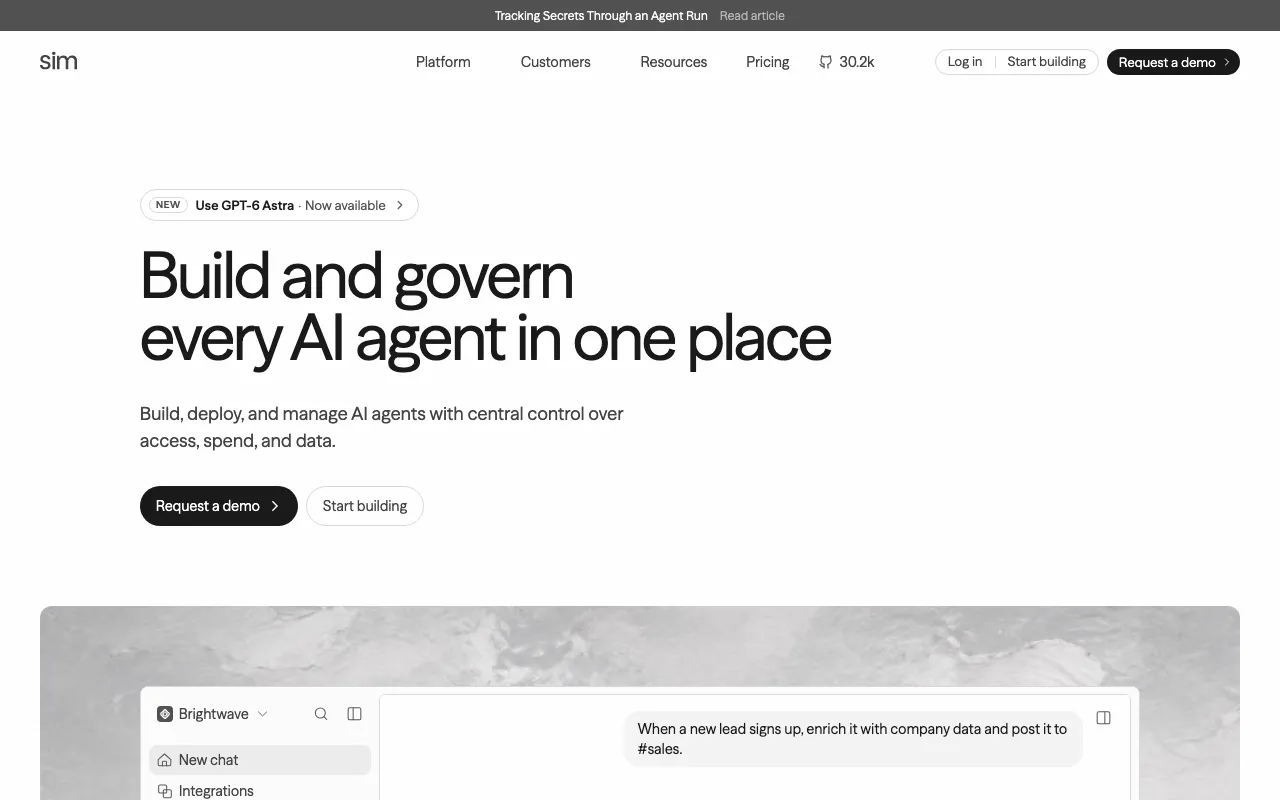
Sim lets teams build, deploy, and monitor AI agents and workflows in one workspace. It connects many integrations and LLMs with visual, chat, or code-based authoring.
Overview
Sim is a collaborative workspace for designing, running, and overseeing AI agents and automation workflows. Teams can author flows on a visual canvas, through conversation, or with code, then deploy and track activity from the same place.
The platform links to hundreds of integrations and major language models, so agents can reach tools such as Slack, Notion, CRMs, and databases. Workspaces also hold structured tables, file storage, and knowledge bases that agents can read and update between runs.
Builders can use Sim in a hosted cloud environment or run it on their own infrastructure with Docker or Kubernetes. A macOS desktop client is available, and MCP clients can connect to manage workspaces, workflows, tables, files, and logs.
Enterprise-oriented controls include SSO, directory provisioning, permission groups, audit records, and usage monitoring. Cloud deployments expose these governance features; self-hosted setups follow separate enterprise documentation.
Key features
- Visual, chat, and code workflow authoring
- 280+ integrations and major LLM support
- Shared tables, files, and knowledge bases
- Run monitoring, logs, and scheduling
- MCP access for external AI clients
- SSO, SCIM, and permission groups
- Self-hosted Docker and Kubernetes installs
- macOS desktop application
Use cases
- Sales and support agent automation
- Internal workflow orchestration
- Knowledge-backed chat agents
- Lead enrichment and routing
- Governed enterprise AI rollout
Does the same job as
Sim doesn't name these products itself, but its own description shows it does the same job.