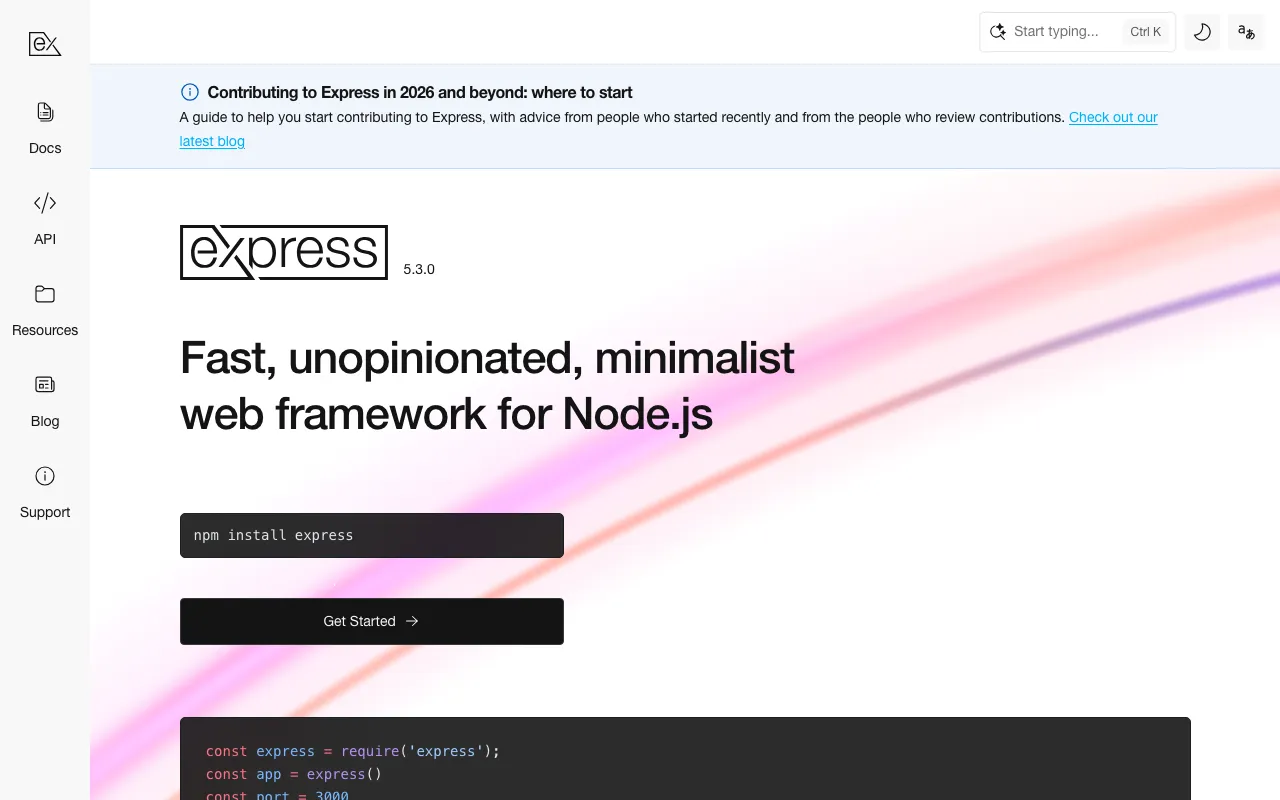
Express.js offers routing, middleware, and HTTP helpers for Node servers. It stays unopinionated about databases and view engines so you assemble your stack.
Overview
Express is a web application framework for Node.js focused on HTTP servers with a small core. It exposes routing, middleware chaining, and helpers for redirects, caching, and content negotiation while leaving persistence and rendering choices to the developer.
Applications are created by installing the package, defining routes on an app instance, and listening on a port. An optional executable scaffolds starter projects, and more than a dozen template engines can be wired through a consolidation layer.
Middleware from the wider ecosystem extends authentication, parsing, logging, and other concerns without bundling them into the core. The stated philosophy targets single-page apps, hybrid sites, public HTTP APIs, and similar workloads where you want thin control over Node’s networking primitives.
Performance and test coverage are emphasized in project messaging, and governance is maintained by a technical committee with published migration notes between major releases.
Key features
- HTTP routing and middleware pipeline
- Content negotiation helpers
- View rendering via many template engines
- Application generator executable
- Official middleware ecosystem
- Suitable for APIs and hybrid sites
- Thin layer over Node HTTP features
- High automated test coverage
Use cases
- REST or JSON HTTP APIs
- Server-rendered marketing sites
- Single-page app backends
- Prototypes needing quick route wiring




 Ionic Enterprise


