qmetrics.net

Expo

React framework for universal native mobile and web apps

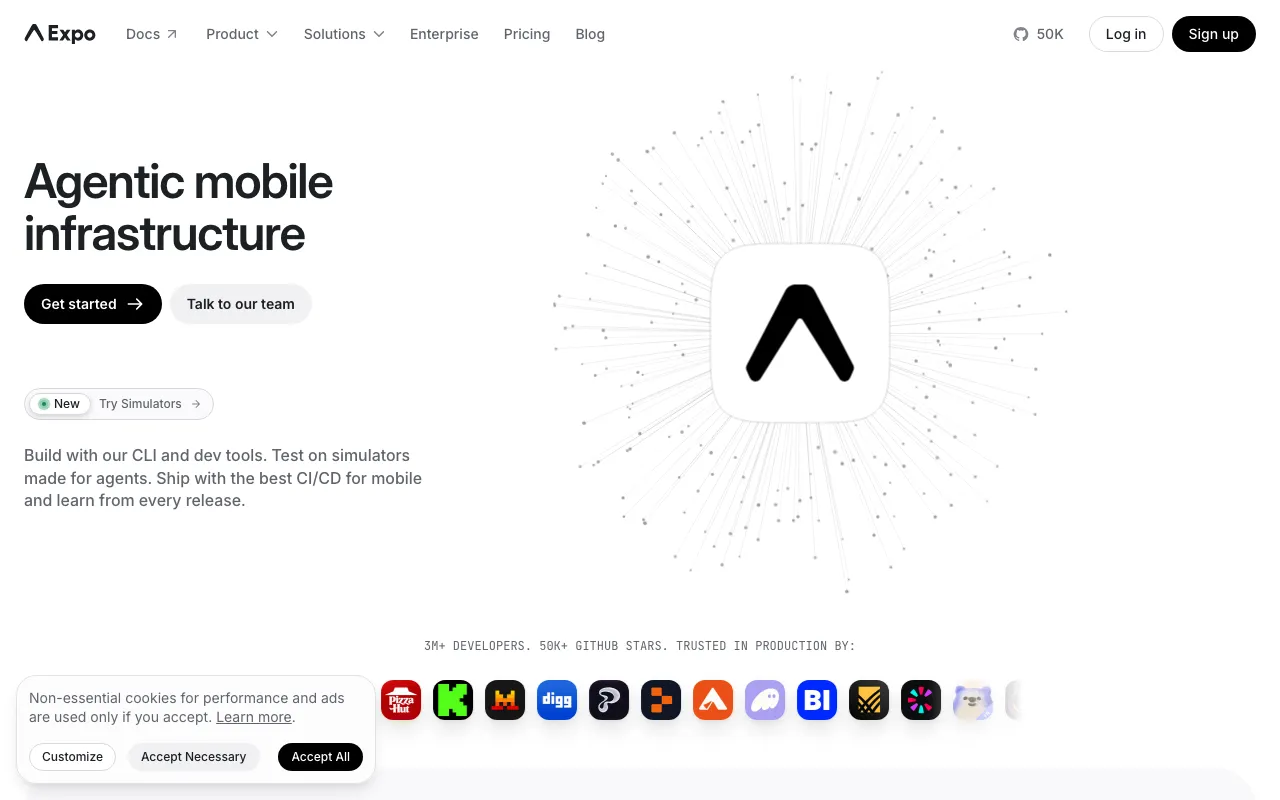
Expo screenshot

Expo lets teams write React and JavaScript once and target Android, iOS, and the web. It bundles a runtime, SDK modules, CLI, Router, and optional hosted build services.

Overview

Expo is an open platform for building universal native applications from a shared React and JavaScript codebase. The same project can ship to Android, iOS, and web runtimes using Expo’s libraries and tooling instead of maintaining wholly separate native projects.

The open-source side includes the Expo SDK, a modules API for native capabilities, the Expo Go client for on-device testing, the Expo CLI, Expo Router for navigation, templates from create-expo-app, and documentation. Developers extend apps with production-ready APIs covering sensors, media, filesystem access, and many other device features through unified JavaScript interfaces.

Expo Application Services (EAS) is a related hosted layer for builds, store submission, over-the-air updates, simulators, workflows, and production monitoring. Teams can adopt only the OSS toolchain or pair it with EAS for CI, TestFlight and Play deployment, update channels, and crash or performance telemetry.

Newer materials emphasize agent-friendly workflows: CLI skills, MCP connectors, cloud simulators coding agents can drive, and validation pipelines before store releases. The stack remains compatible with custom native modules when projects outgrow managed defaults.

Key features

  • Single codebase for Android, iOS, and web
  • Expo SDK with broad device APIs
  • Expo Go for device testing
  • Expo Router navigation
  • create-expo-app project templates
  • Custom native module integration path
  • Optional EAS builds and OTA updates
  • CLI and agent tooling including MCP

Use cases

  • Shipping a cross-platform consumer mobile app
  • Prototyping native UI with React skills
  • Delivering web and mobile from one repo

Tags

Similar software

ECC

Open-source agent engineering toolkit for coding harnesses

ECC adds planning, verification, review, memory, skills, and security scanning to coding agents such as Claude Code, Codex, and Cursor. It installs as plugins, packages, and managed adapters across multiple harnesses.

★ 311.7k⟳ 8 days agoMIT
Frameworks & PlatformsDesktop/CLI app

React

JavaScript library for web and native user interfaces

React helps developers build interfaces from reusable components that manage their own state. Views update declaratively when underlying data changes.

★ 253k⟳ 2 days agoMIT
Frameworks & PlatformsDesktop/CLI app

Flutter

Open-source UI framework for multi-platform apps from one codebase

Flutter is an SDK for building user experiences for mobile, web, and desktop from a single codebase. It uses the Dart language and compiles to native machine code or web targets.

★ 181.5k⟳ todayBSD-3-Clause
Open Source Alternative to:Ionic Enterprise

Bootstrap

Responsive HTML, CSS, and JavaScript front-end toolkit

Bootstrap supplies CSS, JavaScript, and Sass-based styles for building responsive, mobile-first sites. It ships prebuilt grid layouts, UI components, and optional JavaScript plugins.

★ 175.1k⟳ 2 days agoMIT

Langflow

Visual low-code builder for AI agents and workflows

Langflow is a visual builder for AI agents and workflows. Flows can be customized in Python and deployed as an API or as an MCP server, with support for major LLMs and vector databases.

★ 157k⟳ todayMIT
Open Source Alternative to:Relevance AIVoiceflow

LangChain

Framework for agents and LLM-powered applications

LangChain helps developers chain interoperable components and integrations to build agents and LLM-powered applications. It offers a standard interface for models, embeddings, vector stores, and related pieces.

★ 150.1k⟳ 2 days agoMIT






