
MemPalace
Local-first semantic memory for AI agents
MemPalace stores conversation text verbatim and retrieves it with semantic search. It exposes an MCP server and CLI for coding agents.

Local-first personal context workspace with scoped AI agents
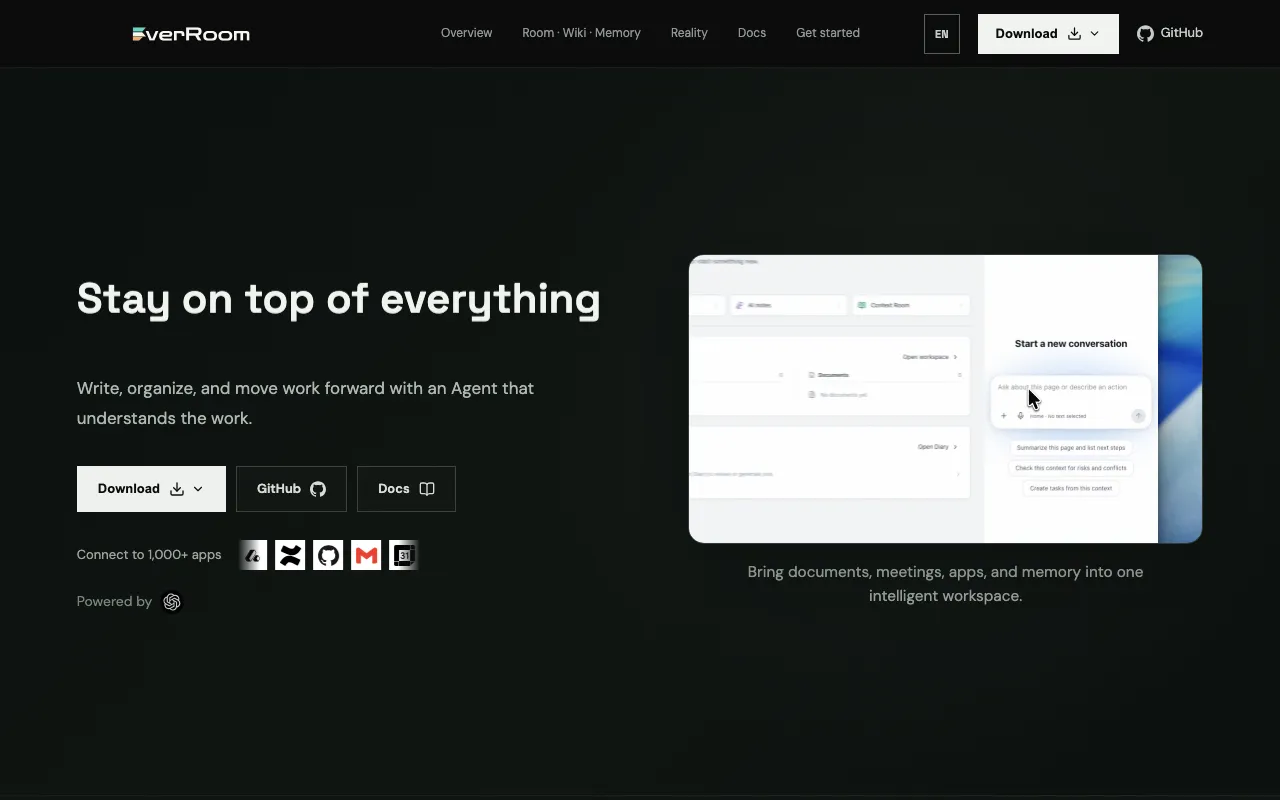
EverRoom connects files, meetings, and apps into Context Rooms where you write, remember, and delegate work to agents that see room-scoped context.
EverRoom is a local-first desktop workspace that keeps project information, memory, and AI assistance in one place. You link sources such as local files, repositories, meetings, audio, and optional connectors (Feishu, Slack, Notion, Gmail), then organize them into Context Rooms bounded by topic, person, or responsibility.
Each room assembles evidence with provenance, wiki pages, entities, decisions, tasks, and layered memory so agents receive scoped tools instead of an unbounded global prompt. Context Docs provide versioned writing with reviewable agent edits; Reality Perception captures and transcribes conversations for later search.
The desktop stack uses Electron with a React UI and a local Gateway service (Fastify) supervised by the app, backed by SQLite storage, unified ingest, optional MemoryCore, and connector bridges. Agents run in persistent sessions with streaming, cancellation, and an Agent Office for scheduled tasks.
Development currently targets macOS first, with APIs and schemas still evolving. Optional cloud connectors exist, but the design emphasizes on-machine evidence, human review of generated summaries, and graceful degradation when memory or model services are unavailable.
Local-first semantic memory for AI agents
MemPalace stores conversation text verbatim and retrieves it with semantic search. It exposes an MCP server and CLI for coding agents.
Self-hosted, privacy-focused AI research notebook and Notebook LM alternative
Open Notebook is a self-hosted research workspace where you add sources, chat with AI about them, take notes and generate podcasts. It works with 20+ cloud or local AI providers.

Self-hostable personal AI assistant for searching docs and the web
Khoj is an open-source personal AI app that chats with local or online LLMs and answers questions from your documents and the web. It supports custom agents, scheduled automations and research.
Unofficial Python and CLI client for Gemini Notebook
notebooklm-py exposes Google Gemini Notebook (formerly NotebookLM) through a Python API, shell commands, MCP, and REST hooks. It targets automation and agent workflows beyond the web interface.

Private, offline NotebookLM-style AI desktop app for confidential documents
Free, open-source desktop app acting as a private AI agent over your own files. It answers with citations, edits and converts documents, and runs offline with a local or remote model, with no account.
Shared personal memory and skills across coding agents
memU captures agent session history into reusable Markdown skills and retrieves them before new tasks. Host adapters exist for Codex, Claude Code, Cursor, OpenClaw, and others.