qmetrics.net

Ember.js

Convention-driven JavaScript framework for ambitious web applications

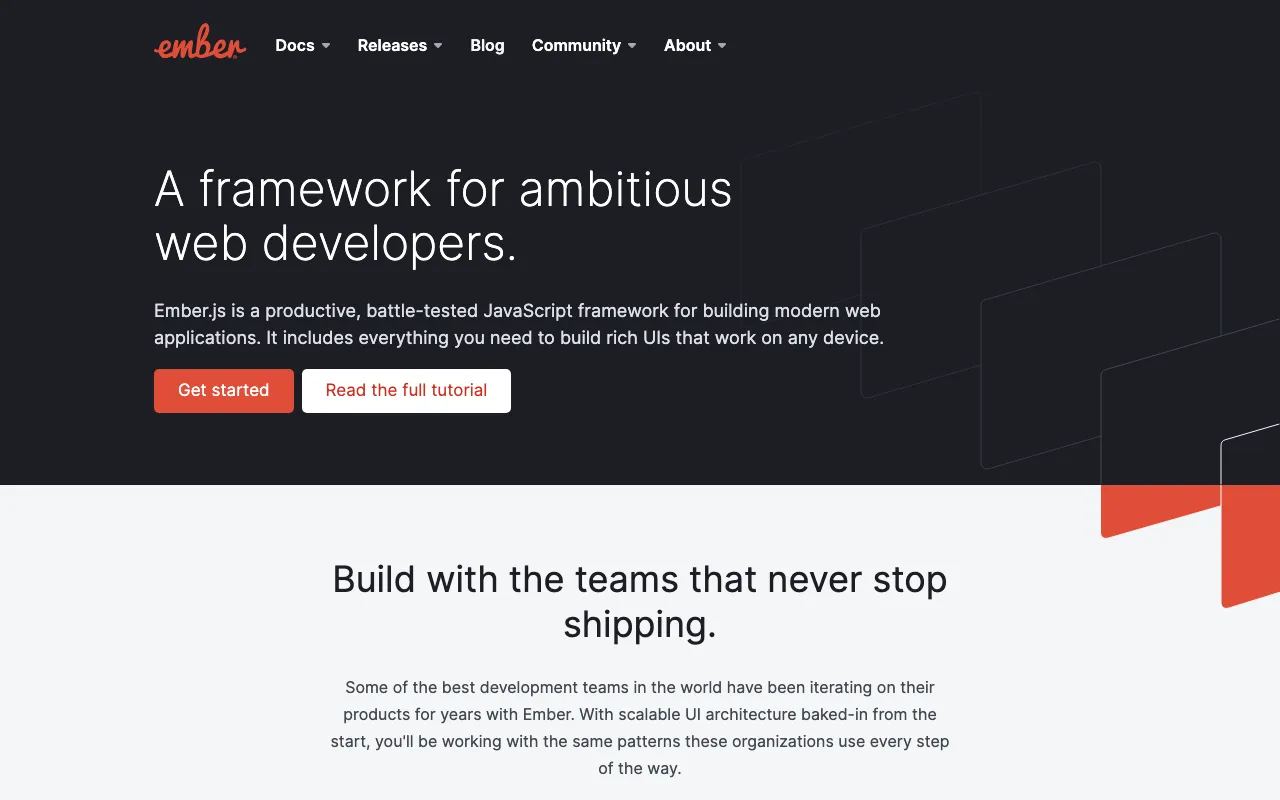
Ember.js screenshot

Ember.js is a JavaScript framework for building rich web UIs with routing, components, and a default data layer. Ember CLI supplies generators, dev server, and production builds.

Overview

Ember targets teams building long-lived browser applications by bundling routing, rendering, data access, and testing into one cohesive stack. URLs drive navigation: routes load templates, fetch models, handle actions, and can redirect based on state. Components favor semantic HTML first, with behavior added incrementally.

New apps ship with Ember Data for managing models, adapters, and serializers, though other data libraries are supported. Autotracking governs what re-renders when state changes. The Glimmer engine compiles templates for rendering performance. Regular LTS releases and a defined security support window are part of the release model, along with a six-week minor release cadence and deprecation tooling that often includes codemods.

Ember CLI generates entities, runs a dev environment with fast rebuilds and autoreload, executes tests in the browser, and builds for production with one command. The ecosystem includes addons for authentication, internationalization, concurrency helpers, and deployment pipelines, plus community resources such as Ember Observer for addon quality signals.

Key features

  • Built-in URL-aware router
  • HTML-first component model
  • Default Ember Data layer
  • Glimmer template rendering
  • Autotracking reactivity
  • Ember CLI build pipeline
  • Three-level test harness
  • LTS releases with security fixes

Use cases

  • Large multi-screen web applications
  • Teams wanting strong framework defaults
  • Apps needing nested async routing
  • Projects standardizing on Ember Data
  • Long-term products with steady upgrades

Tags

Similar software

ECC

Open-source agent engineering toolkit for coding harnesses

ECC adds planning, verification, review, memory, skills, and security scanning to coding agents such as Claude Code, Codex, and Cursor. It installs as plugins, packages, and managed adapters across multiple harnesses.

★ 311.7k⟳ 8 days agoMIT
Frameworks & PlatformsDesktop/CLI app

React

JavaScript library for web and native user interfaces

React helps developers build interfaces from reusable components that manage their own state. Views update declaratively when underlying data changes.

★ 253k⟳ 2 days agoMIT
Frameworks & PlatformsDesktop/CLI app

Flutter

Open-source UI framework for multi-platform apps from one codebase

Flutter is an SDK for building user experiences for mobile, web, and desktop from a single codebase. It uses the Dart language and compiles to native machine code or web targets.

★ 181.5k⟳ todayBSD-3-Clause
Open Source Alternative to:Ionic Enterprise

Bootstrap

Responsive HTML, CSS, and JavaScript front-end toolkit

Bootstrap supplies CSS, JavaScript, and Sass-based styles for building responsive, mobile-first sites. It ships prebuilt grid layouts, UI components, and optional JavaScript plugins.

★ 175.1k⟳ 2 days agoMIT

Langflow

Visual low-code builder for AI agents and workflows

Langflow is a visual builder for AI agents and workflows. Flows can be customized in Python and deployed as an API or as an MCP server, with support for major LLMs and vector databases.

★ 157k⟳ todayMIT
Open Source Alternative to:Relevance AIVoiceflow

LangChain

Framework for agents and LLM-powered applications

LangChain helps developers chain interoperable components and integrations to build agents and LLM-powered applications. It offers a standard interface for models, embeddings, vector stores, and related pieces.

★ 150.1k⟳ 2 days agoMIT






