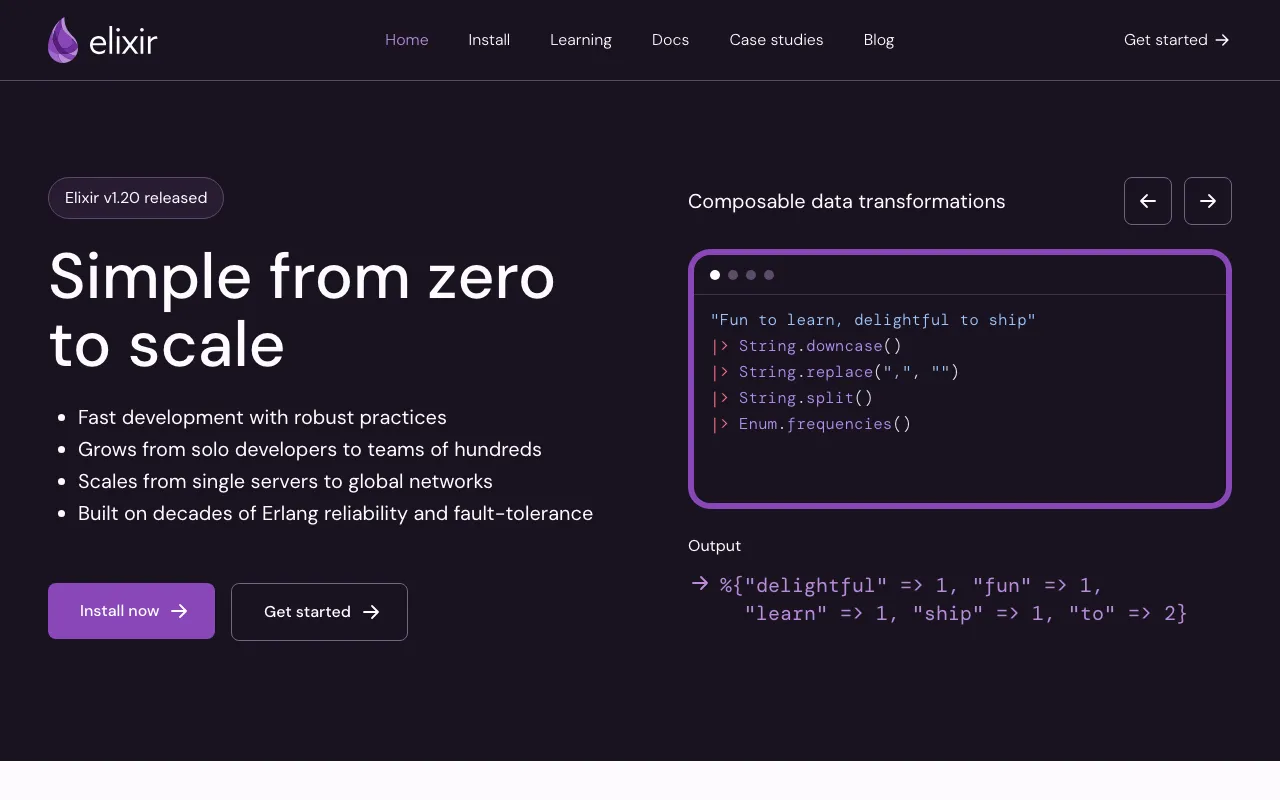
Elixir is a programming language for scalable, maintainable applications. It runs on the Erlang VM with immutability, distribution, and fault-tolerance built in.
Overview
Elixir combines a functional, dynamic syntax with the concurrency and reliability model of the Erlang virtual machine. The language emphasizes clear data-oriented code, gradual typing, and recovery from failure so teams can grow from small programs to multi-node deployments.
A single codebase can scale on multi-core machines and across networked nodes, which suits message-driven and real-time web systems. The toolchain includes a package manager, formatter, documentation tooling, an interactive shell, and ecosystem projects for web stacks, notebooks, and embedded firmware.
Common production patterns pair Elixir with Phoenix and LiveView for web UIs, Ecto for data layers, Broadway and Oban for queues and background work, Nerves and AtomVM for devices, and Nx-related libraries for numerical and machine-learning workflows. Community packages publish through Hex.
Installers target major desktop platforms and support compiling from source when contributing to the language itself. Documentation and learning resources live on the project site, with forums and chat channels for support and feature discussion.
Key features
- Erlang VM concurrency model
- Immutable data by default
- Vertical and horizontal scaling
- Built-in package manager
- Code formatter and docs
- Interactive IEx shell
- Gradual type system
- Fault-tolerant process design
Use cases
- Real-time web applications
- Distributed and IoT systems
- Embedded firmware with Nerves
- GPU-oriented ML with Nx
- High-throughput message pipelines




 Ionic Enterprise


