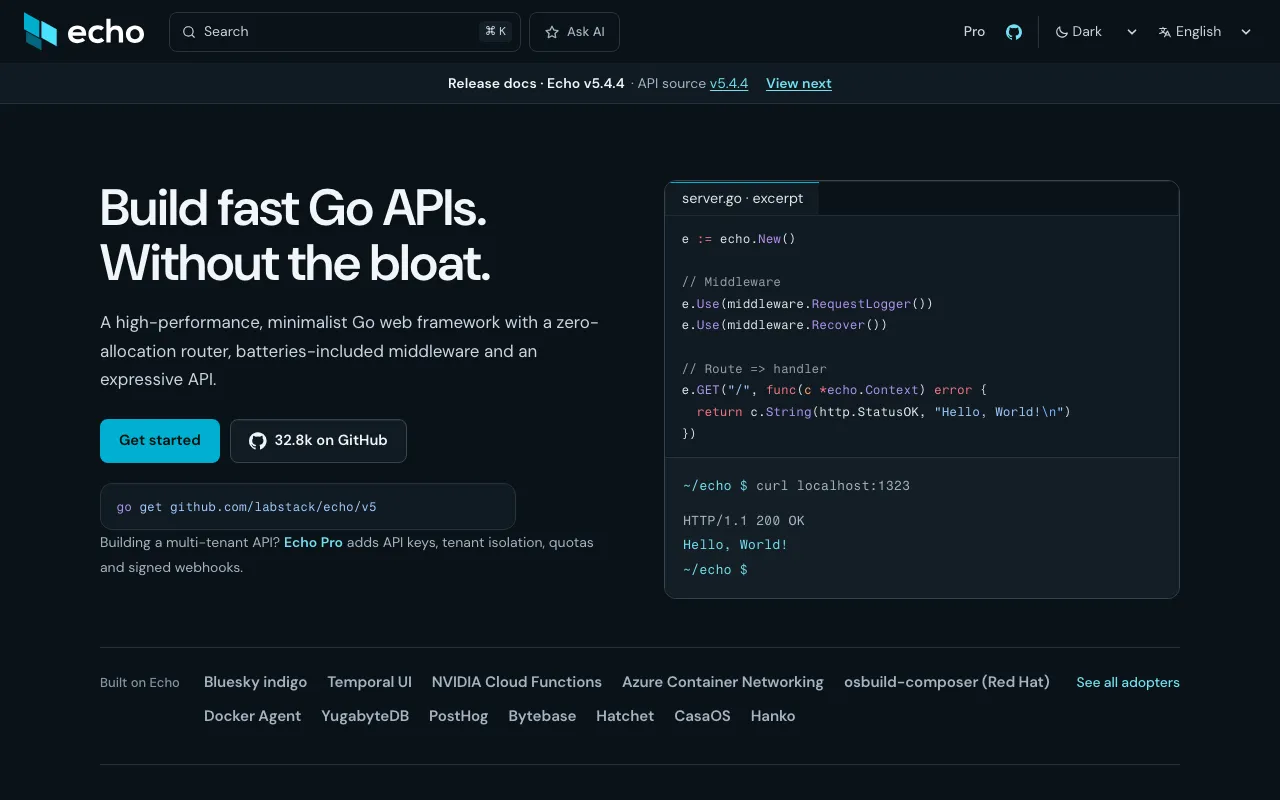
Echo extends Go's net/http with a radix-tree router, binding, middleware, and centralized errors. It is maintained for building APIs and web services in Go.
Overview
Echo is a Go web framework built on the standard net/http package and interoperates with it through wrapper helpers. It adds a radix-tree router, request binding with pluggable validation, official and third-party middleware, and a single HTTP error handler for the whole app. Echo v4 is in maintenance and receives no new features.
Requests flow through optional pre-middleware, routing, route or group middleware, the handler, and then centralized error handling. Features include static, parameter, and wildcard routes; route groups; JSON, XML, form, and query binding; response helpers; structured logging with log/slog; template rendering; TLS, HTTP/2, Let's Encrypt via autocert, and graceful shutdown.
Echo Pro is a separate commercial add-on for v5 with API keys, JWT auth, tenant isolation, quotas, audit records, and signed webhooks. The core framework stays MIT-licensed. Official packages cover JWT, OpenTelemetry, Prometheus, and contrib utilities.
Key features
- Radix-tree HTTP router
- JSON and form data binding
- Route groups and middleware
- Centralized error handling
- TLS, HTTP/2, and autocert
- Graceful server shutdown
- Structured slog request logging
- Pluggable validator and renderer
Use cases
- Go REST and HTTP APIs
- Microservices in Go
- Web backends with middleware stacks
- Services needing graceful shutdown




 Ionic Enterprise


