qmetrics.net

Django Split Settings

Modular Django settings across multiple files

Frameworks & PlatformsDesktop/CLI app
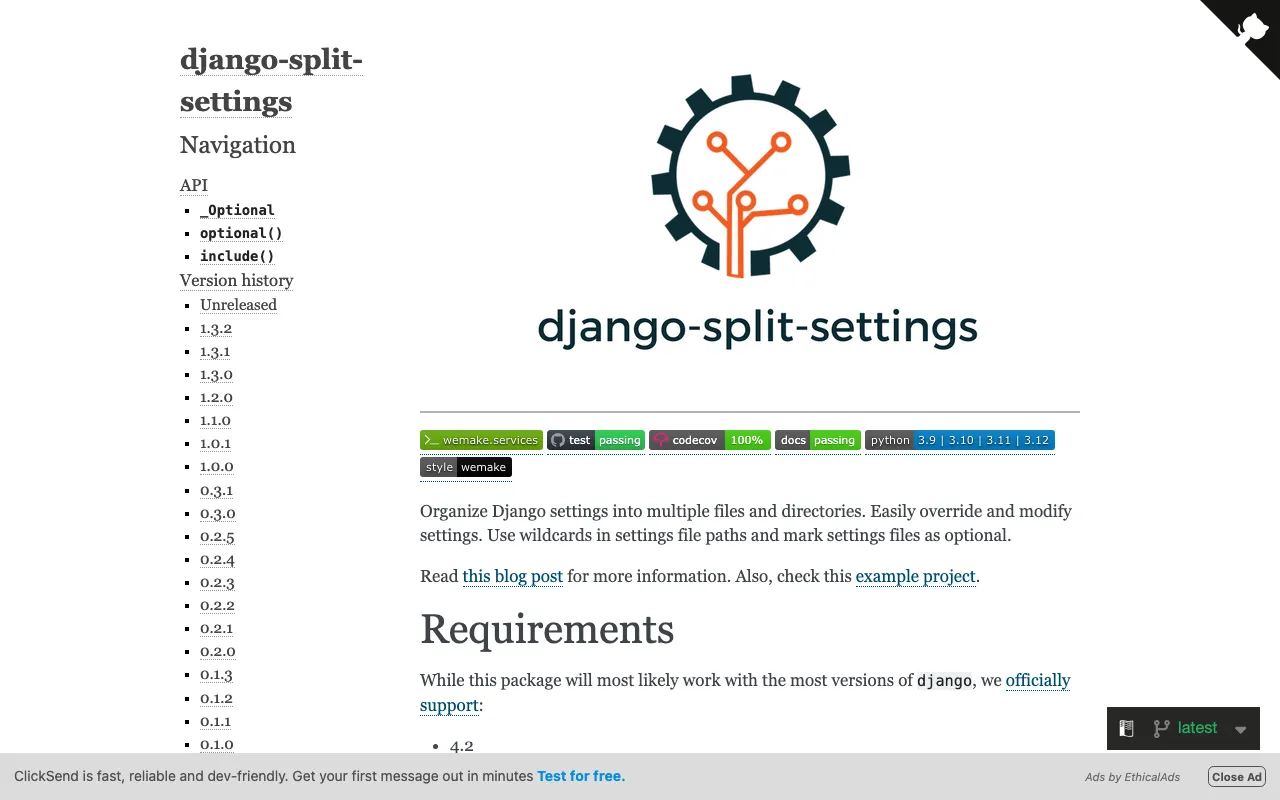
Django Split Settings screenshot

Splits Django configuration into included files and optional components with wildcard paths and shared local context.

Overview

Django Split Settings lets you replace a monolithic settings.py with an ordered list of smaller files, typically organized as a settings package with components such as base and database modules. The include helper loads each file in sequence, and optional() can skip missing paths such as local overrides.

Each included file shares the same local context, so later files can read or change values defined earlier. Wildcards in paths let you pull in every matching module under a directory, with order determined by glob rather than alphabetical sorting. The package has no dependencies beyond Django and documents supported Django release lines.

Documentation explains adjusting BASE_DIR when settings become a package instead of a single file, so static and media paths still resolve to the project root. An API covers include and optional helpers for assembling environment-specific stacks.

The goal is easier overrides per environment and clearer separation of concerns without abandoning plain Python settings files.

Key features

  • Include ordered settings components
  • Optional missing settings files
  • Wildcard glob in settings paths
  • Shared context across included files
  • No extra package dependencies
  • Settings package instead of one file
  • Local override patterns
  • Documented BASE_DIR adjustment

Use cases

  • Splitting large Django settings modules
  • Optional local settings overlays
  • Environment-specific Django configuration
  • Organizing settings by concern

Tags

Similar software

ECC

Open-source agent engineering toolkit for coding harnesses

ECC adds planning, verification, review, memory, skills, and security scanning to coding agents such as Claude Code, Codex, and Cursor. It installs as plugins, packages, and managed adapters across multiple harnesses.

★ 311.7k⟳ 8 days agoMIT
Frameworks & PlatformsDesktop/CLI app

React

JavaScript library for web and native user interfaces

React helps developers build interfaces from reusable components that manage their own state. Views update declaratively when underlying data changes.

★ 253k⟳ 2 days agoMIT
Frameworks & PlatformsDesktop/CLI app

Flutter

Open-source UI framework for multi-platform apps from one codebase

Flutter is an SDK for building user experiences for mobile, web, and desktop from a single codebase. It uses the Dart language and compiles to native machine code or web targets.

★ 181.5k⟳ todayBSD-3-Clause
Open Source Alternative to:Ionic Enterprise

Bootstrap

Responsive HTML, CSS, and JavaScript front-end toolkit

Bootstrap supplies CSS, JavaScript, and Sass-based styles for building responsive, mobile-first sites. It ships prebuilt grid layouts, UI components, and optional JavaScript plugins.

★ 175.1k⟳ 2 days agoMIT

Langflow

Visual low-code builder for AI agents and workflows

Langflow is a visual builder for AI agents and workflows. Flows can be customized in Python and deployed as an API or as an MCP server, with support for major LLMs and vector databases.

★ 157k⟳ todayMIT
Open Source Alternative to:Relevance AIVoiceflow

LangChain

Framework for agents and LLM-powered applications

LangChain helps developers chain interoperable components and integrations to build agents and LLM-powered applications. It offers a standard interface for models, embeddings, vector stores, and related pieces.

★ 150.1k⟳ 2 days agoMIT