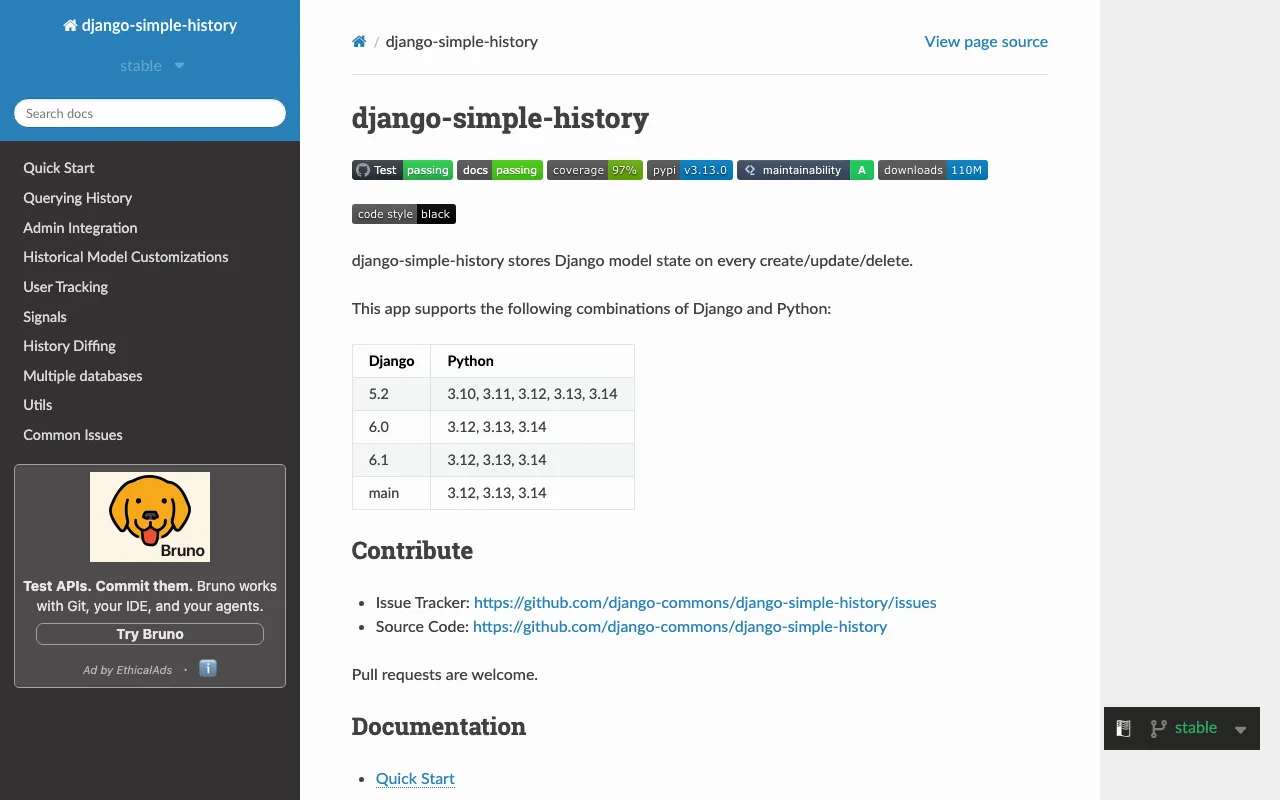
Records Django model state on every create, update, and delete so you can query past versions and revert from the admin.
Overview
Django Simple History stores a snapshot of Django model state whenever records are created, updated, or deleted. It targets teams that need an audit trail of data changes inside Django applications without building custom versioning tables by hand.
After installation and migrations, each tracked model gains historical records you can query on the instance or model class, walk forward and backward in time, revert to an earlier state, and filter with helpers such as as_of. The admin integration lists history, can show diffs between revisions, supports pagination, and allows customizing columns and templates while optionally disabling revert.
The documentation covers user tracking on changes, historic foreign keys and one-to-one fields, many-to-many history, signals, diffing, multiple databases, bulk operations with history, excluded fields, custom history managers, and utilities to clean duplicate or old history rows.
It is a Django app you add to INSTALLED_APPS and wire to models; it does not replace Django itself but extends models and admin for compliance-style record keeping.
Key features
- History on create, update, delete
- Query and revert historical records
- Django admin history integration
- User tracking for changes
- HistoricForeignKey and HistoricOneToOneField
- Many-to-many relationship tracking
- History diffing in admin
- Multiple database support
Use cases
- Audit trail for Django model edits
- Reverting records from Django admin
- Compliance logging of data changes
- Inspecting prior field values over time




 Ionic Enterprise


