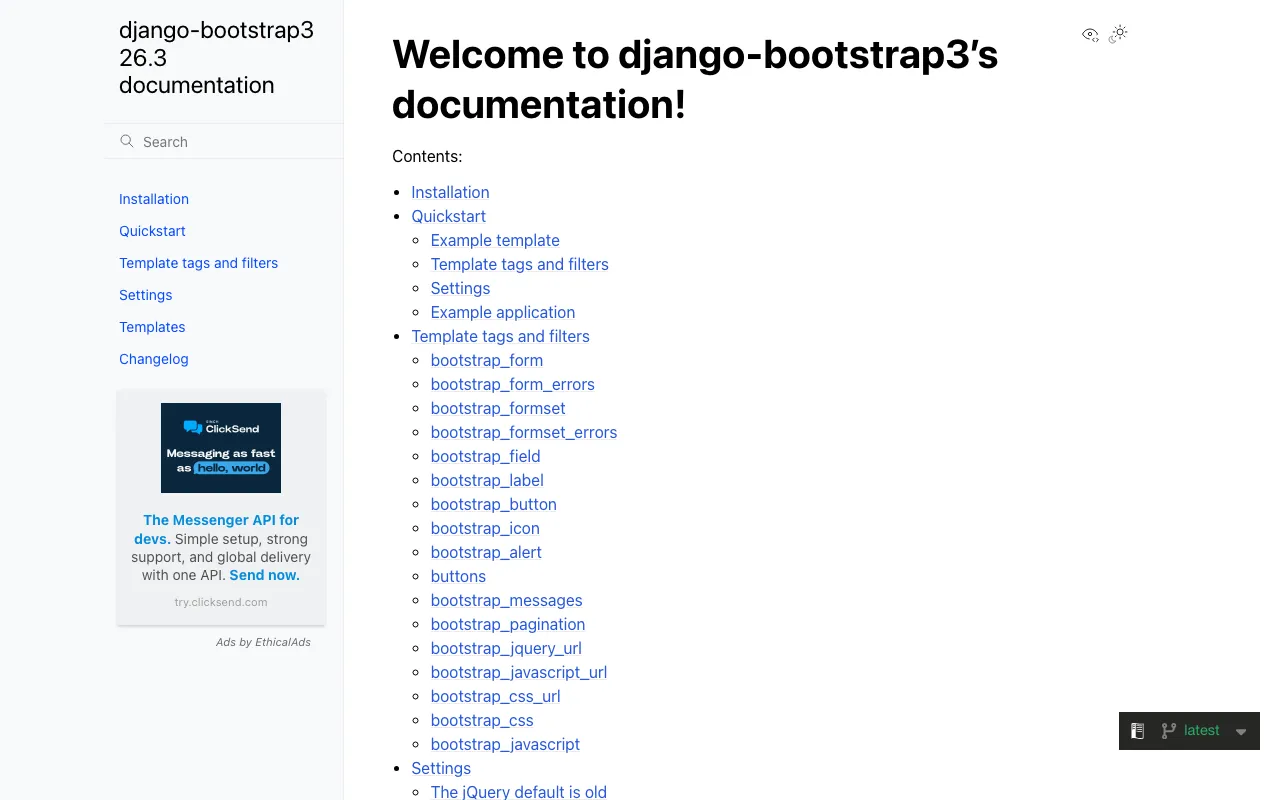
django-bootstrap3 connects Django templates to Bootstrap 3 via template tags for forms, buttons, pagination, and related UI pieces.
Overview
django-bootstrap3 helps Django projects render Bootstrap 3 markup from templates without hand-writing all HTML for common patterns. The goal stated by its maintainers is to blend Django and Bootstrap 3 in one coherent workflow.
After installation as a Django app, templates load a bootstrap3 tag library and use tags for forms, field errors, formsets, buttons, icons, alerts, messages, pagination, and URLs for jQuery, JavaScript, and CSS assets. Settings control how assets and components behave.
The package targets Bootstrap 3 specifically and is in maintenance mode: only bug fixes and security updates are planned, with newer Bootstrap versions handled by sibling packages django-bootstrap4 and django-bootstrap5. Icons may be handled separately via django-icons.
It requires supported Python and Django versions and is distributed for installation via pip, with documentation covering quickstart, settings, and template reference.
Key features
- Bootstrap 3 form rendering tags
- Formset and error helpers
- Buttons, alerts, and messages tags
- Pagination template tags
- Configurable CSS and JS asset URLs
- Example application included
- Documented settings and filters
Use cases
- Legacy Django sites on Bootstrap 3
- Consistent admin-style forms in templates
- Rapid Bootstrap form markup in Django



 Ionic Enterprise


