qmetrics.net

Devopness

Multi-cloud DevOps control plane with MCP access

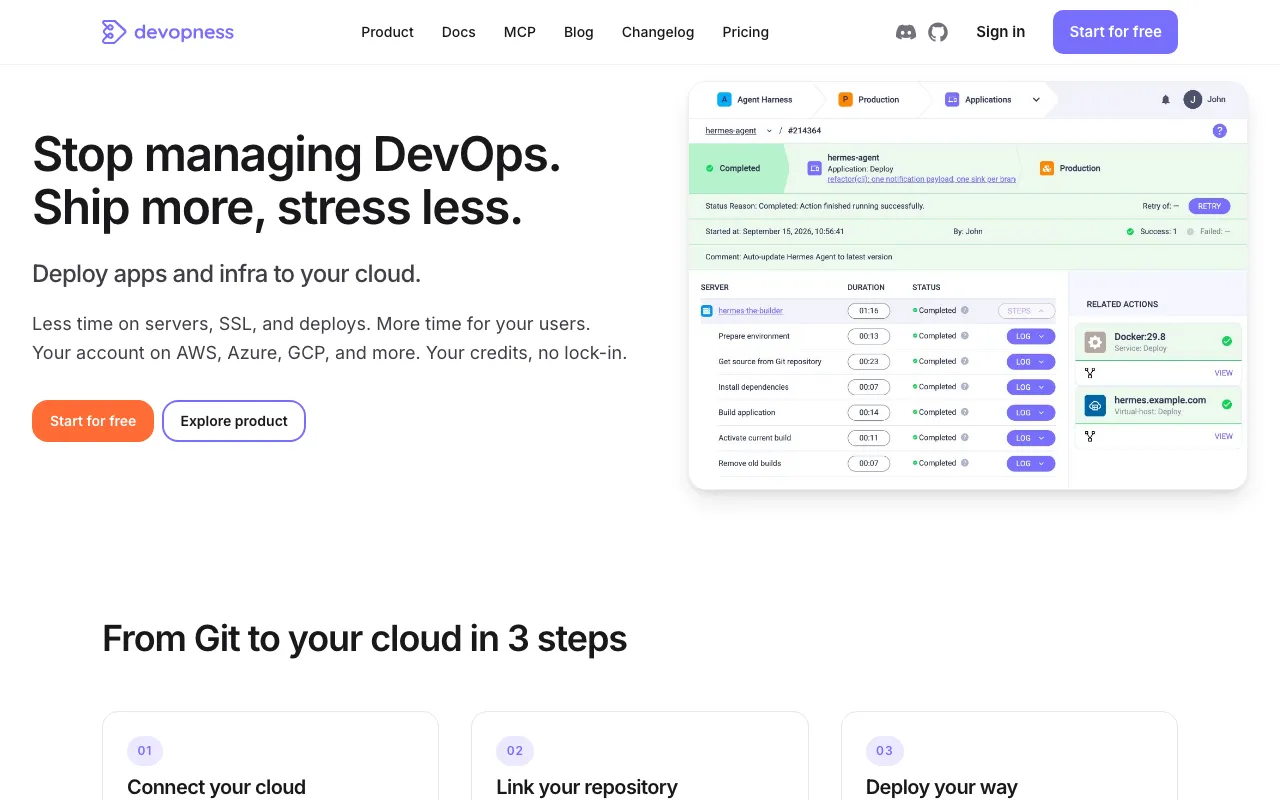
Devopness screenshot

Devopness provisions servers and deploys applications on clouds you own via web, API, mobile, or AI agents using one MCP integration.

Overview

Devopness is a hosted platform for deploying applications and provisioning infrastructure across AWS, Azure, Google Cloud, DigitalOcean, Hetzner, and similar providers inside accounts customers control. It aims to replace separate Terraform, Ansible, CI, and stack-specific panel tools with one opinionated workflow.

Users create organizations, projects, and environments, connect repositories, and trigger zero-downtime deploys from Git pushes. Role-based permissions limit who can change production resources without handing everyone cloud console access.

An MCP server lets compatible agents provision servers, migrate workloads, and run routine DevOps tasks in natural language after linking a Devopness account. SDKs in JavaScript and Python wrap the HTTP API, while open-source materials primarily contain documentation, examples, and UI packages.

The vendor emphasizes that credentials stay out of chat transcripts while deterministic APIs execute changes, with a free tier to start without a credit card.

Key features

  • Multi-cloud server provisioning
  • Git-triggered zero-downtime deploys
  • Web, API, and mobile management
  • MCP integration for AI agents
  • Role-based environment permissions
  • Deploy history and audit views
  • JavaScript and Python SDKs
  • Replaces many panel-style tools

Use cases

  • Founders shipping on their own cloud accounts
  • Agencies standardizing client deployments
  • Agents migrating apps between providers
  • Teams avoiding routine SSH maintenance

Does the same job as

Devopness doesn't name these products itself, but its own description shows it does the same job.


Tags

Compare Devopness

Similar software

Coolify

Self-hostable PaaS for apps, databases, and one-click services

Coolify deploys static sites, databases, and full-stack apps on servers you control, with a dashboard similar to managed hosting platforms. Configurations stay on your machines over SSH.

★ 66.7k⟳ todayApache-2.0
Build & DeploymentSelf-hostable
Open Source Alternative to:HerokuNetlify+3

Dokploy

Self-hostable PaaS for apps and databases

Dokploy is a self-hostable platform-as-a-service for deploying applications and databases on your own VPS. It supports Docker, Compose, multi-server setups, backups, and monitoring.

★ 38.7k⟳ yesterdayApache-2.0
Build & DeploymentSelf-hostable
Open Source Alternative to:HerokuNetlify+3

Dokku

Docker-powered mini PaaS on your own hardware

Dokku is a small platform-as-a-service you install on a Linux VM. You push Git-based, Heroku-style apps that build with buildpacks and run in Docker containers.

★ 32.2k⟳ yesterdayMIT
Build & DeploymentSelf-hostable
Open Source Alternative to:HerokuNetlify+3

Colima

Minimal container runtimes on macOS and Linux

Colima launches Lima-based VMs with Docker, containerd, Kubernetes, or Incus so you can run containers locally on Mac or Linux with simple defaults and port forwarding.

★ 31.9k⟳ 1 month agoMIT
Build & DeploymentDesktop/CLI app
Open Source Alternative to:Docker Desktop

OpenTofu

Open-source infrastructure as code engine

OpenTofu is an open-source tool for building, changing, and versioning infrastructure safely. It manages popular cloud providers and custom in-house systems using declarative configuration.

★ 31k⟳ todayMPL-2.0
Build & DeploymentDesktop/CLI app
Open Source Alternative to:Terraform

Pulumi

Open-source infrastructure as code with familiar programming languages

Pulumi provisions and manages cloud resources through programs written in TypeScript, Python, Go, Java, and other languages. A CLI deploys stacks to AWS, Azure, Google Cloud, Kubernetes, and hundreds of providers.

★ 26k⟳ yesterdayApache-2.0
Build & DeploymentDesktop/CLI app
Open Source Alternative to:Terraform