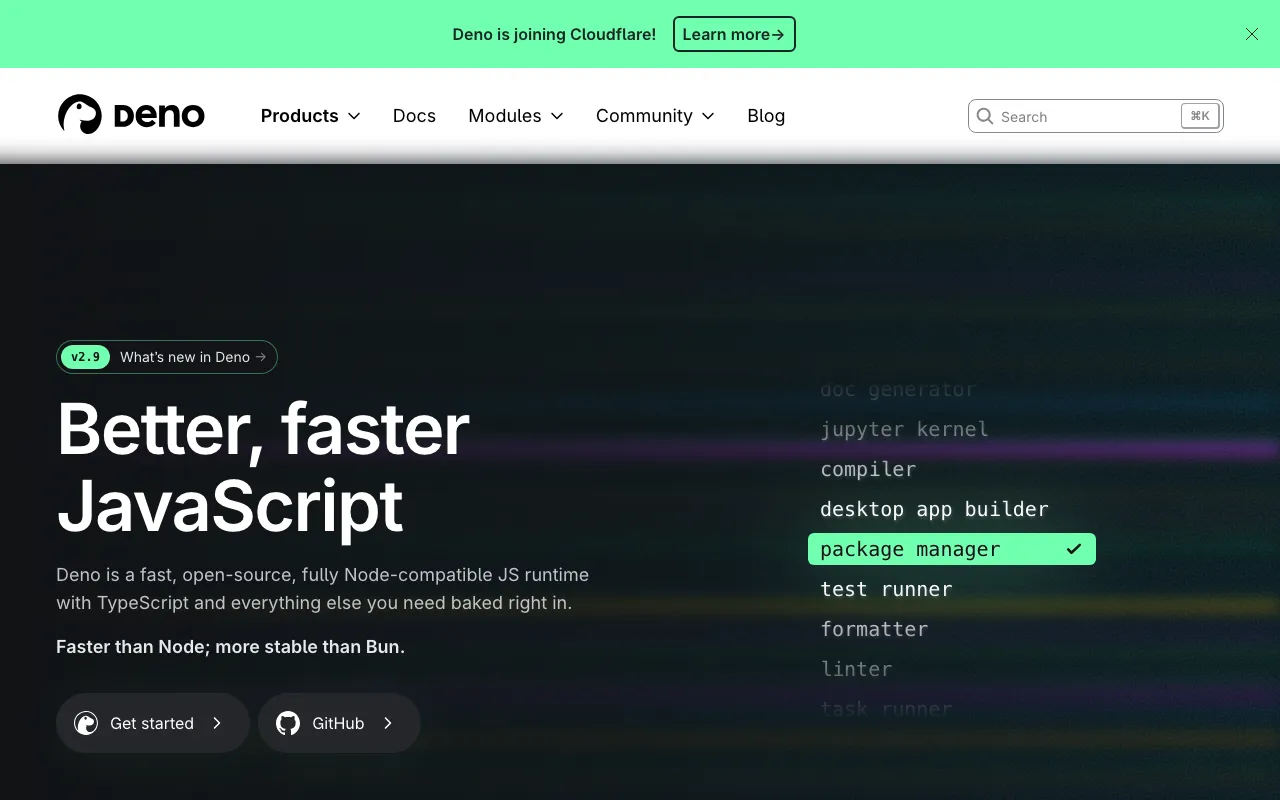
Deno is a JavaScript, TypeScript, and WebAssembly runtime built on V8, Rust, and Tokio. It ships secure defaults, Node compatibility, npm support, and integrated developer tools.
Overview
Deno is a modern runtime for JavaScript and TypeScript, also supporting WebAssembly. It is built on V8, Rust, and Tokio and emphasizes secure defaults together with an integrated developer workflow.
The runtime can run Node-oriented projects and understands common Node project files and module styles, including ESM, JSX or TSX, and node-style imports. TypeScript and npm packages can be used without a separate compiler or bundler setup in the typical workflow.
Built-in commands cover formatting, linting, testing, benchmarking, type checking, documentation generation, task running, serving, compilation, and desktop app building. Package management can pull from npm and JSR, read npm, yarn, and pnpm lockfiles, and work with npm workspaces.
Security controls deny filesystem, network, and environment access by default, with explicit permission flags, optional script allowances, audit commands, and permission tracing.
Common uses include building web servers from TypeScript source and running existing Node-oriented projects through Deno’s compatibility path.
Key features
- V8-based JS and TS runtime
- Secure permission defaults
- Built-in package manager
- Integrated test and lint tools
- npm and JSR package support
- Node project compatibility
- Standard library on JSR
- Browser-aligned Web APIs
Use cases
- Local TypeScript web servers
- Running Node projects on Deno
- Zero-config TypeScript development
- Sandboxed script execution
- Monorepo workspace development




 Ionic Enterprise


