
TensorFlow
End-to-end machine learning platform and tooling ecosystem
TensorFlow is a machine learning platform with Python and C++ APIs, optional GPU packages, and companion libraries for data, training, deployment, and visualization.
JVM deep learning stack with Java APIs and GPU backends
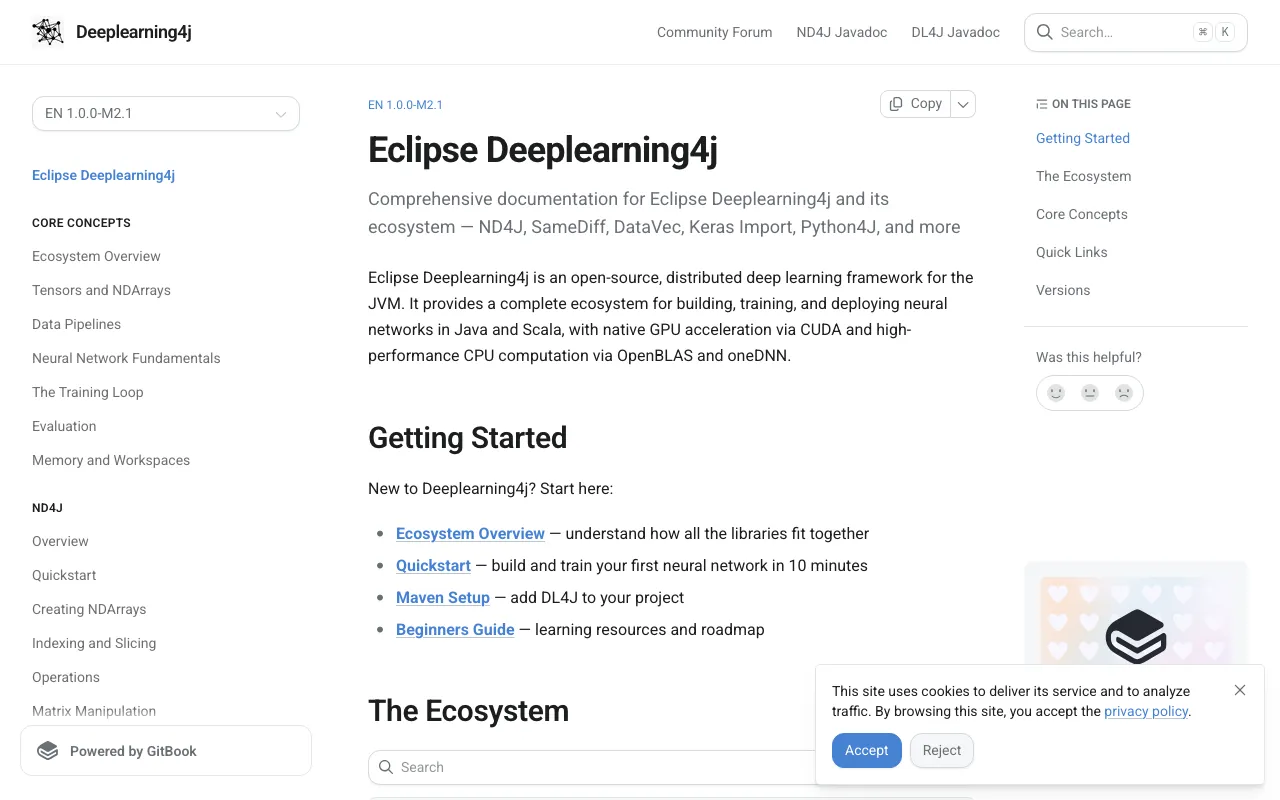
Eclipse Deeplearning4j is a multi-library ecosystem for building, training, and deploying neural networks on the JVM with ND4J, SameDiff, and DataVec.
Eclipse Deeplearning4j targets teams that want deep learning on the Java virtual machine and languages such as Scala, Kotlin, or Clojure. The high-level DL4J API builds multi-layer networks and computation graphs, supports custom layers, can import Keras h5 models including tf.keras, and can run distributed training on Apache Spark.
ND4J supplies general-purpose n-dimensional array math with hundreds of operations, backed by an optimized C++ core with CPU vector paths and CUDA GPU acceleration via libraries such as OpenBLAS, oneDNN, cuDNN, and cuBLAS. SameDiff adds graph-based automatic differentiation comparable in workflow to TensorFlow graph mode, with eager execution planned, and can import TensorFlow frozen protobuf models with further import formats on the roadmap.
DataVec handles ETL from CSV, images, audio, video, HDFS, Spark, and other sources. Python4J embeds CPython for calling Python from JVM code. Documentation covers quickstarts, Maven setup, convolutional and recurrent examples, Keras and TensorFlow import, ONNX import, Spark training, model zoo pretrained networks, and memory workspace tuning.
The stack runs on Windows, Linux, and macOS with hardware support for CUDA GPUs on supported versions, x86 CPUs with AVX variants, ARM CPUs, and PowerPC. Users typically integrate via Maven dependencies rather than a standalone end-user application.
End-to-end machine learning platform and tooling ecosystem
TensorFlow is a machine learning platform with Python and C++ APIs, optional GPU packages, and companion libraries for data, training, deployment, and visualization.

Shared model definitions for multimodal ML workloads
Transformers is a Python library that defines pretrained text, vision, audio, and multimodal models once in PyTorch for shared inference and training across the ecosystem.

Open-source RAG engine and agent context platform
RAGFlow ingests heterogeneous documents, builds retrievable knowledge, and supports agent workflows with citations. It can run on your own hardware with Docker or a from-source server stack.

Local LLM context compression library and proxy
Headroom shrinks tool outputs, logs, JSON, and chat history before LLM calls to cut input tokens while preserving retrievable originals. It offers a Python library, proxy, MCP tools, and agent wrappers.

Local desktop workspace to run and fine-tune AI models
Unsloth is a desktop application to chat with, fine-tune, and serve LLMs, diffusion, audio, and embedding models on your own hardware with optional agent integrations.

TensorFlow reference models and modeling utilities collection
The TensorFlow Model Garden hosts implementations of models and modeling solutions for TensorFlow, installable via pip as tf-models-official.