
Streamlit
Agent-native Python framework for data apps
Streamlit turns Python scripts into interactive data apps and dashboards in the browser. Logic, UI, caching, and auth live in one Python layer for people and coding agents.

Python framework for interactive data apps and dashboards
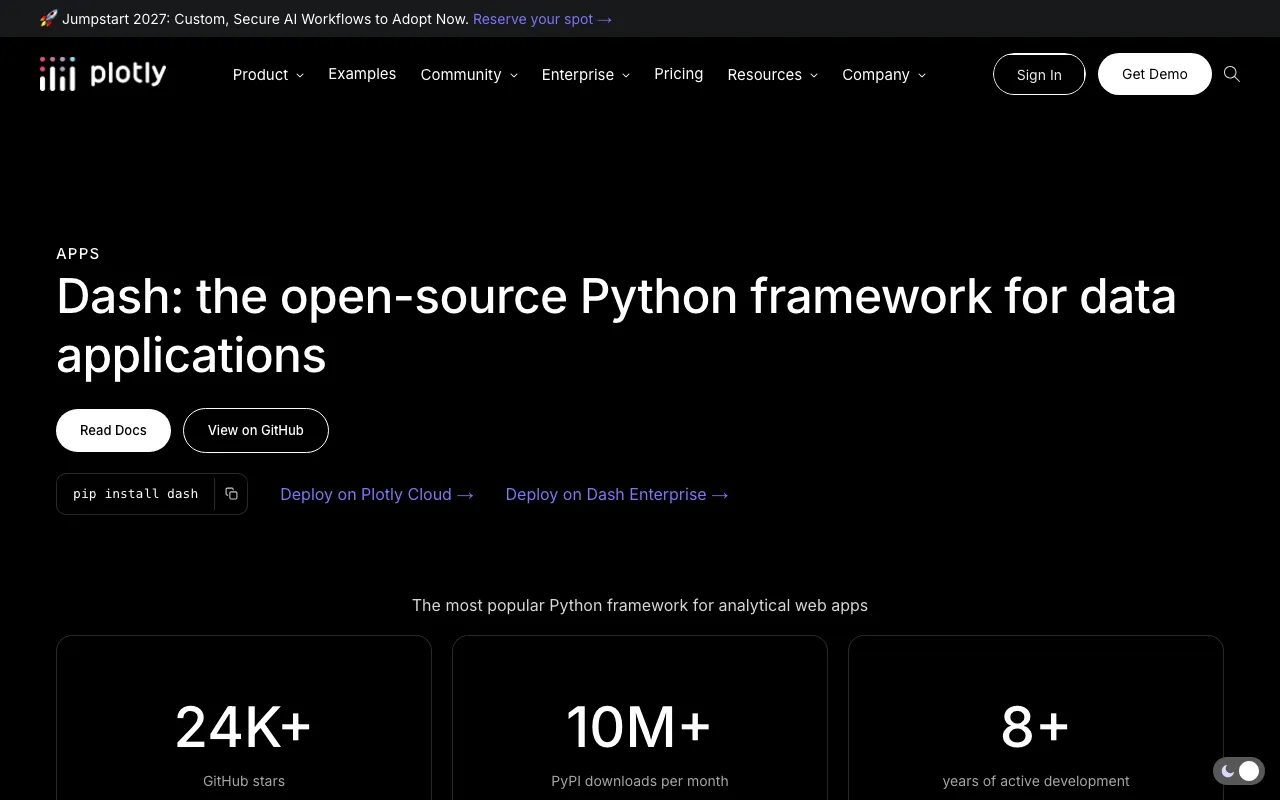
Dash lets analysts build browser-based analytics interfaces in Python alone, wiring dropdowns, sliders, charts, and tables to backend logic. It targets machine-learning and data-science teams who want reactive web UIs without hand-written front-end code.
Dash is a Python framework for constructing interactive data applications served to a browser. Layout and behavior are declared in Python; the stack combines Flask on the server with React and Plotly.js on the client so common controls stay linked to analytical code through callback decorators.
Developers define UI structure with Python components—graphs, inputs, tables, and many optional libraries such as AG Grid, Mantine, and Bootstrap kits—then attach functions that run when inputs change. Pattern-matching, clientside, background, and long-running callbacks support dynamic layouts and jobs that do not block the interface.
Apps run locally via a simple Python entrypoint and can be served with standard WSGI or ASGI hosts. Plotly also offers managed hosting options for broader access, while the framework itself can be deployed to common cloud and Kubernetes environments when teams handle operations themselves.
Multi-page routing, streaming updates, and testing helpers extend the same model from prototypes toward production dashboards in finance, bioinformatics, and similar analytic domains.
Agent-native Python framework for data apps
Streamlit turns Python scripts into interactive data apps and dashboards in the browser. Logic, UI, caching, and auth live in one Python layer for people and coding agents.

Python framework for data and AI web applications
Taipy helps data scientists and ML engineers ship Python-backed web apps. It covers UI generation, data integration, pipelines, and scenario analysis without a separate front-end stack.

Open-source agent engineering toolkit for coding harnesses
ECC adds planning, verification, review, memory, skills, and security scanning to coding agents such as Claude Code, Codex, and Cursor. It installs as plugins, packages, and managed adapters across multiple harnesses.

JavaScript library for web and native user interfaces
React helps developers build interfaces from reusable components that manage their own state. Views update declaratively when underlying data changes.

Open-source UI framework for multi-platform apps from one codebase
Flutter is an SDK for building user experiences for mobile, web, and desktop from a single codebase. It uses the Dart language and compiles to native machine code or web targets.
 Ionic Enterprise

Responsive HTML, CSS, and JavaScript front-end toolkit
Bootstrap supplies CSS, JavaScript, and Sass-based styles for building responsive, mobile-first sites. It ships prebuilt grid layouts, UI components, and optional JavaScript plugins.