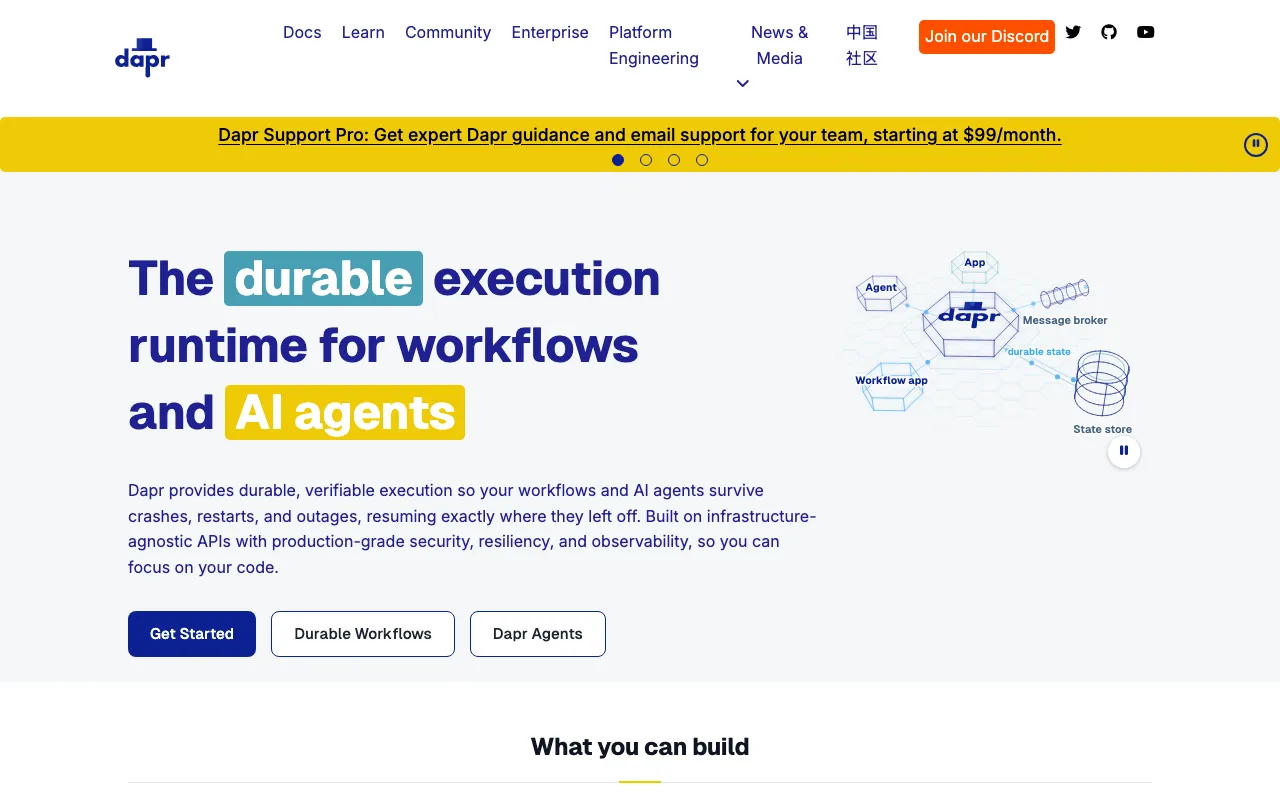
Dapr is a sidecar runtime that adds durable workflows, messaging, state, and service calls to applications. APIs work over HTTP and gRPC with SDKs for several languages.
Overview
Dapr targets teams building microservices, event-driven systems, long-running workflows, and AI agents. It runs as a sidecar next to your code so capabilities stay language-neutral while you keep business logic in the app you already write.
Workflows add durable execution that checkpoints progress and resumes after crashes, pod restarts, node failures, rolling deploys, and network issues. You define flows in ordinary code with patterns such as chaining, fan-out/fan-in, timers, human-in-the-loop events, compensation, and child workflows. A Conversation API wraps LLM calls with prompt caching and tool calling for agent-style workloads.
Beyond workflows, Dapr exposes APIs for secure service invocation, pub/sub, state stores, virtual actors, bindings to external systems, secrets, configuration, distributed locks, cryptography, and scheduled jobs. Components plug into Azure, AWS, GCP, and many brokers and databases without rewriting application code.
Security features include workload identity, mutual TLS between services, authorization policies, and secret retrieval from external vaults. The runtime is designed to deploy on Kubernetes, major clouds, VMs, bare metal, edge, IoT, and air-gapped environments with the same programming model.
Key features
- Durable workflow execution
- Sidecar HTTP and gRPC APIs
- Service-to-service mTLS invocation
- Pluggable pub/sub and state stores
- LLM Conversation API
- Virtual actors pattern
- Secret and configuration APIs
- Multi-language SDK support
Use cases
- Long-running business processes
- Production AI agents with recovery
- Event-driven microservices
- Order processing and approvals
- Secure multi-service mesh-style calls



 Ionic Enterprise
