qmetrics.net

daisyUI

Semantic Tailwind CSS component class plugin

Frameworks & PlatformsDesktop/CLI app
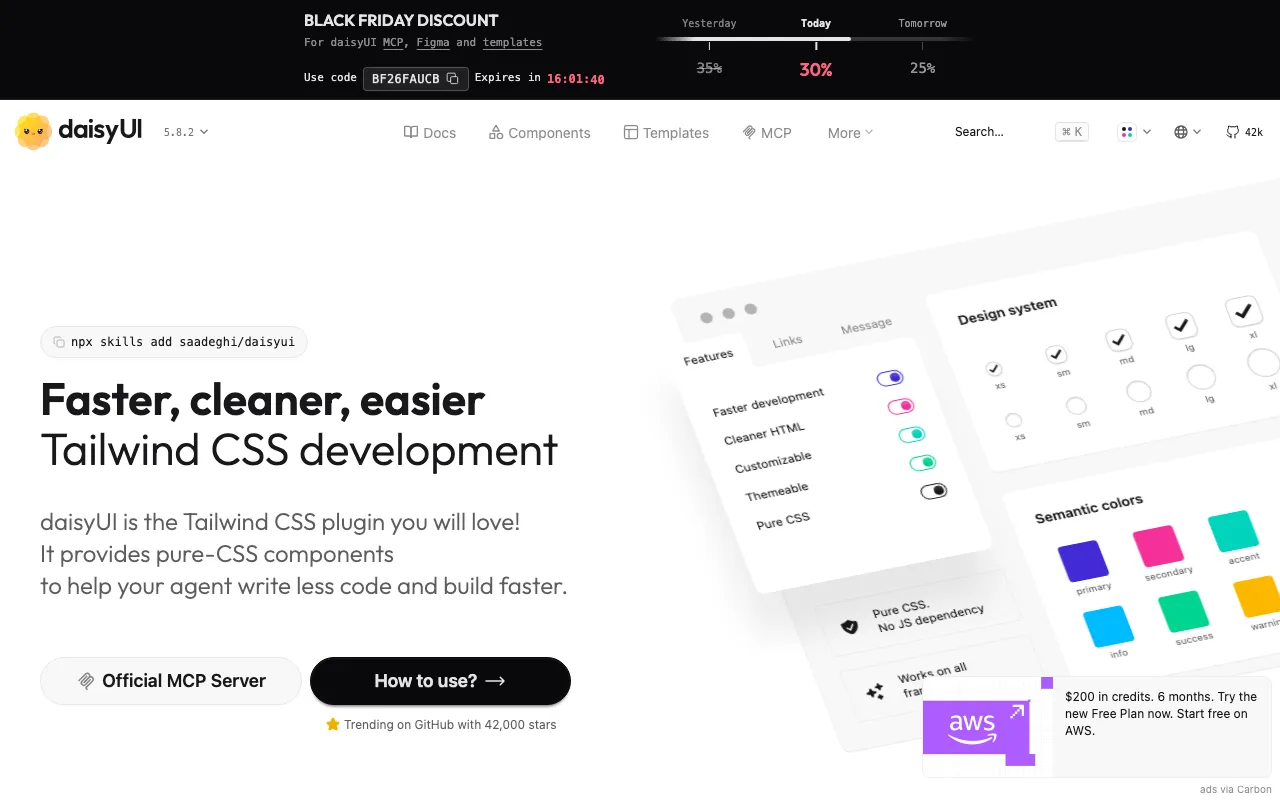
daisyUI screenshot

daisyUI is a Tailwind CSS plugin that adds semantic component class names such as btn and card. It reduces utility clutter and ships built-in themes without extra JavaScript.

Overview

daisyUI extends Tailwind CSS with prefixed component classes so developers style buttons, cards, toggles, and other UI blocks using short semantic names instead of long utility chains. It installs as a dev dependency and generates pure CSS, without requiring a runtime JavaScript bundle.

Because it builds on Tailwind utilities, teams can still customize appearance with familiar utility classes around the semantic components. The plugin adds named color roles such as primary, secondary, accent, and neutral, implemented with CSS variables so dark mode and alternate themes switch by theme class rather than duplicating markup.

The library is framework agnostic within JavaScript ecosystems: any stack that uses Tailwind can consume the classes. Documentation highlights smaller HTML payloads and fewer class names compared to utility-only Tailwind for typical forms and controls.

An official MCP server is advertised for agent-assisted workflows. The project markets itself as a component library layered on Tailwind for faster interface work across dashboards, marketing pages, and admin panels.

Key features

  • Semantic Tailwind component classes
  • Built-in multi-theme colors
  • CSS-variable theme switching
  • No JavaScript runtime required
  • Framework-agnostic CSS output
  • Dark mode via theme names
  • Utility-level customization
  • Common UI primitives included

Use cases

  • Tailwind admin dashboards
  • Marketing pages with less CSS
  • Consistent design tokens
  • Rapid form and button styling
  • Theme switching without duplicate HTML

Tags

Similar software

ECC

Open-source agent engineering toolkit for coding harnesses

ECC adds planning, verification, review, memory, skills, and security scanning to coding agents such as Claude Code, Codex, and Cursor. It installs as plugins, packages, and managed adapters across multiple harnesses.

★ 311.7k⟳ 8 days agoMIT
Frameworks & PlatformsDesktop/CLI app

React

JavaScript library for web and native user interfaces

React helps developers build interfaces from reusable components that manage their own state. Views update declaratively when underlying data changes.

★ 253k⟳ 2 days agoMIT
Frameworks & PlatformsDesktop/CLI app

Flutter

Open-source UI framework for multi-platform apps from one codebase

Flutter is an SDK for building user experiences for mobile, web, and desktop from a single codebase. It uses the Dart language and compiles to native machine code or web targets.

★ 181.5k⟳ todayBSD-3-Clause
Open Source Alternative to:Ionic Enterprise

Bootstrap

Responsive HTML, CSS, and JavaScript front-end toolkit

Bootstrap supplies CSS, JavaScript, and Sass-based styles for building responsive, mobile-first sites. It ships prebuilt grid layouts, UI components, and optional JavaScript plugins.

★ 175.1k⟳ 2 days agoMIT

Langflow

Visual low-code builder for AI agents and workflows

Langflow is a visual builder for AI agents and workflows. Flows can be customized in Python and deployed as an API or as an MCP server, with support for major LLMs and vector databases.

★ 157k⟳ todayMIT
Open Source Alternative to:Relevance AIVoiceflow

LangChain

Framework for agents and LLM-powered applications

LangChain helps developers chain interoperable components and integrations to build agents and LLM-powered applications. It offers a standard interface for models, embeddings, vector stores, and related pieces.

★ 150.1k⟳ 2 days agoMIT






