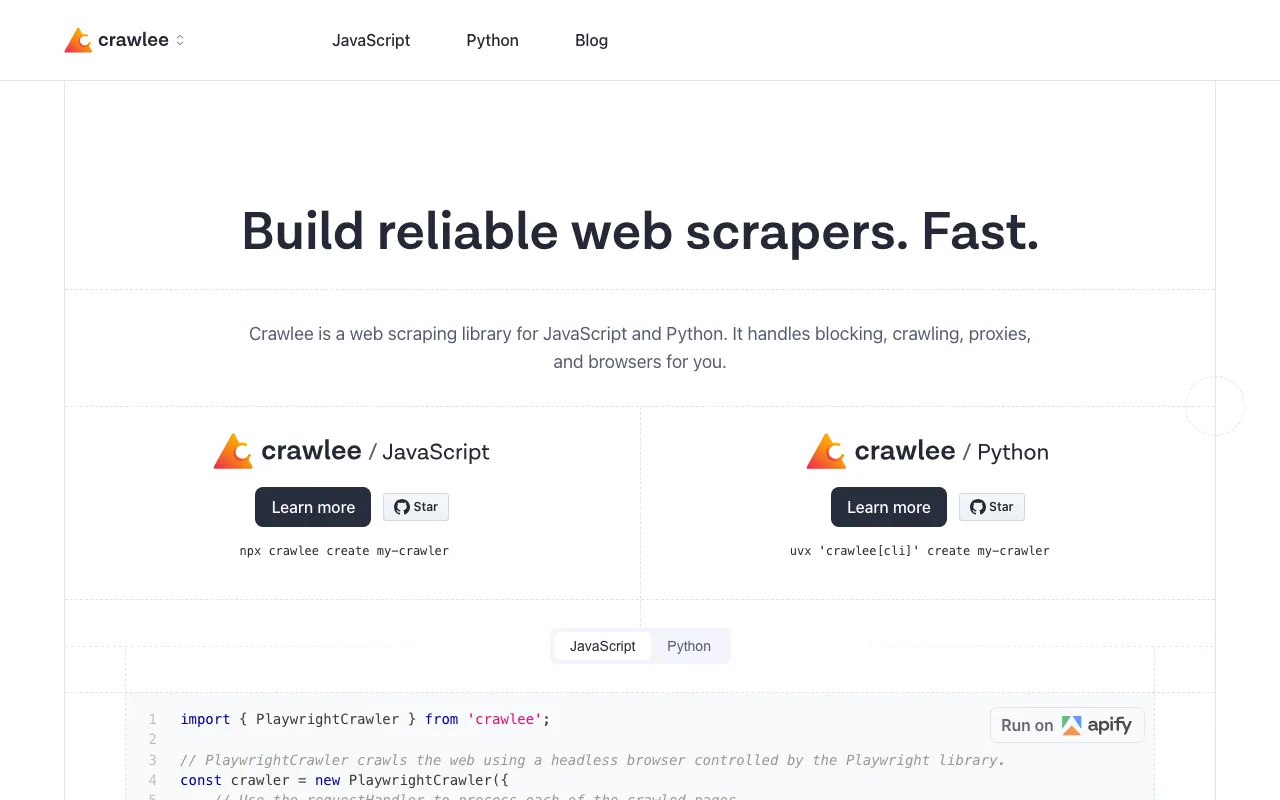
Crawlee builds reliable crawlers in JavaScript or TypeScript with HTTP or headless browsers, queues, storage, proxies, and retries.
Overview
Crawlee is a Node.js library for crawling links, scraping pages, and saving results to local disk or cloud backends. It unifies raw HTTP clients and headless browser engines behind one crawler API so projects can switch between Cheerio, JSDOM, Playwright, and Puppeteer without rewriting orchestration code.
Request queues track URLs for breadth-first or depth-first runs, with hooks for routing, retries, and lifecycle events. Storage abstractions handle tabular datasets and downloaded files. Proxy rotation and session handling aim to reduce blocking; default settings are tuned to mimic browser-like TLS and header behavior on HTTP crawls.
Browser crawlers support JavaScript rendering, screenshots, and managed browser lifecycles in headless or headful modes. A CLI scaffolds starter projects, and ready-made Dockerfiles support deployment. Configuration can relocate the default ./storage directory and tune concurrency against available hardware.
The package targets modern Node releases and is maintained alongside a Python port. It runs on your own machines by default, with optional integration paths documented for the Apify cloud platform.
Key features
- HTTP and browser crawlers
- Playwright and Puppeteer support
- Persistent request queues
- Dataset and file storage
- Proxy rotation and sessions
- Browser-like HTTP fingerprints
- CLI project scaffolding
- Deployment Dockerfiles
Use cases
- Structured website data extraction
- JavaScript-rendered page scraping
- Link discovery crawls
- Exporting crawl results to CSV