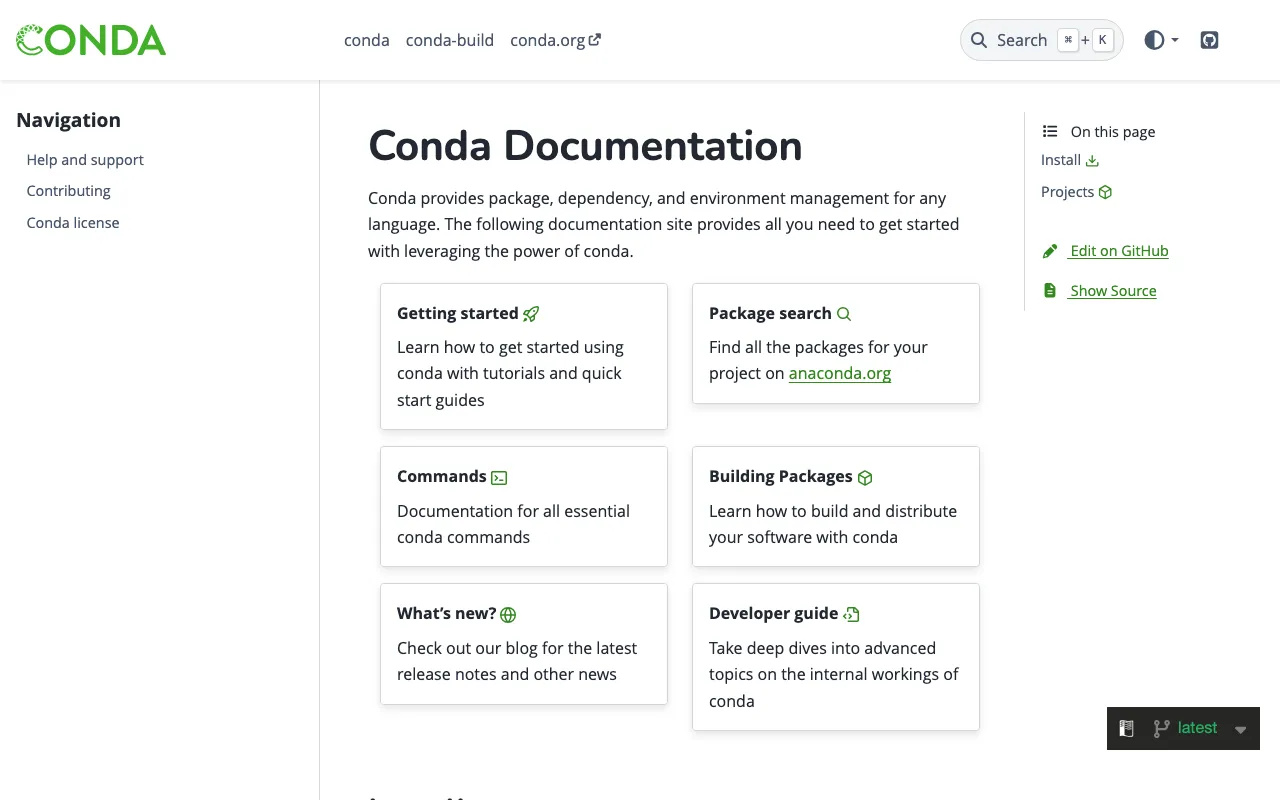
Conda installs and updates packages, resolves dependencies, and manages isolated environments on major operating systems. Its CLI is open source and language-agnostic.
Overview
Conda is a cross-platform package manager that treats environments as first-class installations. It installs binary packages, tracks dependencies, and creates isolated environments quickly, using hard links when possible to save disk space.
The conda command-line interface is written in Python and ships inside distributions such as Miniconda, Miniforge, and the Anaconda Distribution. Users create environments with conda create, activate them with conda activate, and install software with conda install from default or community channels.
Community projects such as conda-forge and Bioconda extend available packages. Users can build recipes, publish packages to anaconda.org, and add third-party channels so conda resolves installs from those indexes.
Documentation covers environment workflows, searchable package indexes, recipe building, and companion tools like conda-lock, constructor, and conda-pack for reproducible and portable environments.
Key features
- Isolated conda environments
- Cross-language binary packages
- Dependency resolution on install
- Channel-based package indexes
- Hard-link efficient environments
- Recipe-based package building
- Integration with Miniconda and Miniforge
Use cases
- Python and scientific software stacks
- Reproducible project environments
- Publishing packages to anaconda.org
- Managing non-Python binary libraries