qmetrics.net

CliFx

Class-first .NET framework for command-line apps

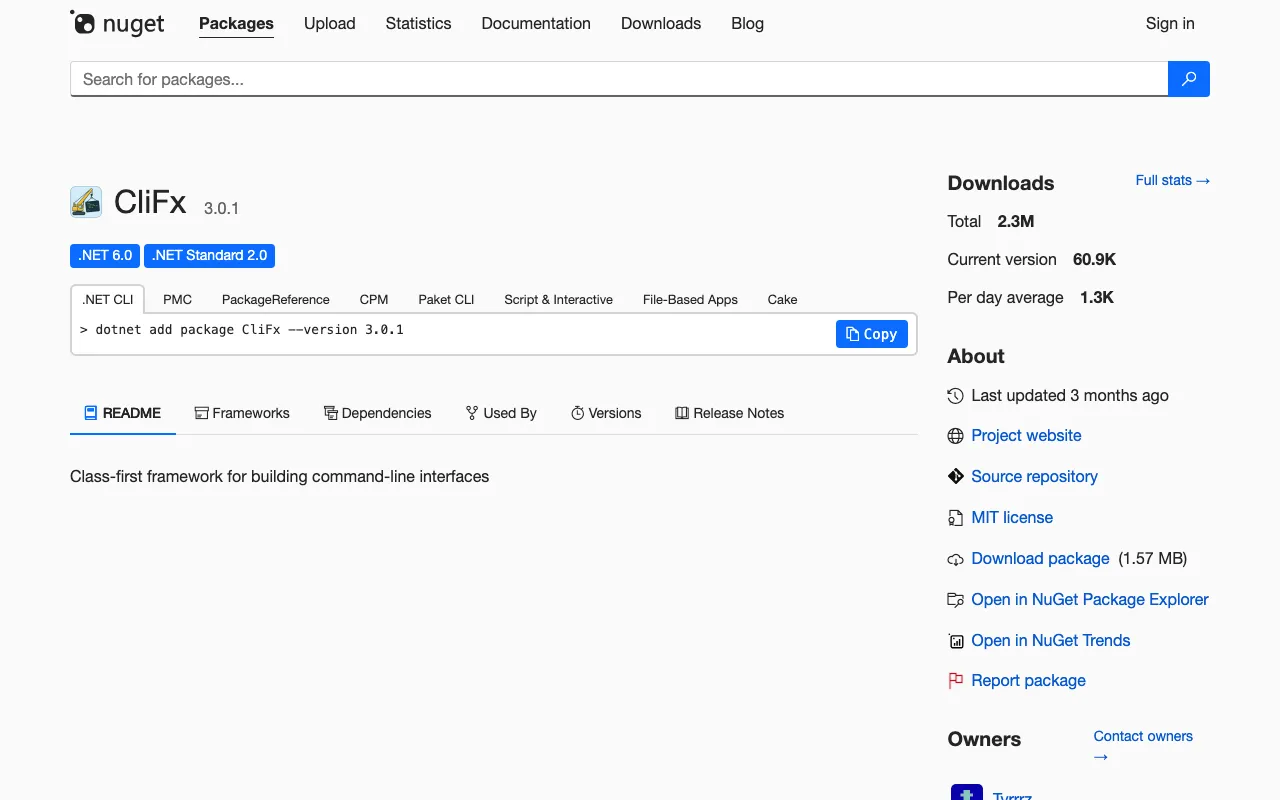
CliFx screenshot

Models CLI programs as commands with attributed properties for parameters and options. It handles parsing, routing, help text, and cancellation without boilerplate.

Overview

CliFx is a .NET library that treats command-line applications as a hierarchy of command classes rather than manual argument parsing code. Each command is a partial type implementing ICommand with an ExecuteAsync method and properties decorated as parameters or options.

The framework generates entry-point wiring, POSIX-style argument binding, nested subcommands, automatic help for -h and --help, graceful handling of interrupt signals, and a testable IConsole abstraction instead of direct System.Console calls. Validators and custom input converters extend binding for specialized types, and environment variables can back required options when appropriate.

It targets .NET Standard 2.0 and newer runtimes, advertises compatibility with ahead-of-time compilation and trimming, and ships with no third-party dependencies. Distribution is primarily through NuGet for use in console executables and tools such as exporters or automation utilities built on .NET.

Compared to using only a parser library, CliFx positions itself as a full application framework where commands, error handling, and help generation are first-class concerns.

Key features

  • Command classes with attributes
  • Auto-generated help and routing
  • Nested command hierarchies
  • IConsole test abstraction
  • Custom converters and validators
  • Environment variable option fallbacks
  • Interrupt-aware cancellation
  • AOT and trimming compatibility

Use cases

  • Building structured .NET CLI tools
  • Multi-command console applications
  • Testable command-line automation
  • Libraries needing nested subcommands
  • Replacing hand-rolled argv parsing

Tags

Similar software

ECC

Open-source agent engineering toolkit for coding harnesses

ECC adds planning, verification, review, memory, skills, and security scanning to coding agents such as Claude Code, Codex, and Cursor. It installs as plugins, packages, and managed adapters across multiple harnesses.

★ 311.7k⟳ 8 days agoMIT
Frameworks & PlatformsDesktop/CLI app

React

JavaScript library for web and native user interfaces

React helps developers build interfaces from reusable components that manage their own state. Views update declaratively when underlying data changes.

★ 253k⟳ 2 days agoMIT
Frameworks & PlatformsDesktop/CLI app

Flutter

Open-source UI framework for multi-platform apps from one codebase

Flutter is an SDK for building user experiences for mobile, web, and desktop from a single codebase. It uses the Dart language and compiles to native machine code or web targets.

★ 181.5k⟳ todayBSD-3-Clause
Open Source Alternative to:Ionic Enterprise

Bootstrap

Responsive HTML, CSS, and JavaScript front-end toolkit

Bootstrap supplies CSS, JavaScript, and Sass-based styles for building responsive, mobile-first sites. It ships prebuilt grid layouts, UI components, and optional JavaScript plugins.

★ 175.1k⟳ 2 days agoMIT

Langflow

Visual low-code builder for AI agents and workflows

Langflow is a visual builder for AI agents and workflows. Flows can be customized in Python and deployed as an API or as an MCP server, with support for major LLMs and vector databases.

★ 157k⟳ todayMIT
Open Source Alternative to:Relevance AIVoiceflow

LangChain

Framework for agents and LLM-powered applications

LangChain helps developers chain interoperable components and integrations to build agents and LLM-powered applications. It offers a standard interface for models, embeddings, vector stores, and related pieces.

★ 150.1k⟳ 2 days agoMIT





