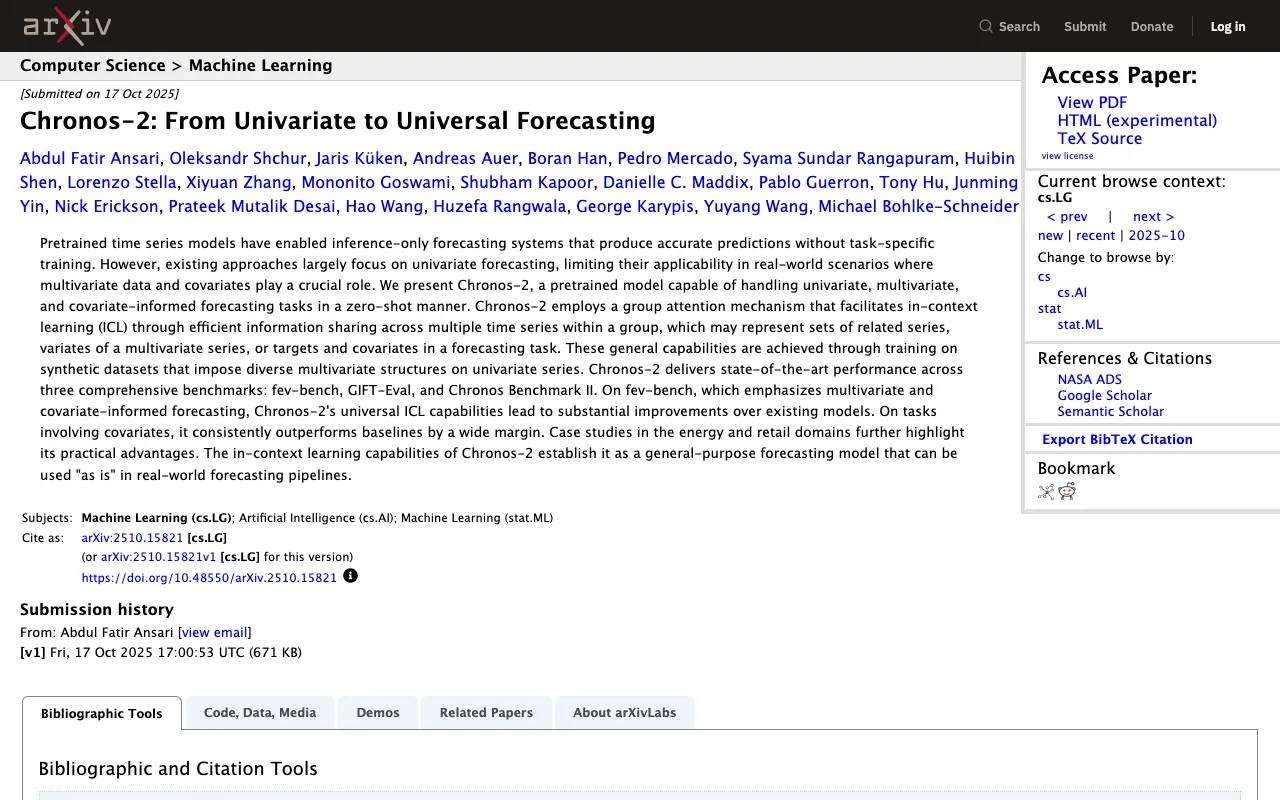
Chronos provides Python interfaces to pretrained forecasting models for univariate, multivariate, and covariate-informed time series. Chronos-2 adds group attention for in-context learning across related series.
Overview
The Chronos package exposes a family of pretrained time series forecasting models meant for inference without task-specific training on many workloads. Chronos-2 supports univariate, multivariate, and covariate-informed forecasting in a zero-shot manner.
Chronos-2 uses a group attention mechanism so information can be shared across multiple series in a group, including related univariate series, multivariate variates, or targets with covariates. Training on synthetic data with varied multivariate structure underpins those capabilities.
Local inference can be installed via pip. For production deployment, Amazon SageMaker options include SageMaker JumpStart endpoints and an AutoGluon-Cloud path that accepts pandas DataFrames for real-time, serverless, or batch inference.
Model weights and interfaces align with the Hugging Face ecosystem. Example notebooks cover quick starts and cloud deployment walkthroughs.
Key features
- Pretrained Chronos and Chronos-2 models
- Univariate and multivariate zero-shot forecast
- Covariate-informed forecasting support
- Group attention across related series
- pip-installable inference package
- SageMaker JumpStart deployment path
- AutoGluon-Cloud DataFrame API
- Hugging Face model integration
Use cases
- Zero-shot demand or metric forecasting
- Multivariate series with shared context
- Forecasts with exogenous covariates
- Production endpoints on AWS SageMaker