qmetrics.net

Laya

Multilingual typed decision engine for agents

Laya screenshot

Returns calibrated choice, score, and yes/no answers in one forward pass over text or media. Routes requests across checkpoints for 100+ languages on your machine.

Overview

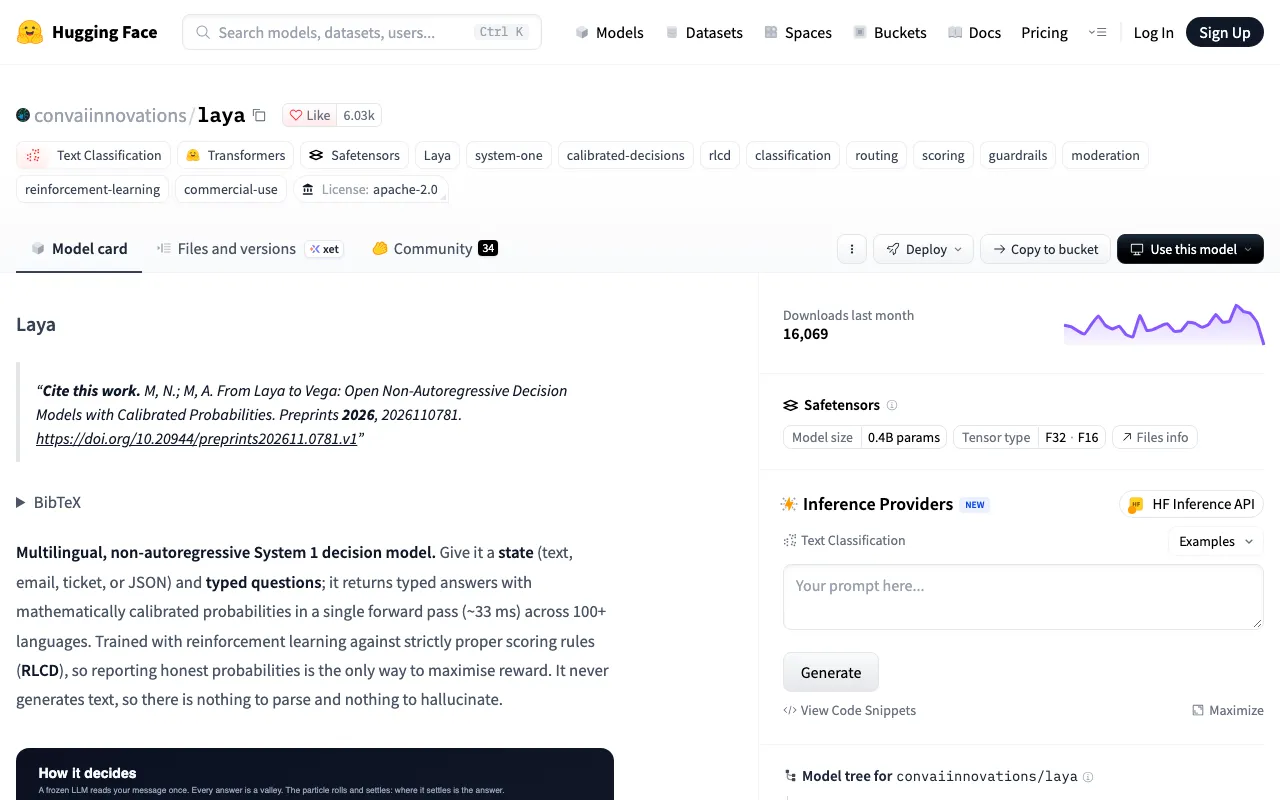
Laya is a non-autoregressive decision engine for agents and workflows. You supply a state such as text, email, or ticket content plus typed questions, and it returns structured answers with calibrated probabilities in a single forward pass instead of open-ended text generation.

The Router detects language and input type, sending images, audio, long documents, or non-Latin text to appropriate checkpoints. The vega engine adds conformal prediction sets, abstain and out-of-distribution flags, and auto versus review routing. Text, images, speech, and long documents can share the same question schema.

Optional continuous learning via a separate vegaml-learn package lets a Learner improve from confirmed answers without full model fine-tuning. An Escalator can send uncertain cases to a teacher model or review queue. HTTP server, MCP, LangChain, and ONNX extras are documented for integration.

Classic encoder checkpoints remain available for short English text with multilingual routing for other scripts, and the documentation contrasts fit-and-calibrate heads with gradient fine-tuning of the reader.

Key features

  • Typed choice, score, and boolean answers
  • 100+ language routing
  • Text, image, audio, and video inputs
  • Calibrated abstain and review routing
  • Conformal prediction sets
  • Optional on-machine learning loop
  • LangChain and MCP integrations
  • Long-context document support

Use cases

  • Ticket triage and routing
  • Workflow gating with calibrated risk
  • Multilingual classification in one pass
  • Agent decision steps without generation
  • Support queue urgency scoring

Tags

Similar software

DeepSeek Harness

Open-source plugin-based agent harness from DeepSeek

DeepSeek Harness is an open-source agent harness built on an everything-is-a-plugin architecture powered by Cordis. It offers a web UI, desktop app, and extensible plugins for daily work, coding, and automation.

★ 288k⟳ 6 days agoMIT

Hermes Agent

Self-improving open-source AI agent with memory, skills and messaging gateway

Open-source AI agent from Nous Research that keeps persistent memory, creates skills from experience, and runs from a terminal, desktop app or messaging platforms with any model provider.

★ 266.6k⟳ todayMIT
Open Source Alternative to:Anthropic ClaudeChatGPT+5

Open WebUI

Self-hosted AI interface for Ollama and OpenAI-compatible models

Open WebUI is a self-hosted AI platform that runs offline and connects to local models through Ollama or to cloud models through OpenAI-compatible APIs. It can be extended with Python.

★ 159.7k⟳ 3 days agoBSD-3-Clause
Open Source Alternative to:Anthropic ClaudeChatGPT+4

MiroFish

Multi-agent swarm intelligence prediction engine

MiroFish builds parallel digital worlds from real-world seed material so multi-agent simulations can explore future outcomes. Users upload seeds and state prediction needs in natural language.

★ 86.9k⟳ 1 month agoAGPL-3.0

LobeHub

Open-source platform for super-agents that work inside team chats

LobeHub adds AI agents to team chat apps like Discord, Slack and Telegram. Agents pick up tasks, hand coding to tools such as Claude Code, report back, and keep lessons from corrections.

★ 86.2k⟳ todayApache-2.0

AnythingLLM

All-in-one private AI app for chatting with documents and running agents

AnythingLLM is an AI application for chatting with your documents and using AI agents, connecting to local or cloud LLMs. It runs as a desktop app or a self-hosted multi-user Docker deployment.

★ 68.7k⟳ 3 days agoMIT
Open Source Alternative to:Anthropic ClaudeGemini+4