
REA
MCP and CLI reverse-engineering toolkit for agents
REA connects coding agents and terminals to local analysis tools for binaries, Electron apps, websites, .NET, and Android targets. Setup registers MCP access and investigation skills via npm.

ELF and Linux kernel binary hardening inspector
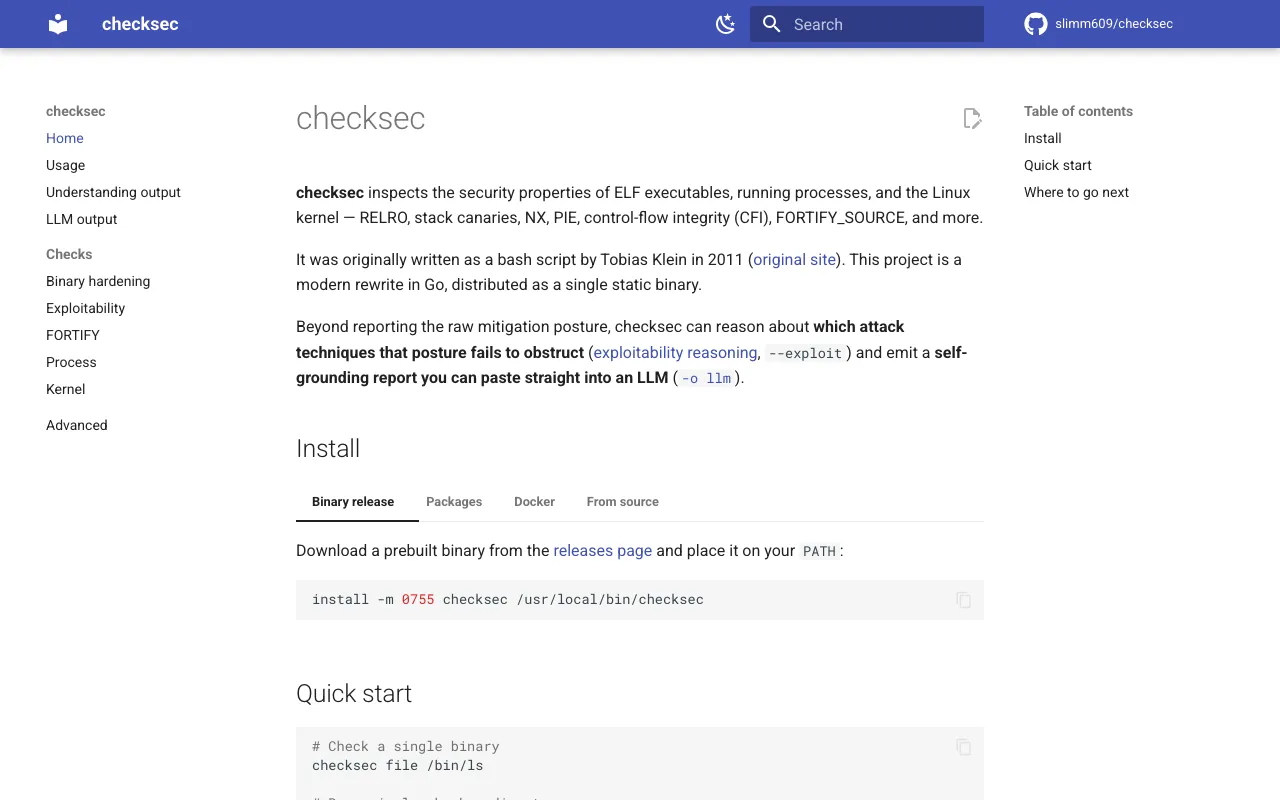
checksec reports security properties of ELF executables, running processes, and Linux kernel configuration. A Go rewrite ships as a single static binary with multiple output formats.
checksec inspects security mitigations on ELF binaries and related Linux system settings, including RELRO, stack canaries, NX, PIE, control-flow integrity, and FORTIFY_SOURCE. It can scan individual files, whole directories, processes by PID, and the running kernel’s hardened configuration.
The tool started as a bash script and is now implemented in Go as a single static binary, aiming for fewer runtime dependencies so checks work on embedded systems, distroless containers, and cross-compiled filesystems. Results can be shown on the command line or exported as JSON, XML, or YAML.
Optional modes reason about which attack techniques the reported posture may not block, and can emit a self-contained Markdown report formatted for use with an LLM assistant. Prebuilt binaries, distribution packages, Docker, and go install are documented install paths.
For offline cross-compiled target filesystems, file checks generally work except Fortify when libraries differ from the host; kernel checks need a running system or an supplied kernel config file.
MCP and CLI reverse-engineering toolkit for agents
REA connects coding agents and terminals to local analysis tools for binaries, Electron apps, websites, .NET, and Android targets. Setup registers MCP access and investigation skills via npm.

Browser-based toolkit for encoding and crypto operations
CyberChef runs in the browser and chains many data operations into recipes. Processing stays on your machine, with optional local Docker or Node.js builds.
CLI for disassembling and rebuilding Android APK packages
Apktool reverse engineers third-party Android APK binaries, decodes resources and smali, supports edits, and rebuilds installable packages from a project-like tree.

Pattern-based static analysis for many languages
Semgrep scans source code with rules that resemble real code to find bugs and enforce standards. It runs locally in the CLI, IDE hooks, pre-commit, or CI.

JavaScript and Node.js source code obfuscator
A package that rewrites JavaScript to hinder reverse engineering, with local transforms, CLI batching, and optional cloud VM obfuscation.
Java and Android bytecode reverse engineering workbench
Bytecode Viewer is a Java desktop suite to open JARs, APKs, DEX, and related formats, decompile or disassemble them, search code, and edit with plugins.