qmetrics.net

CapRover

Self-hosted Docker PaaS with NGINX and Swarm

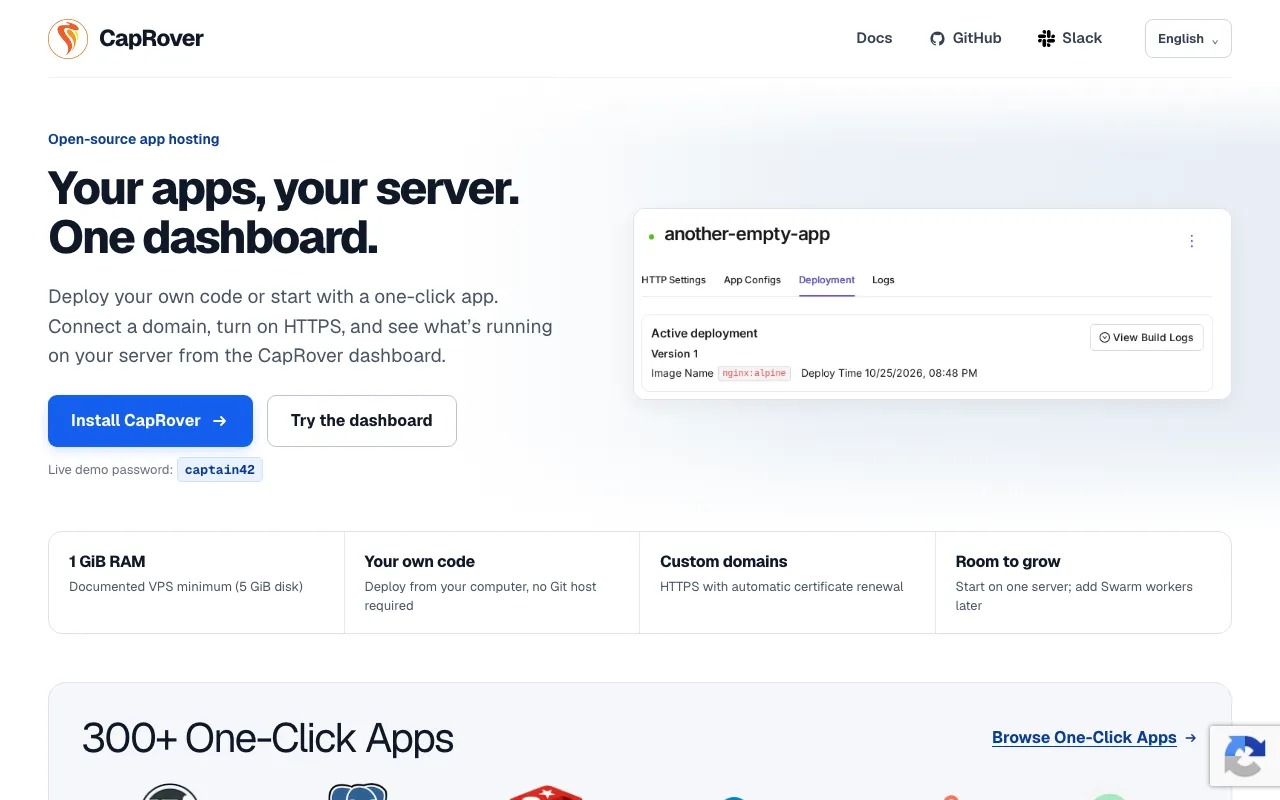
CapRover screenshot

CapRover deploys apps and databases on your server with a web dashboard and CLI. It wraps Docker, NGINX, Let's Encrypt, and Swarm behind a simple interface.

Overview

CapRover is a platform for deploying and managing applications and databases on infrastructure you control. It targets Node.js, Python, PHP, Ruby, Go, ASP.NET, and common databases plus apps like WordPress without requiring deep Docker or NGINX expertise upfront.

A web GUI and CLI (`caprover deploy`) handle everyday operations: deploy from local files, Git, images, tar archives, or supported Docker Compose YAML, attach custom domains, enable HTTPS with automatic certificate renewal, and inspect server health. One-click catalog entries cover hundreds of community apps such as PostgreSQL, Redis, WordPress, Nextcloud, n8n, and Uptime Kuma.

Under the hood it uses Docker Swarm for services, NGINX for routing and customizable per-app templates, and Let's Encrypt for TLS. You can override Swarm service definitions, set pre-deploy hooks, scale to additional worker nodes, and manage a private registry. Removing CapRover is designed to leave deployed apps running.

Documentation describes VPS sizing, Ubuntu-based installation with a preflight check, gzip and WebSocket defaults, deployment history rollbacks, and multi-node clustering. NetData is mentioned as part of the stack behind the interface.

Key features

  • Web dashboard and CLI deploy
  • Docker Swarm orchestration
  • Per-app NGINX templates
  • Automatic Let's Encrypt HTTPS
  • 300+ one-click apps
  • Docker Compose import
  • Custom domains and env vars
  • Cluster workers and registry

Use cases

  • Self-hosted Heroku-style app hosting
  • One-server PaaS on a VPS
  • Multi-language app deployment
  • Private Docker app platform

Does the same job as

CapRover doesn't name these products itself, but its own description shows it does the same job.

Tags

Compare CapRover

Similar software

Coolify

Self-hostable PaaS for apps, databases, and one-click services

Coolify deploys static sites, databases, and full-stack apps on servers you control, with a dashboard similar to managed hosting platforms. Configurations stay on your machines over SSH.

★ 66.7k⟳ todayApache-2.0
Build & DeploymentSelf-hostable
Open Source Alternative to:HerokuNetlify+3

Dokploy

Self-hostable PaaS for apps and databases

Dokploy is a self-hostable platform-as-a-service for deploying applications and databases on your own VPS. It supports Docker, Compose, multi-server setups, backups, and monitoring.

★ 38.7k⟳ yesterdayApache-2.0
Build & DeploymentSelf-hostable
Open Source Alternative to:HerokuNetlify+3

Dokku

Docker-powered mini PaaS on your own hardware

Dokku is a small platform-as-a-service you install on a Linux VM. You push Git-based, Heroku-style apps that build with buildpacks and run in Docker containers.

★ 32.2k⟳ yesterdayMIT
Build & DeploymentSelf-hostable
Open Source Alternative to:HerokuNetlify+3

Colima

Minimal container runtimes on macOS and Linux

Colima launches Lima-based VMs with Docker, containerd, Kubernetes, or Incus so you can run containers locally on Mac or Linux with simple defaults and port forwarding.

★ 31.9k⟳ 1 month agoMIT
Build & DeploymentDesktop/CLI app
Open Source Alternative to:Docker Desktop

OpenTofu

Open-source infrastructure as code engine

OpenTofu is an open-source tool for building, changing, and versioning infrastructure safely. It manages popular cloud providers and custom in-house systems using declarative configuration.

★ 31k⟳ todayMPL-2.0
Build & DeploymentDesktop/CLI app
Open Source Alternative to:Terraform

Pulumi

Open-source infrastructure as code with familiar programming languages

Pulumi provisions and manages cloud resources through programs written in TypeScript, Python, Go, Java, and other languages. A CLI deploys stacks to AWS, Azure, Google Cloud, Kubernetes, and hundreds of providers.

★ 26k⟳ yesterdayApache-2.0
Build & DeploymentDesktop/CLI app
Open Source Alternative to:Terraform