
TensorFlow
End-to-end machine learning platform and tooling ecosystem
TensorFlow is a machine learning platform with Python and C++ APIs, optional GPU packages, and companion libraries for data, training, deployment, and visualization.
Modular framework for multi-agent LLM systems
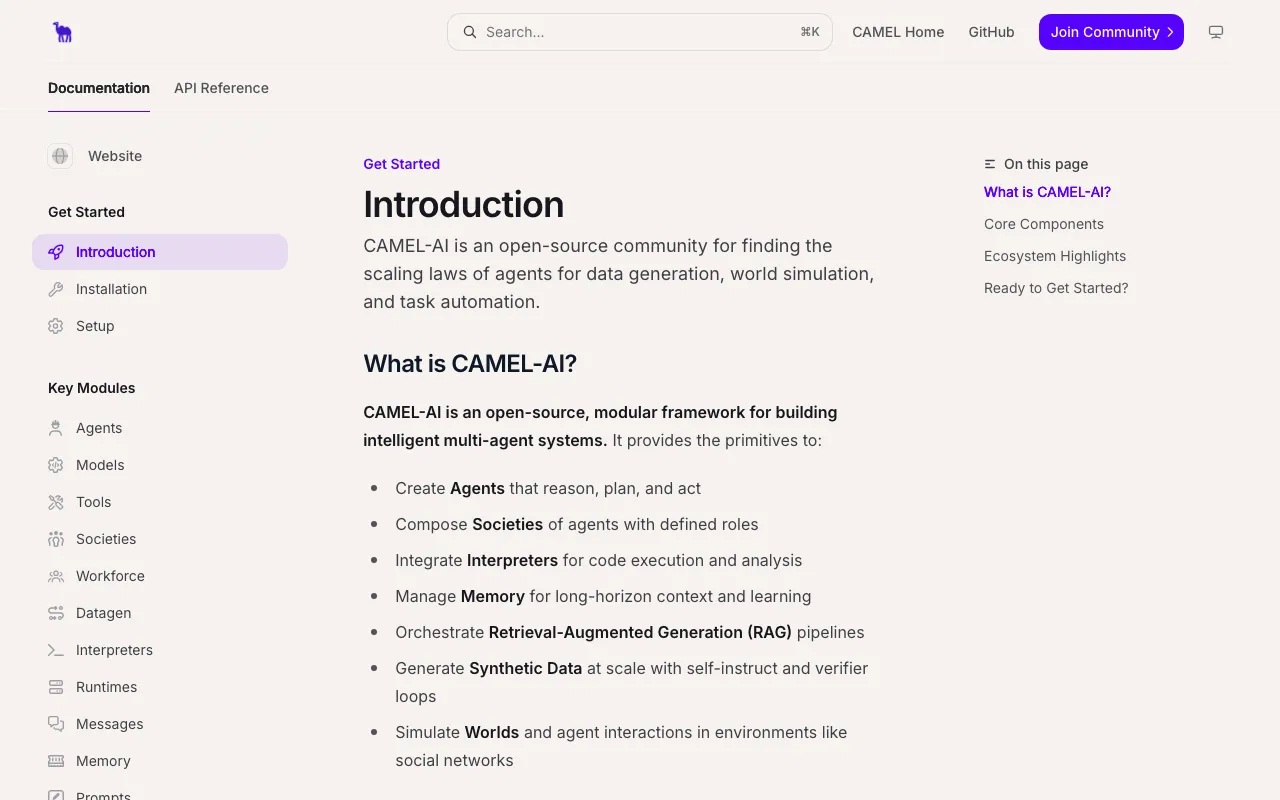
CAMEL-AI helps developers build multi-agent systems for data generation, task automation, and simulated worlds. It installs from PyPI and centers on configurable agents and societies.
CAMEL-AI is a modular framework for assembling intelligent multi-agent systems. Teams use it to create agents that reason and act, define societies with roles and coordination, and wire in interpreters, memory, retrieval pipelines, and synthetic data flows.
Core pieces include atomic LLM-driven agents, coordinator layers for collaboration, execution backends for Python, shell, or browsers, persistent memory and storage, and RAG-style grounding. Built-in pathways support self-instruct data generation, chain-of-thought datasets, and large-scale social simulations.
The project publishes cookbooks and examples ranging from first agents and critic roles to Discord bots, PDF ingestion, video analysis, and hackathon judge committees. Related ecosystem projects named in the docs include Oasis for social simulation, CRAB for cross-environment automation benchmarks, and OWL for workforce-style automation.
Installation is via pip with optional extras for tools and interpreters. Researchers in the community frame the stack around studying agent scaling behavior across tasks, models, and simulated environments.
End-to-end machine learning platform and tooling ecosystem
TensorFlow is a machine learning platform with Python and C++ APIs, optional GPU packages, and companion libraries for data, training, deployment, and visualization.

Shared model definitions for multimodal ML workloads
Transformers is a Python library that defines pretrained text, vision, audio, and multimodal models once in PyTorch for shared inference and training across the ecosystem.
Open-source RAG engine and agent context platform
RAGFlow ingests heterogeneous documents, builds retrievable knowledge, and supports agent workflows with citations. It can run on your own hardware with Docker or a from-source server stack.

Local LLM context compression library and proxy
Headroom shrinks tool outputs, logs, JSON, and chat history before LLM calls to cut input tokens while preserving retrievable originals. It offers a Python library, proxy, MCP tools, and agent wrappers.

Local desktop workspace to run and fine-tune AI models
Unsloth is a desktop application to chat with, fine-tune, and serve LLMs, diffusion, audio, and embedding models on your own hardware with optional agent integrations.
TensorFlow reference models and modeling utilities collection
The TensorFlow Model Garden hosts implementations of models and modeling solutions for TensorFlow, installable via pip as tf-models-official.