
TensorFlow
End-to-end machine learning platform and tooling ecosystem
TensorFlow is a machine learning platform with Python and C++ APIs, optional GPU packages, and companion libraries for data, training, deployment, and visualization.
Open-source AI gateway for LLMs, MCP and agents
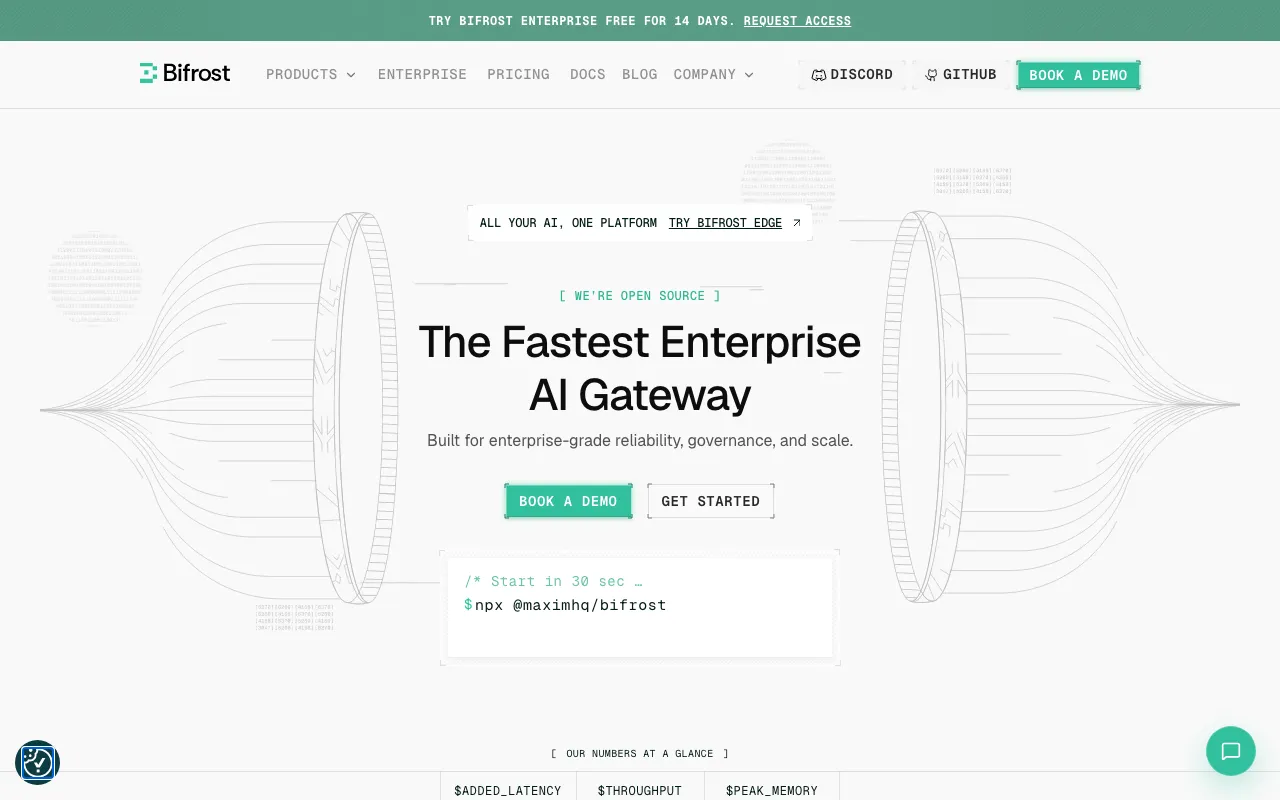
Bifrost is an AI gateway that exposes one OpenAI-compatible API across many model providers. It adds failover, load balancing, semantic caching, virtual keys, budgets and an MCP gateway, with a web UI for configuration.
Bifrost is an AI gateway that sits between applications or agents and model providers such as OpenAI, Anthropic, AWS Bedrock and Google Vertex. It presents a single OpenAI-compatible API for a large catalog of models, and it also supports custom-deployed models. Switching models or providers does not require code changes.
Reliability and cost control features include automatic failover between providers, load balancing across API keys, semantic caching, and budgets that can be set per team, project, model or virtual key. Virtual keys carry independent budgets and access control, so different use cases can be separated. Governance features include audit logs and SSO-based access control.
Bifrost also works as an MCP gateway. It centralizes MCP tool connections, authentication and policy enforcement so agents can use tools through one place. Guardrails can block unsafe outputs and enforce compliance. Observability is built in through OpenTelemetry support and a dashboard for real-time monitoring and analytics.
It can be started with a single npx command and configured through a web UI. It can be used as an HTTP gateway from any language or as a Go SDK embedded in an application. It can also replace an existing SDK's base URL, with compatibility for OpenAI, Anthropic, LiteLLM, Google GenAI, LangChain and others. The project reports about 11 µs of overhead per request at 5,000 requests per second in its benchmarks. Enterprise deployments add features such as adaptive load balancing, clustering and in-VPC deployment.
End-to-end machine learning platform and tooling ecosystem
TensorFlow is a machine learning platform with Python and C++ APIs, optional GPU packages, and companion libraries for data, training, deployment, and visualization.

Shared model definitions for multimodal ML workloads
Transformers is a Python library that defines pretrained text, vision, audio, and multimodal models once in PyTorch for shared inference and training across the ecosystem.
Open-source RAG engine and agent context platform
RAGFlow ingests heterogeneous documents, builds retrievable knowledge, and supports agent workflows with citations. It can run on your own hardware with Docker or a from-source server stack.

Local LLM context compression library and proxy
Headroom shrinks tool outputs, logs, JSON, and chat history before LLM calls to cut input tokens while preserving retrievable originals. It offers a Python library, proxy, MCP tools, and agent wrappers.

Local desktop workspace to run and fine-tune AI models
Unsloth is a desktop application to chat with, fine-tune, and serve LLMs, diffusion, audio, and embedding models on your own hardware with optional agent integrations.
TensorFlow reference models and modeling utilities collection
The TensorFlow Model Garden hosts implementations of models and modeling solutions for TensorFlow, installable via pip as tf-models-official.