qmetrics.net

Atlantis

Self-hosted Terraform pull request automation

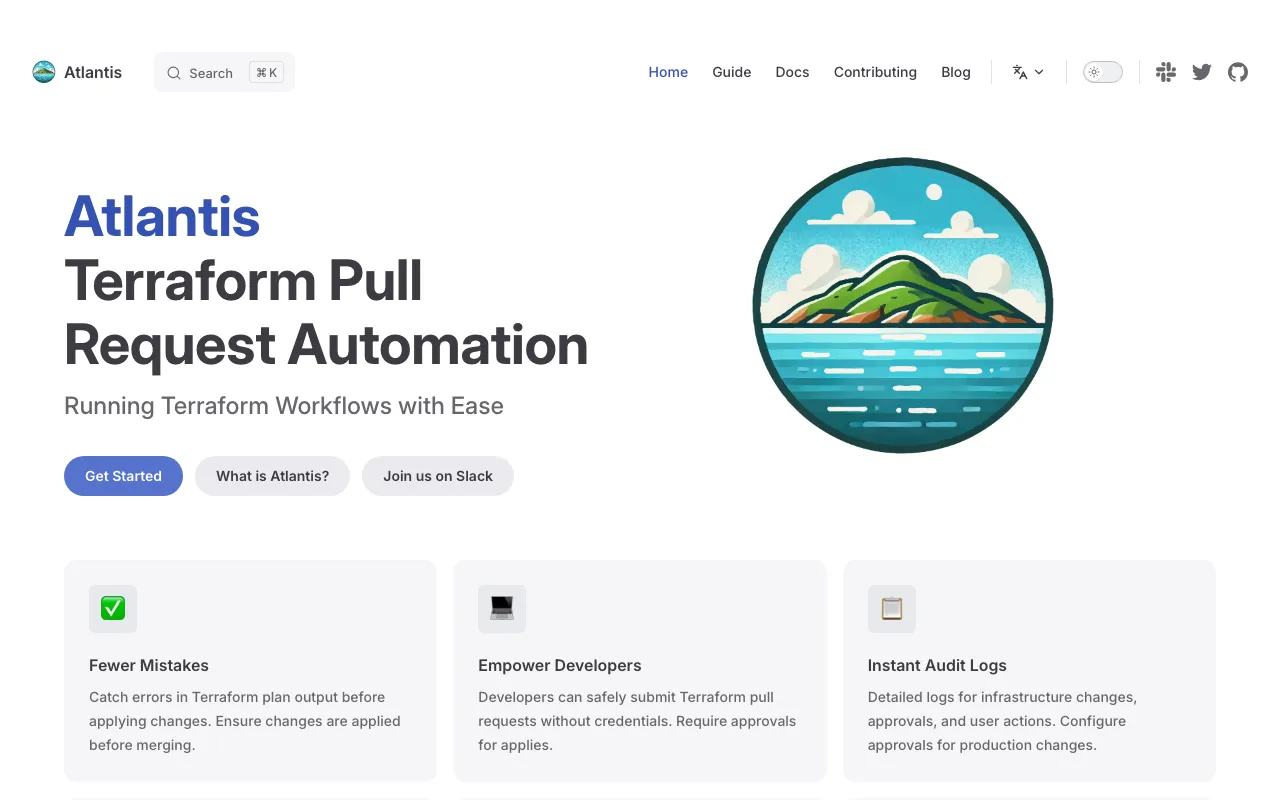
Atlantis screenshot

Atlantis listens for Terraform pull request webhooks, runs plan and apply remotely, and posts results on the PR.

Overview

Atlantis is a self-hosted Go application that automates Terraform workflows around pull requests. It receives Terraform-related pull request events through webhooks from supported Git hosting systems.

When triggered, Atlantis runs terraform plan, import, and apply in a controlled remote environment and comments on the pull request with command output. The goal is to make proposed infrastructure changes visible to the team, let developers collaborate on Terraform without handing out cloud credentials, and keep apply steps standardized.

The marketing site highlights plan review before merge, approval gates for applies, and logging of infrastructure changes and user actions. It supports GitHub, GitLab, Bitbucket, and Azure DevOps and can be deployed on virtual machines, Kubernetes, Fargate, and similar environments.

Documentation and a getting-started guide are published on the project website, with downloadable releases for installation.

Key features

  • Webhook-driven Terraform PR automation
  • Remote plan, import, and apply execution
  • Pull request comments with command output
  • Approval workflows for applies
  • Audit-style change logging
  • Multi Git provider support
  • Self-hosted credential isolation

Use cases

  • Team-visible Terraform plans on every pull request
  • Letting developers propose infra changes without cloud keys
  • Standardizing Terraform apply steps in CI-style flows
  • Requiring review before production applies

Tags

Similar software

Coolify

Self-hostable PaaS for apps, databases, and one-click services

Coolify deploys static sites, databases, and full-stack apps on servers you control, with a dashboard similar to managed hosting platforms. Configurations stay on your machines over SSH.

★ 66.7k⟳ todayApache-2.0
Build & DeploymentSelf-hostable
Open Source Alternative to:HerokuNetlify+3

Dokploy

Self-hostable PaaS for apps and databases

Dokploy is a self-hostable platform-as-a-service for deploying applications and databases on your own VPS. It supports Docker, Compose, multi-server setups, backups, and monitoring.

★ 38.7k⟳ yesterdayApache-2.0
Build & DeploymentSelf-hostable
Open Source Alternative to:HerokuNetlify+3

Dokku

Docker-powered mini PaaS on your own hardware

Dokku is a small platform-as-a-service you install on a Linux VM. You push Git-based, Heroku-style apps that build with buildpacks and run in Docker containers.

★ 32.2k⟳ yesterdayMIT
Build & DeploymentSelf-hostable
Open Source Alternative to:HerokuNetlify+3

Colima

Minimal container runtimes on macOS and Linux

Colima launches Lima-based VMs with Docker, containerd, Kubernetes, or Incus so you can run containers locally on Mac or Linux with simple defaults and port forwarding.

★ 31.9k⟳ 1 month agoMIT
Build & DeploymentDesktop/CLI app
Open Source Alternative to:Docker Desktop

OpenTofu

Open-source infrastructure as code engine

OpenTofu is an open-source tool for building, changing, and versioning infrastructure safely. It manages popular cloud providers and custom in-house systems using declarative configuration.

★ 31k⟳ todayMPL-2.0
Build & DeploymentDesktop/CLI app
Open Source Alternative to:Terraform

Pulumi

Open-source infrastructure as code with familiar programming languages

Pulumi provisions and manages cloud resources through programs written in TypeScript, Python, Go, Java, and other languages. A CLI deploys stacks to AWS, Azure, Google Cloud, Kubernetes, and hundreds of providers.

★ 26k⟳ yesterdayApache-2.0
Build & DeploymentDesktop/CLI app
Open Source Alternative to:Terraform