qmetrics.net

Project AIRI

Self-hosted AI VTuber and digital companion platform

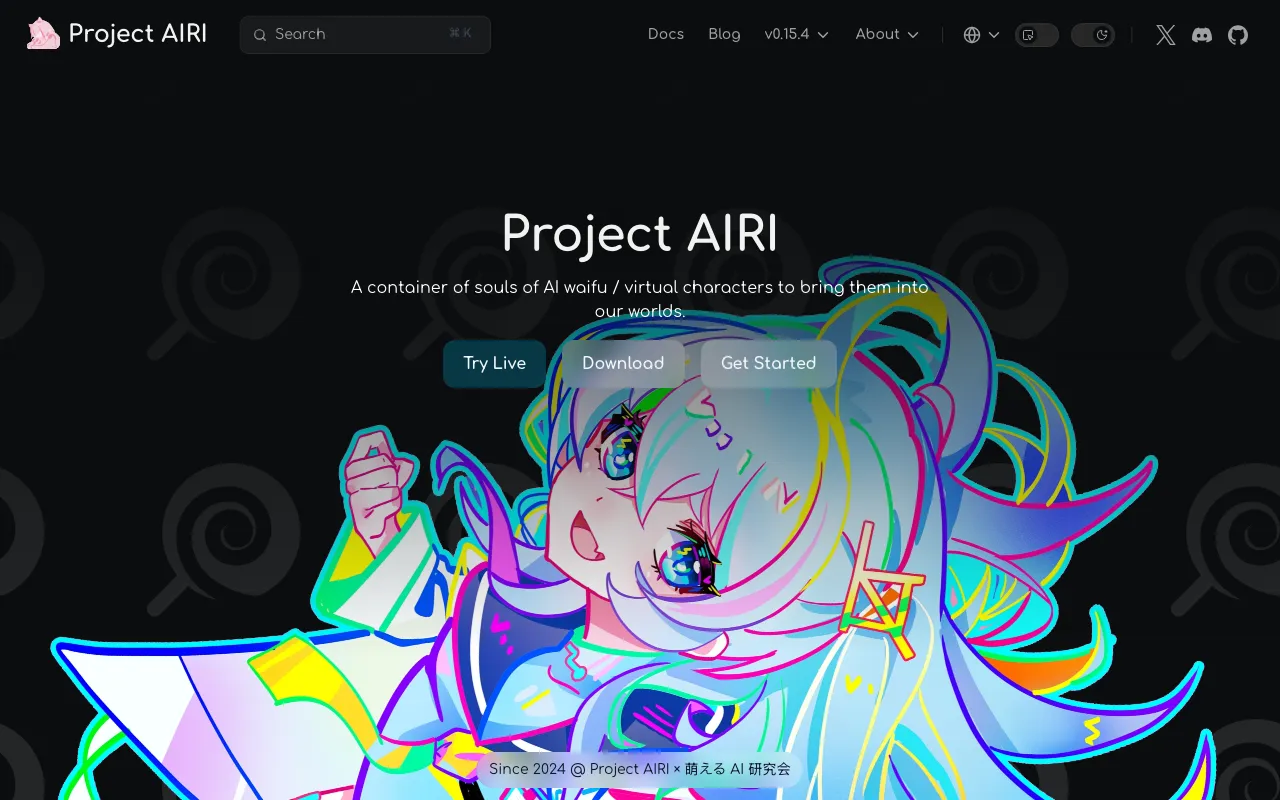
Project AIRI screenshot

Project AIRI builds a cyber companion with realtime voice chat, VRM and Live2D avatars, and optional game integrations for web, desktop, and mobile.

Overview

Project AIRI targets an owned digital companion inspired by streaming VTubers who chat and play games live. It packages large-language-model dialogue with avatar presentation, speech input and output, and ambitions beyond plain text chat toward shared activities such as Minecraft or Factorio.

The stack leans on web technologies—WebGPU, WebAudio, Web Workers, WebAssembly, and WebSocket—so a browser stage can run on modern devices, including PWA mobile use. Desktop builds can still tap native CUDA or Apple Metal for inference while using web tech for graphics, layout, and a plugin system under development.

Avatar support covers VRM and Live2D models with animation, blinking, idle eye movement, and look-at behavior. Audio paths include browser microphone input, client-side speech recognition, and talking detection. In-browser databases such as DuckDB WASM or pglite back local data; memory subsystems remain partly work in progress.

Users can try a hosted web stage, install desktop builds via winget, Scoop, or Homebrew Cask, or pursue mobile Capacitor development. Related packages under the proj-airi organization extend database, icon, and Live2D utilities spawned from the same effort.

Key features

  • VRM and Live2D avatar control
  • Client-side speech recognition
  • Realtime voice chat focus
  • Browser stage with WebGPU graphics
  • Desktop builds with native inference
  • In-browser DuckDB or pglite storage
  • PWA support for mobile browsers
  • LLM providers via xsai integration

Use cases

  • Personal AI companion on your machine
  • Interactive VTuber-style streaming experiments
  • Voice chat with animated avatars
  • Game-adjacent agent integrations
  • Browser-first AI character demos

Tags

Similar software

OpenClaw

Open-source personal AI assistant running on your devices and chat apps

Open-source AI assistant that runs on your own computer and answers in chat apps such as WhatsApp, Telegram, Slack and Discord. State, memory and credentials stay on your hardware.

★ 395.3k⟳ todayMIT
Open Source Alternative to:ChatGPTChatGPT Plus+3

DeepSeek Harness

Open-source plugin-based agent harness from DeepSeek

DeepSeek Harness is an open-source agent harness built on an everything-is-a-plugin architecture powered by Cordis. It offers a web UI, desktop app, and extensible plugins for daily work, coding, and automation.

★ 288k⟳ 6 days agoMIT

Hermes Agent

Self-improving open-source AI agent with memory, skills and messaging gateway

Open-source AI agent from Nous Research that keeps persistent memory, creates skills from experience, and runs from a terminal, desktop app or messaging platforms with any model provider.

★ 266.6k⟳ todayMIT
Open Source Alternative to:Anthropic ClaudeChatGPT+5

Ollama

Run open AI models locally or in the cloud

Ollama runs open language models such as Gemma, Qwen, DeepSeek and gpt-oss on macOS, Windows and Linux, locally or in the cloud. It offers a CLI, a REST API, and Python and JavaScript libraries.

★ 188.3k⟳ 2 days agoMIT
Open Source Alternative to:OpenAI API

Stable Diffusion Webui

Gradio web interface for Stable Diffusion

AUTOMATIC1111’s web UI wraps Stable Diffusion with txt2img, img2img, inpainting, upscalers, training tabs, and a settings-driven Gradio front end. Install scripts target NVIDIA and AMD GPUs plus Apple Silicon.

★ 165.4k⟳ 2 years agoAGPL-3.0
AI Interaction & InterfacesNo commits in 18+ monthsSelf-hostable

Open WebUI

Self-hosted AI interface for Ollama and OpenAI-compatible models

Open WebUI is a self-hosted AI platform that runs offline and connects to local models through Ollama or to cloud models through OpenAI-compatible APIs. It can be extended with Python.

★ 159.7k⟳ 3 days agoBSD-3-Clause
Open Source Alternative to:Anthropic ClaudeChatGPT+4