Gradio
Python toolkit for machine learning web demos and apps
Gradio is a Python package for building demos or web applications around ML models, APIs, or arbitrary Python functions, with optional link sharing and no JavaScript required.
Generative UI framework for agent-streamed native interfaces
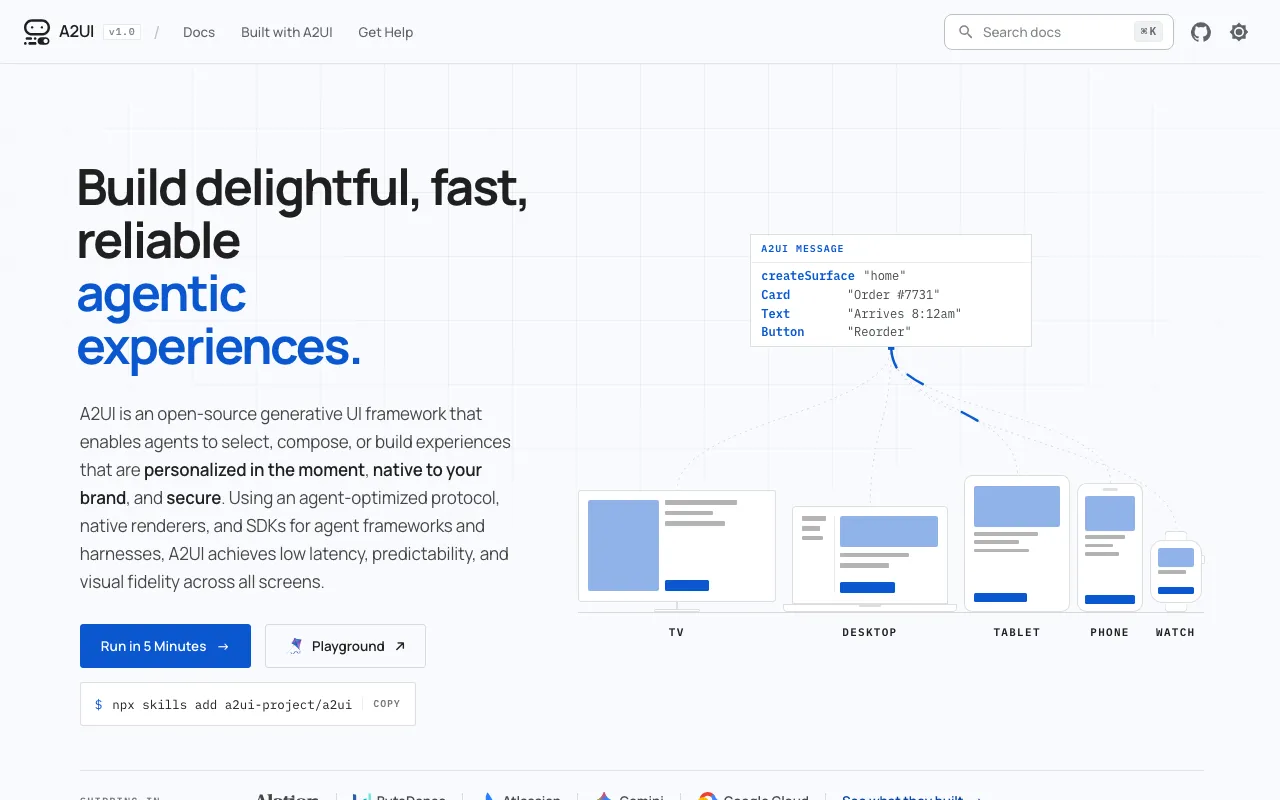
A2UI lets agents send layout data over a streaming protocol while client apps draw the UI with native widgets in major web and mobile frameworks.
A2UI (Agent-to-User Interface) is a generative UI framework for agentic applications. Agents describe interfaces as validated data instead of executable code, and host applications render those descriptions with native components. The design targets low-latency streaming, progressive updates, and consistent experiences across platforms.
The stack spans inference, transport, and rendering. Agent SDKs help models produce UI descriptions in supported inference formats. Messages follow a wire-stable transport protocol with schema validation. Renderers combine a core library, a framework adapter, and a widget catalog so only approved components can appear in the final UI.
Supported renderers cover React, Angular, Lit, Flutter, SwiftUI, Jetpack Compose, and related ecosystems. Agent SDKs exist for several popular languages, and packages ship for Python, TypeScript, Dart, and Swift. An browser-based Composer can generate A2UI JSON without a local install, and a CLI supports build-stage validation and codegen.
Typical fits include server- or agent-driven flows, dynamically composed screens, cross-platform streaming from one agent, and cases where remote agents must stay inside strict capability boundaries. UI is expressed through catalogs and schemas so hosts control styling, registered components, and what data agents may touch.
Tooling on the roadmap spans build, evaluate, distribute, and monitor stages, including eval suites, MCP App embedding, and user-action feedback from renderers back to agents.
Python toolkit for machine learning web demos and apps
Gradio is a Python package for building demos or web applications around ML models, APIs, or arbitrary Python functions, with optional link sharing and no JavaScript required.
Standard protocol for opaque AI agent communication and collaboration
Agent2Agent (A2A) is a protocol that lets agentic applications on different frameworks and servers discover each other, negotiate interaction, and collaborate securely without sharing internal state.
Event-based protocol linking AI agents to user-facing applications
AG-UI standardizes bi-directional event streams between agent backends and frontends so chat, tools, shared state, and human approvals work consistently across frameworks and clients.

TypeScript React primitives and runtimes for production AI chat UIs
React library for assembling ChatGPT-style chat with streaming, tools, attachments, and pluggable backends via the Vercel AI SDK, LangGraph, and other adapters.

Streaming Markdown renderer for AI chat UIs
Streamdown is a React-oriented package meant as a drop-in stand-in for react-markdown when model output arrives token by token.

React UI components for audio and agent applications
ElevenLabs UI is a shadcn/ui-based component library for agent and audio interfaces in Next.js apps. A CLI adds orbs, waveforms, voice agents, players, and related widgets to your project.