Gradio
Python toolkit for machine learning web demos and apps
Gradio is a Python package for building demos or web applications around ML models, APIs, or arbitrary Python functions, with optional link sharing and no JavaScript required.
Standard protocol for opaque AI agent communication and collaboration
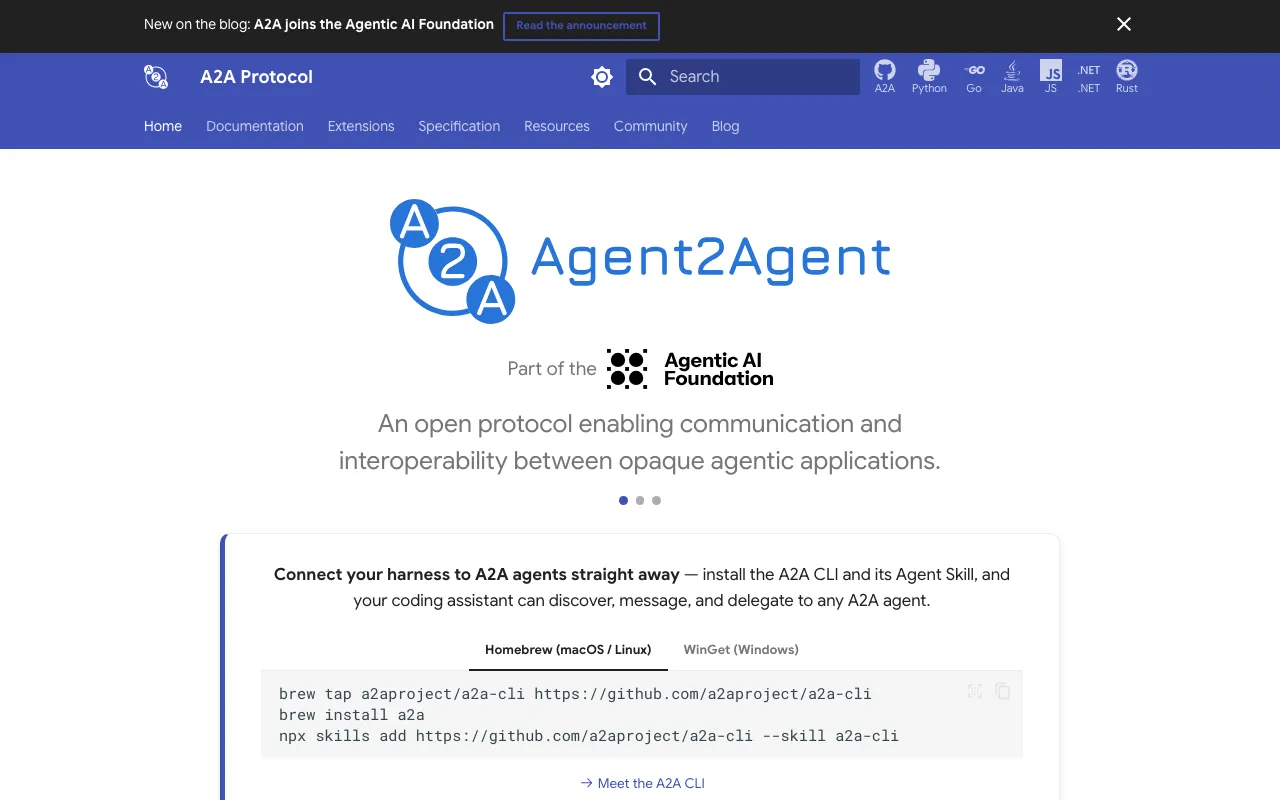
Agent2Agent (A2A) is a protocol that lets agentic applications on different frameworks and servers discover each other, negotiate interaction, and collaborate securely without sharing internal state.
The Agent2Agent (A2A) protocol gives generative AI agents a shared way to interoperate when they are built with different tools, run on separate servers, and stay opaque to one another. It targets collaboration among agents as peers, not only tool calls from a single orchestrator.
Agents can discover capabilities through Agent Cards, agree on modalities such as text, forms, or media, and work together on long-running tasks while keeping memory, proprietary logic, and internal tools private. Communication uses JSON-RPC 2.0 over HTTP or HTTPS, with synchronous responses, server-sent streaming, and asynchronous push notifications.
Official SDKs exist for Python, Go, Java, JavaScript, C#/.NET, and Rust, all implementing the same A2A v1.0 specification. An A2A CLI and related agent skill can install on macOS, Linux, or Windows so coding assistants can discover, message, and delegate to compliant agents. The project is governed under the Linux Foundation and originated from Google.
A2A is positioned alongside MCP: MCP links an agent to tools, APIs, and data, while A2A links agents to other agents. Documentation covers specifications, tutorials, extensions, and sample clients and servers.
Enterprise-oriented design notes include authentication, security, and observability. Rich payloads can include text, files, and structured JSON, and formal extensions allow added capabilities under a tiered promotion process.
Python toolkit for machine learning web demos and apps
Gradio is a Python package for building demos or web applications around ML models, APIs, or arbitrary Python functions, with optional link sharing and no JavaScript required.
Event-based protocol linking AI agents to user-facing applications
AG-UI standardizes bi-directional event streams between agent backends and frontends so chat, tools, shared state, and human approvals work consistently across frameworks and clients.
Generative UI framework for agent-streamed native interfaces
A2UI lets agents send layout data over a streaming protocol while client apps draw the UI with native widgets in major web and mobile frameworks.

TypeScript React primitives and runtimes for production AI chat UIs
React library for assembling ChatGPT-style chat with streaming, tools, attachments, and pluggable backends via the Vercel AI SDK, LangGraph, and other adapters.

Streaming Markdown renderer for AI chat UIs
Streamdown is a React-oriented package meant as a drop-in stand-in for react-markdown when model output arrives token by token.

React UI components for audio and agent applications
ElevenLabs UI is a shadcn/ui-based component library for agent and audio interfaces in Next.js apps. A CLI adds orbs, waveforms, voice agents, players, and related widgets to your project.