
TensorFlow
End-to-end machine learning platform and tooling ecosystem
TensorFlow is a machine learning platform with Python and C++ APIs, optional GPU packages, and companion libraries for data, training, deployment, and visualization.

Distributed gradient boosted decision tree library
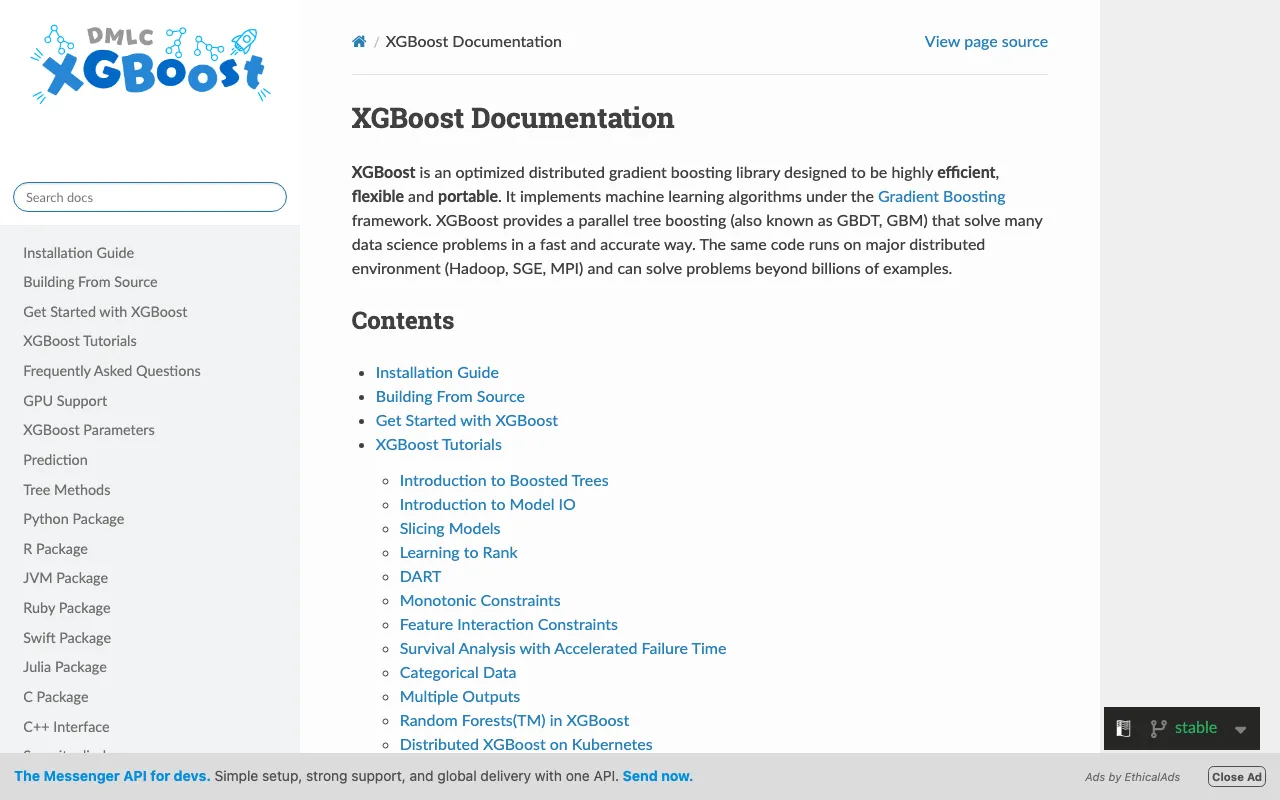
XGBoost implements parallel gradient boosted trees (GBDT/GBM) for classification and regression workloads. The same core runs on a single machine or on distributed stacks such as Spark, Dask, Hadoop, and Kubernetes.
XGBoost is a portable gradient boosting framework aimed at speed and flexibility on structured tabular data. It builds ensembles of decision trees sequentially, with optimizations for training, prediction, and memory use compared with naive boosting implementations.
Language bindings cover Python, R, Java, Scala, C, Julia, Ruby, Swift, and others, with documentation for scikit-learn-style estimators, native APIs, and JVM Spark integrations. Tutorials in the official docs walk through ranking, survival analysis, categorical features, GPU execution, and custom objectives.
For large datasets, distributed modules target clusters via Spark, Dask, Ray, Flink, and related runners, including Kubernetes-oriented guides. The project also documents model IO, slicing, external memory training, and privacy-oriented inference patterns with partner tooling.
Teams typically install a language package, feed training matrices or data frames, tune hyperparameters, and export models for batch or online scoring in the same environment.
End-to-end machine learning platform and tooling ecosystem
TensorFlow is a machine learning platform with Python and C++ APIs, optional GPU packages, and companion libraries for data, training, deployment, and visualization.

Run open AI models locally or in the cloud
Ollama runs open language models such as Gemma, Qwen, DeepSeek and gpt-oss on macOS, Windows and Linux, locally or in the cloud. It offers a CLI, a REST API, and Python and JavaScript libraries.

Shared model definitions for multimodal ML workloads
Transformers is a Python library that defines pretrained text, vision, audio, and multimodal models once in PyTorch for shared inference and training across the ecosystem.

LLM inference engine in C/C++ for local and cloud hardware
llama.cpp runs large language models and multimodal models locally or in the cloud with minimal setup. It includes a CLI, an OpenAI-compatible server with a built-in chat app, and a C library API.

General-purpose speech recognition and translation model
Whisper is a speech recognition model trained on diverse audio. It supports multilingual transcription, speech-to-English translation, and language identification via Python or the command line.

High-throughput, memory-efficient inference and serving engine for LLMs
vLLM is a library and server for running and serving large language models. It uses PagedAttention and continuous batching for throughput, offers an OpenAI-compatible API, and runs on many GPU, CPU and accelerator types.