Linux
Core operating system kernel for Linux systems
The Linux kernel is the core of any Linux operating system. It manages hardware, system resources, and provides fundamental services for other software.

Web-based administration panel for Unix servers
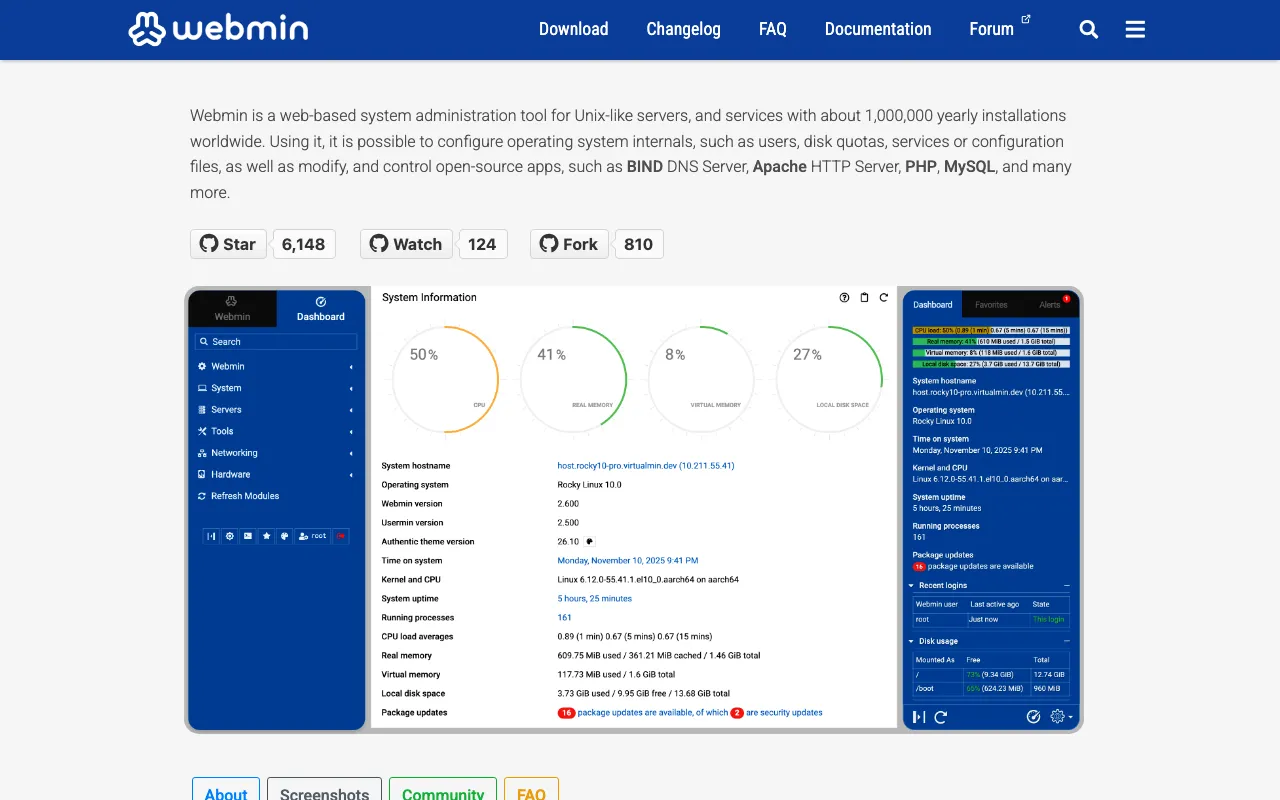
Webmin is a browser control panel for Unix-like servers. It configures users, disks, services, and common apps such as Apache, BIND, PHP, and MySQL.
Webmin provides a web interface for administering Unix-like servers and the services they run. Administrators use it to adjust operating system settings—users, quotas, daemons, and configuration files—and to manage widely deployed open-source components including BIND, Apache, PHP, and MySQL.
The core distribution ships with a large set of standard modules, and third-party modules can add or tailor functionality. Related projects extend the same stack for virtual hosting and limited end-user mail or file tasks, but Webmin itself focuses on full server control through the browser.
Installation packages and detailed setup guidance are published on the project download site. Runtime requirements center on a supported Perl version. The panel is designed to run on infrastructure you operate, not as a remote-only SaaS console.
Because modules cover DNS, web servers, databases, firewalls, backups, and hardware reporting, teams use Webmin as a single entry point for routine maintenance without logging in separately to every subsystem.
Core operating system kernel for Linux systems
The Linux kernel is the core of any Linux operating system. It manages hardware, system resources, and provides fundamental services for other software.
Automated Windows VMs inside Docker with KVM acceleration
Dockur Windows runs full Windows desktops or servers in a container with hands-free ISO install. It supports many releases, RDP, shared folders, and flexible networking.

Web control panel for Xray-core proxy servers
3X-UI is a web panel for deploying, configuring, and monitoring Xray-core servers and many proxy or VPN protocols from one VPS or multi-node setup.

Web UI for Docker, Swarm, and Kubernetes fleets
Portainer Community Edition offers a browser-based console to manage Docker, Swarm, Podman, Kubernetes, and ACI environments from one place. A commercial edition adds enterprise governance, GitOps, and support.
Secure lightweight microVM monitor for serverless workloads
Firecracker is a virtualization stack for running container and function workloads in microVMs. It pairs hardware isolation with low overhead for multi-tenant serverless-style hosting.

Personal cloud OS around the Docker app ecosystem
CasaOS is a home-oriented personal cloud system with a simple web UI to install Docker apps, manage files and drives, and monitor apps on your own hardware.