
TensorFlow
End-to-end machine learning platform and tooling ecosystem
TensorFlow is a machine learning platform with Python and C++ APIs, optional GPU packages, and companion libraries for data, training, deployment, and visualization.

GGUF speech-to-text inference library
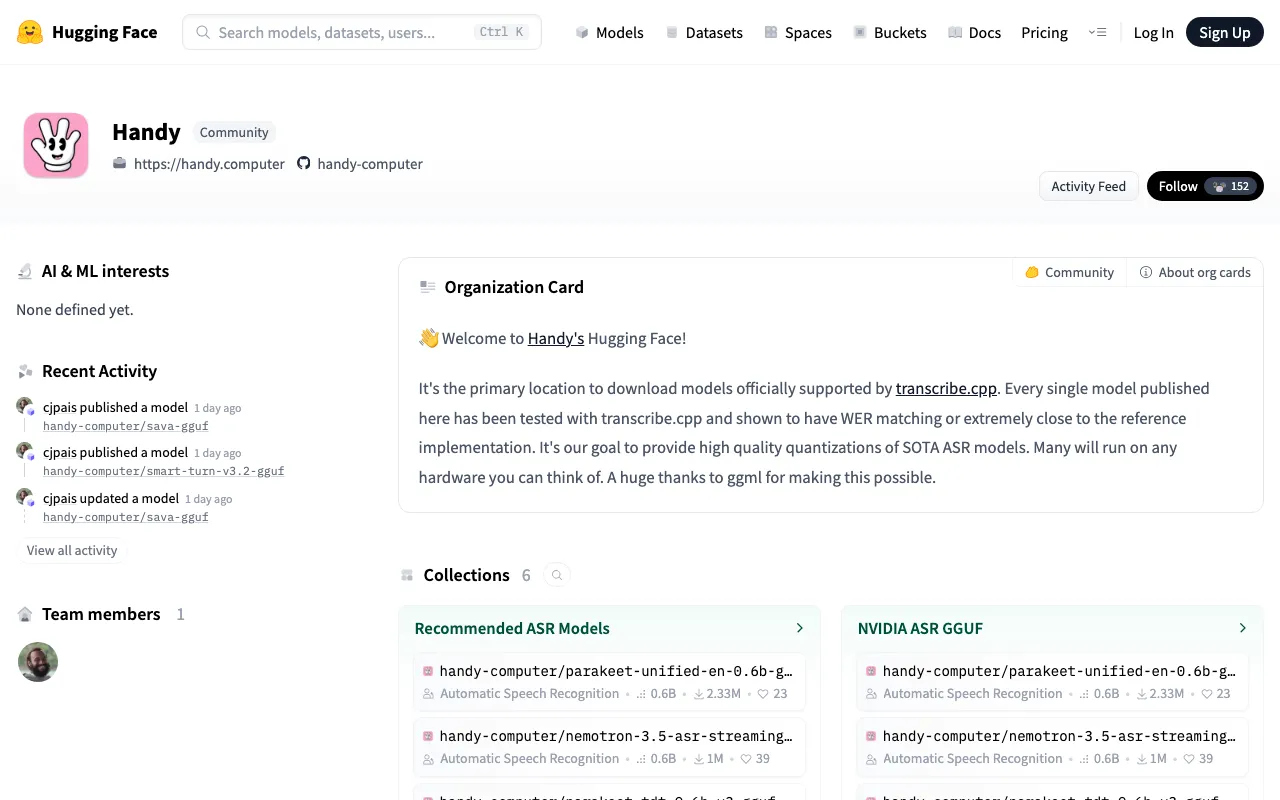
C/C++ library that runs many speech-to-text model families from GGUF weights on ggml, with GPU backends and CPU fallback. Publishes WER-checked models and bindings for several languages.
transcribe.cpp is an inference engine for automatic speech recognition and related audio models. It loads GGUF checkpoints on the ggml runtime and supports Metal on Apple Silicon, Vulkan on Linux and Windows, CUDA on NVIDIA GPUs, and ROCm on AMD hardware, plus a tinyBLAS-accelerated CPU path.
The project ships support for numerous model families—Whisper, Parakeet, Moonshine, Granite Speech, Voxtral, and others—with streaming and batch modes, plus separate catalogs for diarization-only, language ID, voice activity detection, and end-of-turn detectors. Published handy-computer models on Hugging Face are numerically checked against reference implementations.
Input audio is expected as 16 kHz mono WAV; other formats can be converted externally. Weights can be memory-mapped from GGUF on CPU and Metal. A quantization tool shrinks models using standard ggml presets, and pre-built quant downloads are documented per model family.
Official bindings wrap the C API for Python, TypeScript, Rust, and Swift. It functions as a portable ASR stack accelerated across platforms, with a queryable model catalog and benchmark profiles governing publication quality.
End-to-end machine learning platform and tooling ecosystem
TensorFlow is a machine learning platform with Python and C++ APIs, optional GPU packages, and companion libraries for data, training, deployment, and visualization.

Run open AI models locally or in the cloud
Ollama runs open language models such as Gemma, Qwen, DeepSeek and gpt-oss on macOS, Windows and Linux, locally or in the cloud. It offers a CLI, a REST API, and Python and JavaScript libraries.

Shared model definitions for multimodal ML workloads
Transformers is a Python library that defines pretrained text, vision, audio, and multimodal models once in PyTorch for shared inference and training across the ecosystem.

LLM inference engine in C/C++ for local and cloud hardware
llama.cpp runs large language models and multimodal models locally or in the cloud with minimal setup. It includes a CLI, an OpenAI-compatible server with a built-in chat app, and a C library API.

General-purpose speech recognition and translation model
Whisper is a speech recognition model trained on diverse audio. It supports multilingual transcription, speech-to-English translation, and language identification via Python or the command line.

High-throughput, memory-efficient inference and serving engine for LLMs
vLLM is a library and server for running and serving large language models. It uses PagedAttention and continuous batching for throughput, offers an OpenAI-compatible API, and runs on many GPU, CPU and accelerator types.