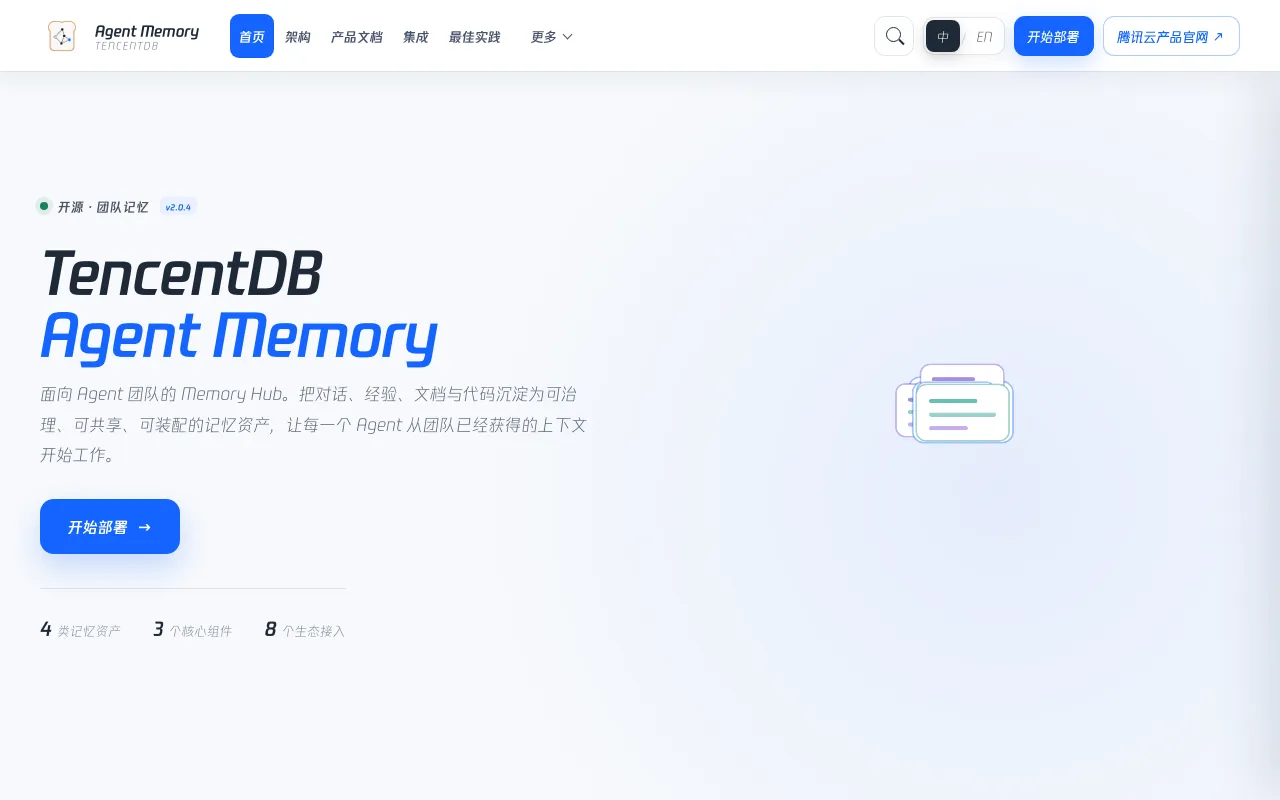
TencentDB Agent Memory turns conversations, documents, and code into governed memory assets multiple AI agents and frameworks reuse; Memory Hub lets teams review, share, and equip Chat Memory, Skills, Wiki, and CodeGraph
Overview
TencentDB Agent Memory is built for teams that run multiple AI coding and assistant clients and want context to persist across sessions and people. It organizes reusable memory into four asset types: Chat Memory for preferences and decisions, Skills for distilled workflows, Wiki for structured documentation with link graphs, and CodeGraph for symbol and call-relationship indexing.
The stack runs as deployable server components: memory-core, memory-hub, and a proxy that many agents can point at with minimal client changes. Supported clients listed in the documentation include Claude Code, Codex, CodeBuddy, OpenClaw, and others, often by changing the agent base URL and user key rather than adding plugins.
Administrators use the Memory Hub to create teams, bind agents, set visibility (private, team, restricted ACL), manage versions, and assign which assets each agent may load. Cold-start flows import codebases, document files, and past conversation sessions so new agents inherit prior work instead of re-learning from scratch.
Chat Memory is refined through layered storage from raw conversations up to persona-level profiles, with retrieval combining vectors, BM25, and limits on context size. Skills capture steps, validation, and resources beyond simple prompts. Wiki ingests formats such as Markdown, Office files, and PDF; CodeGraph supports impact analysis before code changes.
Key features
- Four memory asset types: Chat Memory, Skill, Wiki, CodeGraph
- Shared memory server with proxy for multiple agent clients
- Team panel for review, sharing, and agent loadouts
- Layered conversation memory with ACL-bound retrieval
- Document Wiki with link graph and multi-format ingest
- CodeGraph indexing for symbols and call relationships
- Import of codebases, docs, and past agent sessions
- Private, team, and restricted access controls
Use cases
- Sharing project context across agent sessions and teammates
- Equipping different agents with role-specific memory assets
- Onboarding new agents with imported docs and code graphs
- Extracting reusable Skills from completed agent tasks



 Anthropic Claude
 ChatGPT