 DBOS
Kubernetes
Open-source container scheduling and management system
Kubernetes (K8s) manages containerized applications across many hosts. It automates deployment, scaling, and ongoing operations for grouped containers.

Open-source durable execution and workflow platform
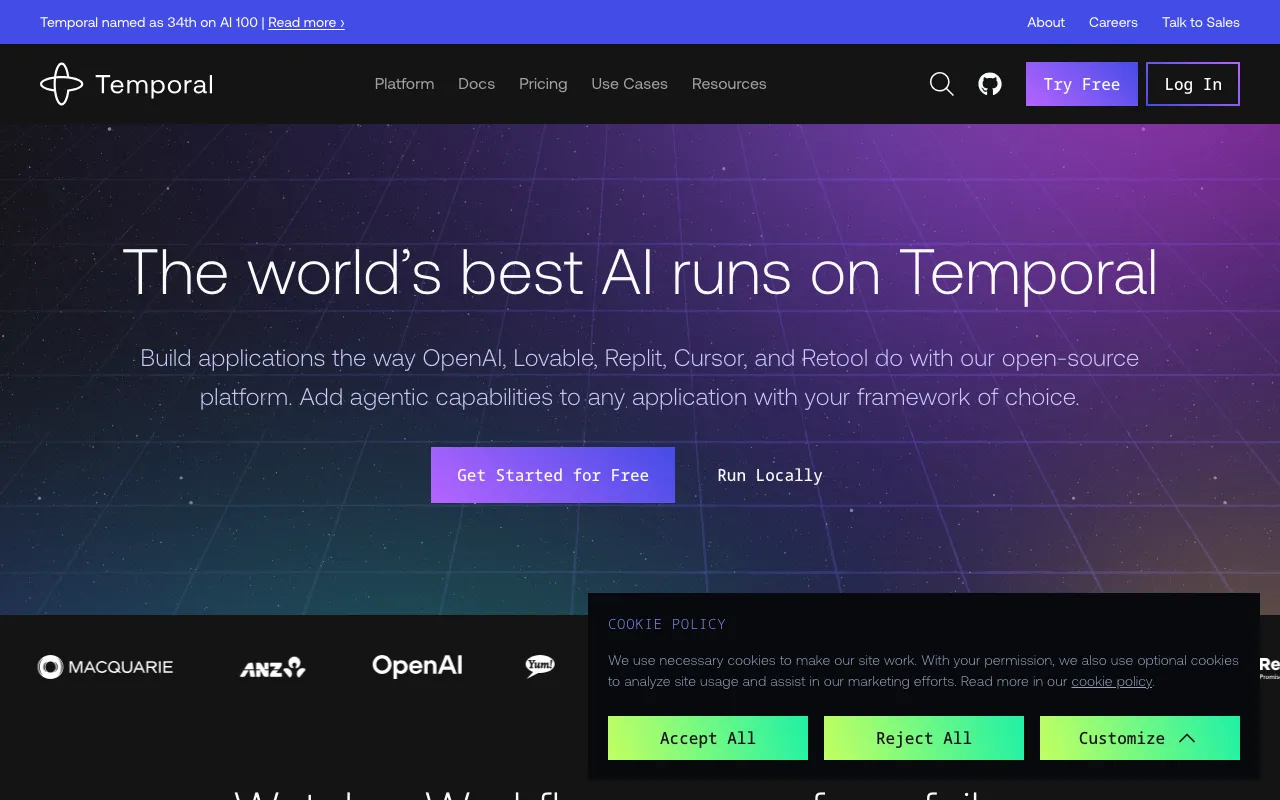
Temporal runs application workflows with automatic retries and failure recovery. Developers write business logic in supported SDKs while the server keeps durable state.
Temporal is a durable execution platform aimed at building scalable applications while keeping reliability concerns in the server rather than in hand-written recovery code. The Temporal server runs units of application logic called Workflows in a way that handles intermittent failures and retries failed operations.
Developers implement Workflows, Activities, and Workers through language SDKs, while this codebase provides the server. Workflows can represent long-running processes such as order handling, infrastructure deployment, or training pipelines, with the full running state persisted so execution can be recovered, replayed, or paused.
Activities model failure-prone steps such as API calls or network work, with automatic retries. The platform also offers task queues, signals, timers, and visibility into workflow execution through a CLI and Web UI.
You can start a pre-built server image locally for development, run sample applications, and interact with the cluster using the Temporal CLI. The technology grew out of a fork of Uber's Cadence and is developed by Temporal Technologies.
Organizations may run the Temporal Service on their own infrastructure as part of the open-source offering, or use a hosted Temporal Cloud option if they prefer not to operate the server themselves.
Temporal doesn't name these products itself, but its own description shows it does the same job.
Open-source container scheduling and management system
Kubernetes (K8s) manages containerized applications across many hosts. It automates deployment, scaling, and ongoing operations for grouped containers.
Agentless IT automation and configuration engine
Ansible automates configuration management, deployments, cloud provisioning, ad-hoc tasks, and multi-node orchestration using SSH without installing agents on managed hosts.

Dynamic HTTP reverse proxy and load balancer for microservices
Traefik routes HTTP traffic to microservices and balances load across backends. It watches orchestrators and registries to update routes without manual restarts.

Multi-container Docker application definition tool
Docker Compose defines and runs multi-container applications described in a Compose file. A single docker compose up command starts the configured services, networks, and volumes together.

Secure lightweight microVM monitor for serverless workloads
Firecracker is a virtualization stack for running container and function workloads in microVMs. It pairs hardware isolation with low overhead for multi-tenant serverless-style hosting.

Compact certified Kubernetes distribution for constrained environments
K3s packages production-ready Kubernetes in a single small binary with lighter memory use, aimed at edge, IoT, CI, development, and ARM deployments.