
TensorFlow
End-to-end machine learning platform and tooling ecosystem
TensorFlow is a machine learning platform with Python and C++ APIs, optional GPU packages, and companion libraries for data, training, deployment, and visualization.
PyTorch reinforcement learning algorithm implementations and documentation
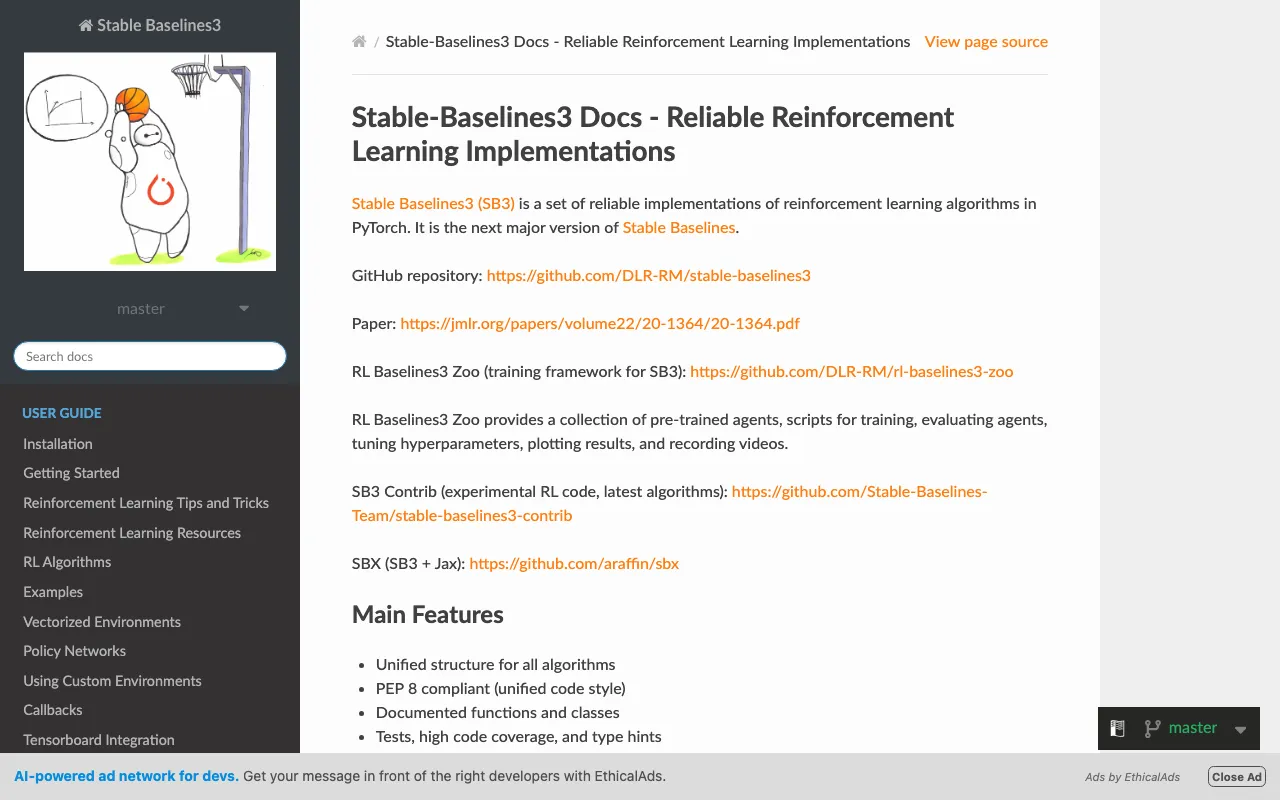
Stable Baselines3 (SB3) delivers tested PyTorch implementations of reinforcement learning algorithms for research and industry baselines. Online documentation explains installation, algorithms, training patterns, and integrations.
Stable Baselines3 is a PyTorch toolkit that implements common reinforcement learning algorithms with a unified interface. It follows the prior Stable Baselines lineage and targets users who already understand reinforcement learning basics.
The library supports custom Gymnasium environments and policies, dictionary observation spaces, callbacks, and TensorBoard logging. Documented algorithms span on-policy and off-policy methods with varied action space types, while experimental variants live in companion projects such as SB3 Contrib and SBX.
Documentation walks through training, saving and loading models, vectorized environments, Atari and robotics examples, and migration from earlier Stable Baselines versions. Integrations cover experiment trackers such as Weights & Biases and Hugging Face for sharing trained models.
A related RL Baselines3 Zoo project provides training scripts, hyperparameter tuning, benchmarking, and pre-trained agents for common environments. The docs site is the reference for API details, reproducibility notes, and export options for deployed models.
End-to-end machine learning platform and tooling ecosystem
TensorFlow is a machine learning platform with Python and C++ APIs, optional GPU packages, and companion libraries for data, training, deployment, and visualization.

Run open AI models locally or in the cloud
Ollama runs open language models such as Gemma, Qwen, DeepSeek and gpt-oss on macOS, Windows and Linux, locally or in the cloud. It offers a CLI, a REST API, and Python and JavaScript libraries.

Shared model definitions for multimodal ML workloads
Transformers is a Python library that defines pretrained text, vision, audio, and multimodal models once in PyTorch for shared inference and training across the ecosystem.

LLM inference engine in C/C++ for local and cloud hardware
llama.cpp runs large language models and multimodal models locally or in the cloud with minimal setup. It includes a CLI, an OpenAI-compatible server with a built-in chat app, and a C library API.

General-purpose speech recognition and translation model
Whisper is a speech recognition model trained on diverse audio. It supports multilingual transcription, speech-to-English translation, and language identification via Python or the command line.

High-throughput, memory-efficient inference and serving engine for LLMs
vLLM is a library and server for running and serving large language models. It uses PagedAttention and continuous batching for throughput, offers an OpenAI-compatible API, and runs on many GPU, CPU and accelerator types.