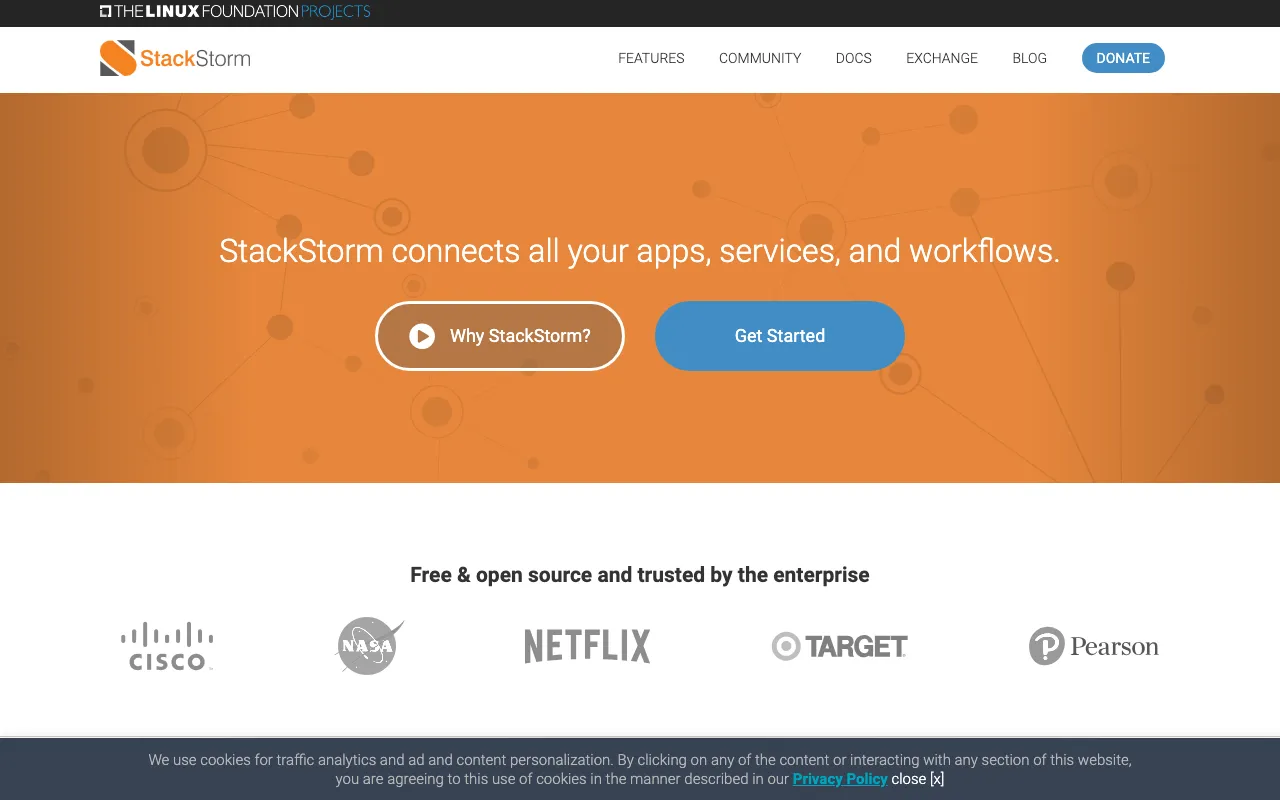
StackStorm connects tools and runs automated actions when events occur. Rules, workflows, and hundreds of integration packs support remediation, deployments, and ChatOps.
Overview
StackStorm is a platform for integration and automation across services and tools. It ties existing infrastructure together so teams can react to events with scripted actions, with emphasis on operational patterns like troubleshooting, remediation, continuous deployment, and security response.
Inbound sensors watch external systems and fire triggers when something happens. Rules map triggers to actions or workflows with matching criteria and payload mapping. Actions are outbound integrations ranging from SSH and HTTP to OpenStack, Docker, and custom Python or shell scripts. Workflows chain actions with ordering, conditions, and shared context. Content ships in packs that bundle triggers, actions, rules, and workflows for sharing via StackStorm Exchange.
The architecture uses microservices on a message bus and scales horizontally. Operators use a REST API, CLI, web UI, and Python bindings. An audit trail records manual and automated executions with trigger context and results for export to log analytics tools.
Typical patterns include monitoring-driven diagnostics posted to Slack or JIRA, automated hardware failure workflows, Jenkins-driven deployments with load-balancer traffic shifts, and ChatOps. Installation targets a 64-bit Linux host via an installer script, with documentation covering authoring rules, sensors, and workflows.
Key features
- Event sensors and trigger types
- Rules mapping events to actions
- Multi-step workflows
- Reusable integration packs
- REST API CLI and web UI
- ChatOps-oriented automations
- Audit trail of executions
- Horizontal microservice scaling
Use cases
- Auto-remediate incidents from alerts
- Orchestrate CI/CD deployment steps
- Run diagnostic playbooks on failures
- Coordinate ChatOps in team channels
- Automate security response playbooks


 ChatGPT