Kubernetes
Open-source container scheduling and management system
Kubernetes (K8s) manages containerized applications across many hosts. It automates deployment, scaling, and ongoing operations for grouped containers.

Self-hosted AWS-compatible cloud on your own hardware
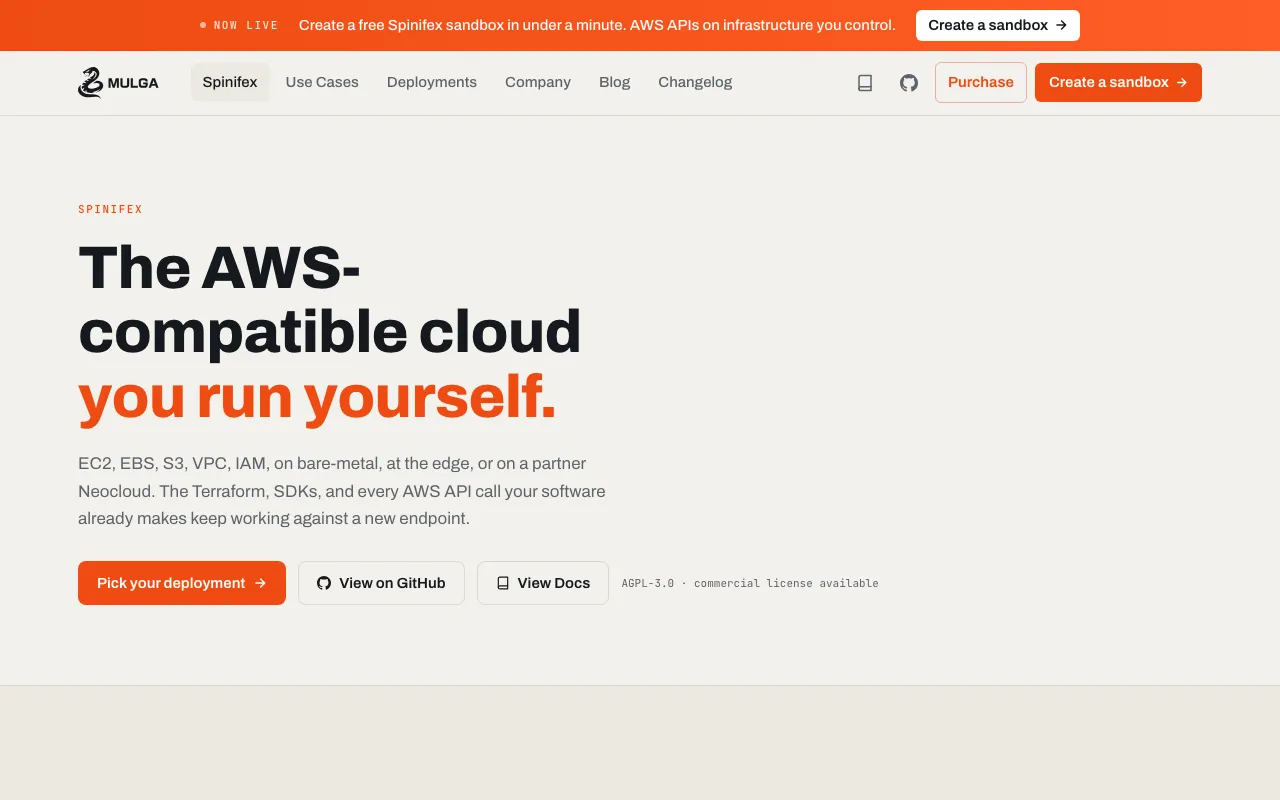
Spinifex recreates common AWS services on infrastructure you control so existing CLI, SDK, and Terraform workflows can target EC2, EBS, S3, VPC, IAM, EKS, and RDS on bare metal, edge, or on-premise.
Spinifex is an open infrastructure platform from Mulga that exposes an AWS-compatible API on servers you operate. It is aimed at moving workloads off hyperscalers, running AI closer to data, or carrying familiar cloud APIs to edge and air-gapped sites without rewriting application code.
The AWS CLI, SDKs, and Terraform can point at a Spinifex endpoint while the stack runs on your hardware, keys, and network. Available services include compute on QEMU/KVM, VPC networking, IAM with SigV4, load balancers, Kubernetes through k3s, container registry and ECS-style hosting, and managed PostgreSQL or MariaDB, with additional services on the published roadmap.
Unlike local emulators used mainly for development testing, Spinifex boots real virtual machines, attaches replicated block volumes, and writes objects into its own storage backends so production-style workloads can run on owned metal. A built-in web console covers instances, volumes, buckets, networks, and identity objects.
You can install on Ubuntu or Debian hosts, use bare-metal USB or ISO installers, or run multi-node clusters in a data centre. A hosted sandbox endpoint is also offered for short trials, separate from self-managed deployments.
Open-source container scheduling and management system
Kubernetes (K8s) manages containerized applications across many hosts. It automates deployment, scaling, and ongoing operations for grouped containers.

Self-hostable PaaS for apps, databases, and one-click services
Coolify deploys static sites, databases, and full-stack apps on servers you control, with a dashboard similar to managed hosting platforms. Configurations stay on your machines over SSH.
Automated Windows VMs inside Docker with KVM acceleration
Dockur Windows runs full Windows desktops or servers in a container with hands-free ISO install. It supports many releases, RDP, shared folders, and flexible networking.

Web UI for Docker, Swarm, and Kubernetes fleets
Portainer Community Edition offers a browser-based console to manage Docker, Swarm, Podman, Kubernetes, and ACI environments from one place. A commercial edition adds enterprise governance, GitOps, and support.

Self-hostable PaaS for apps and databases
Dokploy is a self-hostable platform-as-a-service for deploying applications and databases on your own VPS. It supports Docker, Compose, multi-server setups, backups, and monitoring.

Service mesh for securing and observing microservices
Istio layers onto Kubernetes and other platforms to manage traffic, security, and telemetry for microservices with minimal application code changes.
 Heroku
 Netlify